
80% of the Dominican prison population has mental health problems


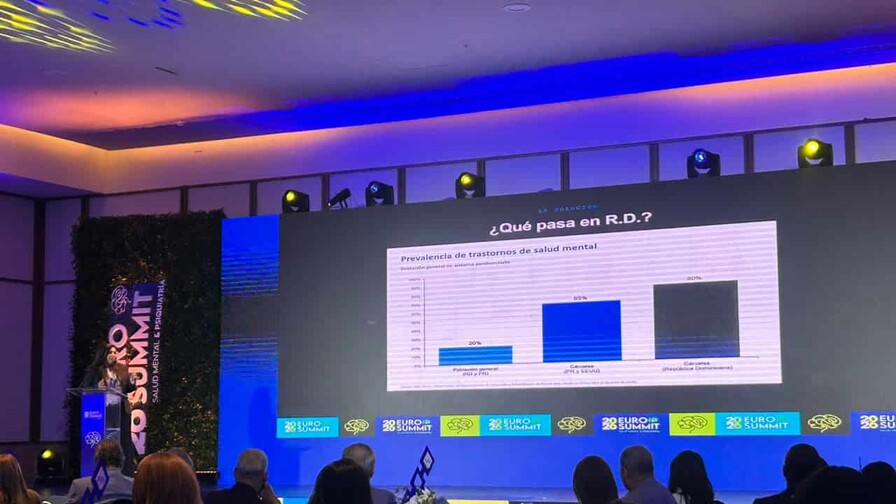
Forensic psychiatrist Nubia Lluberes warned that nearly 80% of people deprived of their liberty in the Dominican Republic have some mental health problem, a figure that contrasts with the estimated 20% in the general population, which highlights the need to integrate psychiatric care into the country’s justice system.
During the conference ” Justice without mental health is not justice: the SIM model as a framework for transformation,” presented at the Euro Summit 2026 on Saturday, the specialist argued that the high prevalence of mental disorders in prisons is not due to these people committing more crimes, but rather to the fact that many never received timely treatment and ended up being absorbed by the penal system.
“What happens when a person with a mental illness commits an offense because of their condition? That is the question we must answer as a society ,” Lluberes stated at the beginning of his presentation.
The specialist explained that many inmates arrive at prison without having been properly diagnosed or treated, and once inside the system, the difficulties in accessing specialized care worsen their condition.
Lluberes pointed out that this reality forces a rethinking of how the country addresses the relationship between mental health and justice, considering that a system that responds only with imprisonment neglects the treatment that many patients need.
SIM Model
In response, he introduced the Sequential Interception Model ( SIM ), a tool developed in the United States that identifies six key moments when people with mental disorders can receive care before, during, and after their time in the justice system.
The goal is for community services, the police, hospitals, courts, and the prison system to work in a coordinated manner to prevent those experiencing a mental health crisis from unnecessarily ending up in prison.
Drawing on his experience in the Texas prison system, where he has worked in psychiatric hospitals for incarcerated individuals, Lluberes explained that the lack of coordination between institutions can have fatal consequences, from the deterioration of patients to suicides or the use of forceful measures that could have been avoided with early intervention.
- He also considered that the Dominican Republic can adapt this model by strengthening community mental health services, training police and justice personnel, and improving communication among hospitals, courts, and penitentiary centers.
The conference was part of the Euro Summit 2026, a meeting that brought together more than 200 doctors, national and international specialists, to discuss current mental health challenges and promote evidence-based public policies and clinical practices.