

Montoconcho regulations: the outstanding debt that authorities are still evading


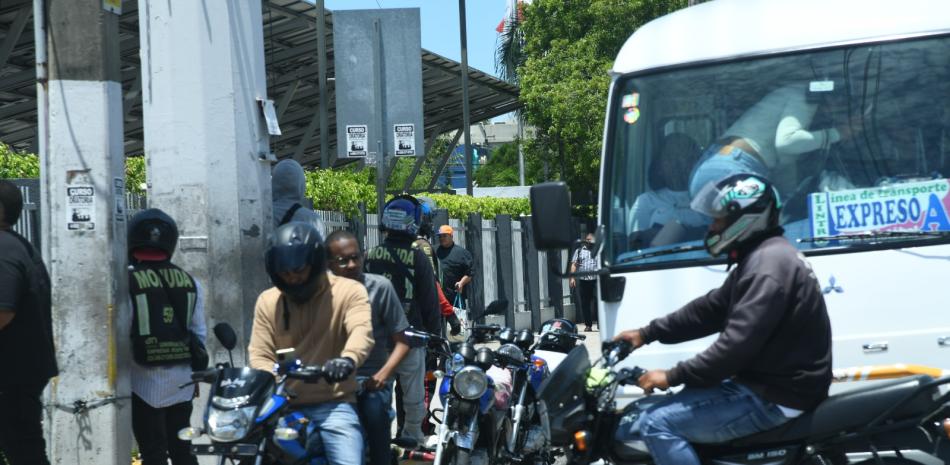
Santo Domingo — A motorcycle taxi driver, traveling in the opposite direction, grazed a truck with his motorcycle. He immediately fell and lay on the hot pavement, complaining of pain. A few seconds later, the rest of his colleagues surrounded the truck, causing a traffic jam in front of the Centro de los Héroes metro station.
Although, apparently, there were no serious injuries or risky situations that affected the truck driver’s integrity in this incident, it did highlight what frequent users of that Metro station have been wondering about for about a month: What is that motorcycle taxi stand doing there?
The sudden appearance of more than 10 motorcycle taxi drivers , identified by the vests “MOHUDA” and “UNIMODIN”, occupying a long stretch of the street in front of the station, and next to a “No Passengers” sign, is not a coincidence, according to people who frequent the area.
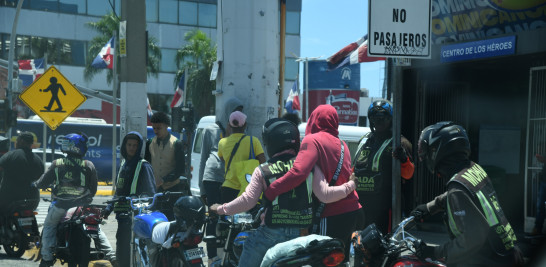
Motorcycle taxis are positioned in front of the Centro de los Héroes Metro station, where there is also a “No Passengers” sign. Leonel Matos
It happened shortly after the inauguration of the Independence Corridor. Passersby confirmed that, with the sudden disappearance of public transportation, motorcyclists gradually moved in until they finally settled in the space where they now interfere daily with the free flow of both pedestrian and vehicular traffic, without any intervention from the authorities.
This scene is repeated in several areas of the Dominican capital, where motorcycles dominate the vehicle fleet, according to data from the General Directorate of Internal Taxes ( DGII ). As of February 2026, there were approximately 841,647 registered motorcycles in the National District. By April 2026, the number of motorcycles circulating in the country had reached 3,954,053. However, only slightly more than 11,000 people hold a legal license to drive them, as indicated by 2025 data from the National Institute of Transit and Land Transportation (INTRANT).
Given this reality, a new question arises: who authorizes the placement of a motorcycle taxi stand?
Authorizations and registration
Through three requests for free access to public information, we asked the Mayor’s Office of the National District and the National Institute of Transit and Land Transportation (Intrant) about any list, record or documents in general terms that contain the authorized or registered motorcycle taxi stops, at least in the first instance in the capital.
These two institutions, according to Law 63-17 on Mobility, Land Transport, Transit and Road Safety of the Dominican Republic, have the shared responsibility of regulating the transport of motorcycles.
Article 75 mandates this: “Motorcycle transport will be regulated by Intrant, in coordination with the municipalities, and will operate in accordance with the provisions relating to traffic and road safety, established in this law and its regulations.”
To operate a motorcycle taxi (motoconcho), the law requires authorization and an “operating license” issued jointly by both entities. In addition, the law mandates a “municipal motorcycle registry,” which, as its name suggests, is the responsibility of the municipality where the motorcycle taxi stand is located.
“That doesn’t exist here. I asked the head of the Department of Transit and Urban Mobility and he confirmed that there isn’t one,” a source within the National District Mayor’s Office reported when asked about the registration or management of motorcycle taxis.
The comment from within the city council comes after the Public Information Access Office of that entity refused to respond to our request and redirected it to Intrant, making Intrant responsible for the response.
About 14 working days passed before Intrant finally responded to our long request with a four-line paragraph.
“In that regard, accepting the request you made to us via the Single Portal for Access to Public Information (SAIP), we are pleased to inform you of the response provided by the Passenger Transport Directorate, which indicates that, according to current law, the registration of said information corresponds to the municipalities,” the document states.
In short, they passed the buck between themselves, claiming that the responsibility lay with the other institution and implying that, in practice, the ‘shared responsibility’ mandated by law does not apply to them.
However, in September 2025, Intrant gave a different response to a very similar request. At that time, it was also requested information on motorcycle taxi (motoconcho) stops in Greater Santo Domingo for the period 2020-2025, with a similar outcome but with a more detailed explanation.
In its response, Intrant indicated that “currently the required information is in a process of internal review and validation, which is part of the established mechanisms to guarantee the accuracy, consistency and relevance of the data before its dissemination,” in addition to other paragraphs where, after a long justification, it can finally be extracted from its words that they are in a phase of “collection and identification.”
This response differs from the one received a few weeks ago, in which Intrant simply pointed to the Mayor’s Office of the National District as the entity responsible for all actions related to motorcycle taxi drivers.
Contradictions
Despite the two responses in which Intrant and the Mayor’s Office imply they do not currently handle any public information regarding the regulation of motorcycle stops, Intrant’s institutional records indicate otherwise.
Upon reviewing the 2025 version hosted on their website, I found a section detailing what the Motorcycle Operating License Department did.
It specifies that in 2025, hundreds of applications were received to register motorcycle taxi stops, update the membership of some existing ones, and conduct a census of more than 200 work areas for motorcycle taxi drivers across different provinces, including the National District.
The report also specifies that compensation was given to “mototaxi drivers” who operated near the areas where the new Metro and Cable Car stops were built in Los Alcarrizos, and they also had access to training in different parts of the country.
The path to regulation
The apparent lack of current regulations does not mean the absence of precedents that served as a trial and error process and that can be used to coordinate new actions for the future.
One of them was the National Motorcycle Registration Plan , initiated in June 2021 and discontinued in 2023, whose main objective was to identify, register and regulate the immense number of motorcycles circulating in the country, both for road safety and citizen security issues.
Intrant itself also that same year, according to its institutional records, outlined a viable protocol to address regulation, establishing the need to carry out reorganization actions on public roads through coordinated work with the Municipal Transit and Public Space Defense and Use departments of the municipalities.
From an urban planning perspective, the Sustainable Urban Mobility Plan for Greater Santo Domingo also offers solutions. Instead of proposing the eradication of this mode of transport, mobility specialists suggest integrating it into the formal system as a feeder or “last-mile” service.
To achieve this safely, they indicated in the document that the strategy consists of enabling exclusive and well-signposted “intermodal transfer infrastructures” in the vicinity of mass transit stations, such as the one at the Heroes Center.
“This physical delimitation of the space prevents the spontaneous occupation of sidewalks and lanes, reducing vehicular friction and protecting the physical integrity of pedestrians,” he explains.
The viability of these measures is supported by international experiences that have already yielded positive results in the region. Technical reports on road safety in Latin America, endorsed by the Spanish Road Association, highlight regulations, such as those implemented in Brazil, for motorcycle taxi services. In Brazil, a system was used that established direct oversight and clear administrative requirements for operation, resulting in improved traffic flow.
The problem of motorcycle taxi stands presents an opportunity to transform the current chaos into an efficient mobility model. The evasion of institutional responsibilities is the first step toward improving the regulation, oversight, and organization of this sector.


There could be a zillion regulations for the motoconchos on paper. The problem could be resolved with less of them on the roads and unfailing government enforcement of the regulations. However, the country’s leaders are more concerned about keeping the rule breaking motoconchistas happy to gain their votes. The leaders have less concern for public safety because votes are more important.