

The millions of dollars the country has spent to “improve” traffic


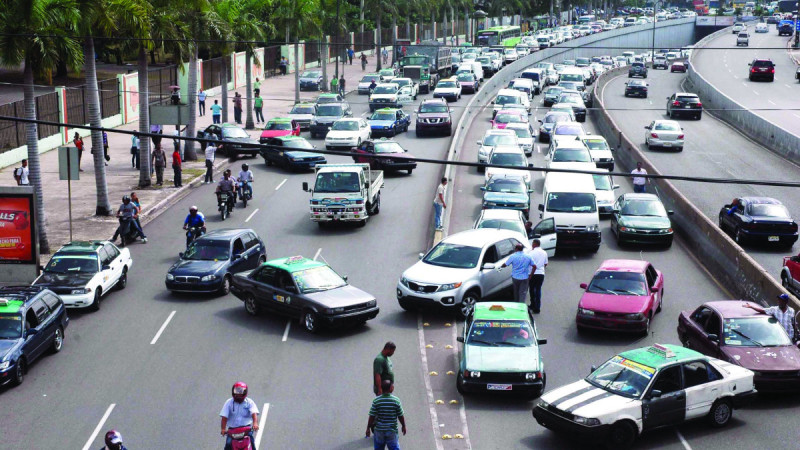
Santo Domingo — The country has borrowed at least two billion dollars over the last seven years to address daily traffic problems, with a focus on the main cities.
We analyzed five loan agreements, approved by the National Congress and endorsed by the Ministry of Finance and the President of the Republic, that sought to finance projects to improve road infrastructure.
The first contract
In December 2019, the Government of Danilo Medina signed a US$250 million loan with the Inter-American Development Bank (IDB). But it wasn’t free money: before receiving it, the
The State had to demonstrate compliance with a list of reforms derived from Law 63-17 on Mobility, Land Transport, Transit, and Road Safety of the Dominican Republic.
The IDB demanded, among other things, that the Road Safety Observatory be operational, that at least five traffic accident investigation units be functioning under the General Directorate of Traffic Safety and Land Transportation (Digesett), that Intrant have new operational departments, and that there be a plan to formalize the informal taxi drivers as businesses. Substantive reforms, not superficial ones.
The loan was granted, and according to the contract, its purpose was to “support the implementation of Law 63-17: create the Road Safety Observatory, formalize public transportation operators, establish traffic accident investigation units, and strengthen the National Institute of Transit and Land Transportation (INTRANT) with new operational departments.” As for the repayments, they are amortized in semi-annual installments until 2039.
France contributes
Ten months later, in October 2020, under the administration of President Luis Abinader, the Ministry of Finance signed an agreement for another US$250 million with the French Development Agency (AFD). The loan finances the same program that the IDB had previously approved.
The Government negotiated a fixed annual interest rate of 2.80% with the AFD. In a world where rates subsequently skyrocketed due to the pandemic and other global events, this was a favorable condition. Repayments are scheduled from March 2025 to September 2039.
The purpose of the financing was to “co-finance” the same IDB program: urban mobility reform, land transport, and road safety. The two loans are coordinated and share the same public policy framework.
An additional detail is that the agreement is governed by French law, and any dispute will be resolved through arbitration in Paris. In French.
The second round of the IDB
In October 2022, the third contract arrived: an additional US$200 million from the IDB, under the same program but with more ambitious conditions. This time, the bank wanted to see, before disbursement, at least ten implemented actions from the National Strategic Road Safety Plan, a school transportation regulation with a gender perspective and universal accessibility, and concrete progress in electromobility.
The loans from the IDB and the AFD are not simply lines of credit. They are agreements that stipulate the Government commits to changing public policies in exchange for financing. If the Government fails to reform, the bank can suspend disbursements or demand prepayment, as stipulated in the signed contracts.
The Alcarrizos Metro
The fourth contract differed from the others already mentioned. This was because it sought to finance construction projects. The Central American Bank for Economic Integration (CABEI) loaned US$250 million to build Line 2C of the Santo Domingo Metro, the section connecting the western part of the capital to the existing system.
The repayment term stipulated in the contract is 20 years from the first disbursement, with a five-year grace period. The interest rate fluctuates with the market: it is the SOFR plus 268 basis points. This means that if international interest rates rise, the monthly payment will increase.
The Santiago Monorail
In July 2024, the Ministry of Finance signed the largest contract in the group analyzed.
BNP Paribas and Citibank, backed by the French Government through its export credit agency (Bpifrance), put 464.9 million euros (about 510 million dollars) on the table to finance the Santiago de los Caballeros Monorail.
Thirteen kilometers of track. Fourteen stations. Twenty thousand passengers per hour at peak times. The main builder is Alstom Transport, a French company that holds 73 percent of the consortium. The interest rate is fixed at 3.78% annually and guaranteed by the French Government.


US$2 billion is less than the construction cost of the Santo Domingo metro extensions (plural), the multiple new teleféricos and thr Santiago monorail. These 4 works alone benefit millions of Dominicans every day.
This excludes the billions spent on road improvements and repairs that were all self funded.
Money well spent.
Chaos on Dominican roads is NOT an infrastructure problem. It is primarily a CULTURAL and HUMAN problem: one that will only improve through education, enforcement, and real consequences.
Repeat offenders should face license suspensions, substantial fines and stricter penalties. Every driver should be required to pass both written and practical examinations to earn and maintain the privilege of driving.
Traffic laws, road safety and driver responsibilities must become part of a nationwide public awareness effort, visible across television, radio, social media, newspapers, billboards, schools, and reinforced by national leadership at the highest level.
The Dominican Republic is growing economically and socially, but this issue continues to hold the country back.
It is unacceptable that year after year the DR ranks among the countries with the highest traffic fatality rates in the world.
Road deaths are not accidents in the traditional sense, they are LARGELY PREVENTABLE TRAGEDIES.
The solution is not simply building more roads.
It comes from building a culture of responsibility, respect for the law, and accountability behind the wheel.