
Sargassum covers the waters of the main Dominican beaches


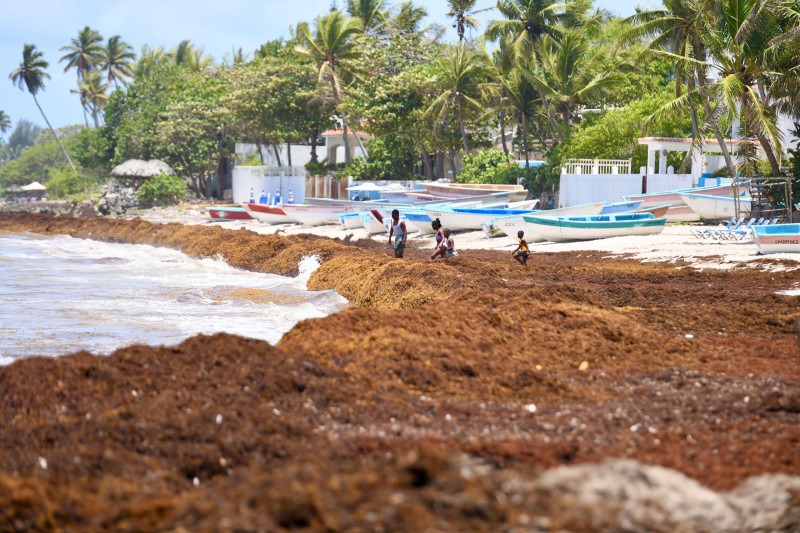
A dense patch of Sargassum covers the waters of the main beaches of the Dominican Republic.
This is how what used to be a landscape of turquoise waters has been transformed into an immense floating carpet of brown and gold algae intertwined with each other.
Amidst the ebb and flow of the waves, the Sargassum seaweed is suffocating the coast. Meanwhile, on the shore, the accumulation of this natural phenomenon has already formed mountains that emit a putrid odor from their decomposition.
A tour conducted by Listín Diario confirmed the impact on businesses, hotel chains, and beachgoers in the municipalities of Boca Chica and Guayacanes, two of the country’s main tourist areas.
A blow to trade
Merchants at the Boca Chica and Guayacanes beach resorts, from vendors of food, drinks, handicrafts, and beach accessories, to those who rent chairs, umbrellas, and entertainment equipment, say that the rapid decomposition of the Sargassum accumulated on the shore “scares away” visitors.
“The Sargassum affects us. It affects us a lot, but if we all cooperate with the cleaning, each of us who has businesses here, it affects us less; that’s why my business is clean,” said Félix González, nicknamed Bomba, who makes a living from a fish and seafood business in Guayacanes.
Santiago Sosa Pérez has dedicated at least 60 years of his life to renting out pedal boats to tourists for RD$800. He stated that the presence of Sargassum seaweed reduces sales due to a lack of visitors.
“People don’t want to come to the beach when they know there’s Sargassum, because it smells bad, they don’t breathe fresh air, and that lowers our income because we don’t sell much,” said merchant Sosa Pérez.
At the same time, he explained that he finds the presence of the “large amount of sargassum” at this time of year strange, because he claims that the phenomenon is more prevalent between September and October.
Beachgoers leave the beaches.
During the Corpus Christi holiday, hundreds of families visited Guayacanes Beach in San Pedro de Macorís. Still, upon entering the resort, their faces turned to disappointment upon seeing the amount of Sargassum that was lodged on the shore.
While this was happening, some parents allowed their children to swim at the beach.
“I am surprised. I have traveled to this beach many times, and I have never seen anything like this.
“I came straight here to bathe, but we’ll have to move somewhere else, because an adult can’t bathe there. Only children bathe like this, but it’s dangerous if it gets in your eyes, and it stings too. Besides, the smell is very strange,” said a dejected David Tolentino, who, after traveling with his family from their home in Monte Plata, regretted his decision upon seeing Guayacanes beach in this state.
Norys Rodríguez was another visitor who decided not to dive into the resort after seeing the conditions it presented.
“I’m from San Pedro, I came last week, and it wasn’t like this, but I don’t want to bathe with all that Sargassum,” he told this newspaper.
The presence of this environmental phenomenon was also evident on some beaches in Boca Chica, as well as on the pier of that coastal municipality, where Sargassum borders the ships, boats, and other vessels that sail through the area.
However, at a minority of these beaches, Sargassum is not yet evident, allowing visitors to carry out their activities as usual.
Beach cleaning
During the visit to both beaches, a cleaning employee was observed using a shovel to remove Sargassum from the coast and pile it on the shore.
Those who depend on businesses in these areas pointed out that, together with the Ministry of Tourism, they have coordinated the preparation of the areas affected by the Sargassum.
Francisco Cuesta Pérez, a member of the cleaning staff at Boca Chica beach and a merchant, informed this newspaper that the ministry has designed a program to clean the beach resort.
“We are here from 7:00 to 11:00 in the morning cleaning all the Sargassum with shovels, so that visitors can come and swim and enjoy everything we have for sale, from fish and shrimp to having a piña colada with their family and friends,” said Cuesta Pérez.
Details about Sargassum
On its official website, the Ministry of Environment states that Sargassum is a natural phenomenon involving the accumulation of floating brown algae in the Atlantic Ocean.
“These algae play an important ecological role by serving as food and shelter for many marine species. However, in recent years, their presence on the Caribbean coasts has increased, causing environmental, economic, and social problems,” they point out.
Although they indicate that Sargassum negatively impacts tourism, they recommend taking action to counteract the phenomenon.
Some measures include “installing floating barriers at sea, cleaning beaches with specialized machinery, monitoring the movement of Sargassum, and using it as a resource for sustainable products. Public education and awareness are also fundamental,” the statement reads.