

Merchants support restricting daytime traffic of heavy vehicles


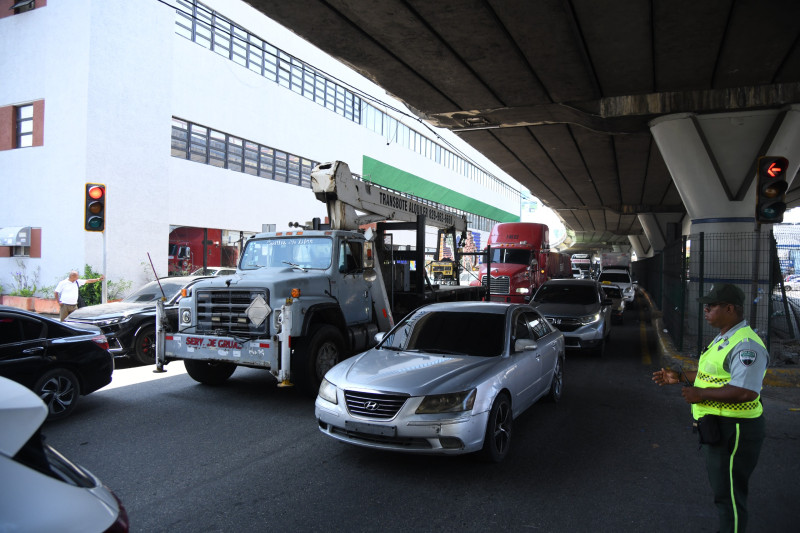
The president of the Dominican Federation of Merchants (FDC), Iván García, supported the proposal by Listin Diario to reduce the circulation of trucks and trailers during working hours to mitigate vehicular congestion in Greater Santo Domingo and Santiago, as outlined in the editorial: “Heavy Vehicles in Peak Hours.”
“The Dominican Federation of Merchants agrees that the circulation of flatbed trucks and double-axle and double-van trucks should be regulated by Intrant and RD Vial, who claim to own the highways,” García said jokingly.
He pointed out that in many towns, such as Mao and Esperanza, there have been multiple accidents involving double-axle trucks carrying materials and food towards the capital.
“They were prohibited from passing through Esperanza; now they must go through the Guayacanes intersection. In addition to the large number of accidents they cause, there is also the issue of the traffic jams they create in cities across the country, especially here in the capital,” he stated.
“Here the longest distance is 130 kilometers; that is, they can perfectly make that journey at 10:00 at night, and the latest they will arrive will be 3:00 or 4:00 in the morning, and in this way, traffic can flow freely both on the highways and in the cities,” added the president of the merchants.
He also explained that these flatbed trucks are 40 feet long and with a double axle, they reach 80 feet, but the trucks used for distribution are only 15 feet long and would not affect the flow of traffic as the former could.
“I understand that Fenatrado, with whom we met 20 years ago, is aware of this situation, and we hope that this initiative, like all the initiatives carried out by the dean of Dominican communication, will be heard, both by the authorities and also by the business sectors, and we fully support this campaign by Listin Diario,” he expressed.
García also noted that if the proposal were implemented, it would force merchants to adjust their working hours to dispatch or receive trucks, but they would be willing to make the sacrifice.
“This will even require us to get up earlier to receive the goods, but I understand that we all have to pay the price, the cost of this sacrifice, for the benefit of the majority of the country. The commercial sector is prepared to open its warehouses to receive the merchandise at 5:00 in the morning so that it can be unloaded at the companies that sell us the products,” García assured.
The editorial points out that the problem does not lie in a lack of rules. It notes that the National Institute of Transit and Land Transportation (INTRANT) has already established restricted hours for heavy-vehicle traffic in urban areas, but these restrictions are not being enforced.


There will be some of these same merchants who will complain later about having to employ their own workers during night hours to attend to shipments and deliveries, hours outside the merchant’s (owners/supervisors) normal work hours. You know the behavior; the boss is always hovering over his employees to prevent them from being lazy or stealing. Bad enough having to supervise during the day, worse if having to extend one’s workhours into the night.