

Researchers at Intec extract high-value raw materials from sargassum for various industries


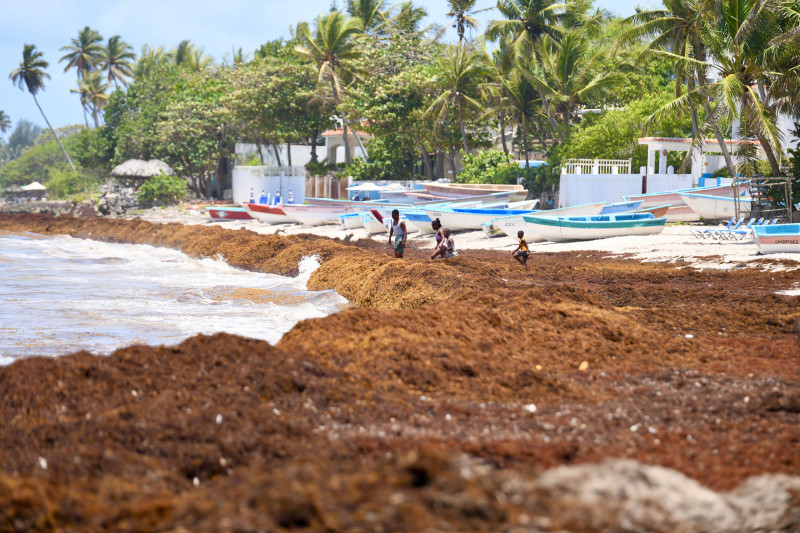
At a time when Sargassum seaweed continues to affect the Caribbean coast, researchers from the Bioplastics and Biomaterials Innovation Unit of the Technological Institute of Santo Domingo (Intec) have successfully extracted alginate from this marine macroalga, a biopolymer widely used across industries for its gelling, thickening, and stabilizing properties.
The study enabled the development and evaluation of an extraction and purification process for alginate present in Sargassum seaweed washing up on Dominican shores. The results demonstrate the technical feasibility of recovering this biopolymer from a biomass that represents one of the main environmental, economic, and social challenges for Caribbean countries.
Alginate is a natural compound found in certain brown algae and has applications in sectors as diverse as the food, cosmetics, agriculture, pharmaceutical, and biomaterials industries. Its ability to form gels and stable structures makes it a material of great interest for the development of sustainable products and innovative technologies.
For the researchers, one of the most relevant aspects of the work is demonstrating that sargassum can also be considered an opportunity to develop new value chains within the circular bioeconomy.
“Traditionally, sargassum has been perceived as waste that affects beaches, coastal ecosystems, and economic activities. This research demonstrates that it can become a source of value-added raw materials when approached from a scientific and innovative perspective,” said Luis Enrique Rodríguez de Francisco, dean of the Basic and Environmental Sciences Area at Intec.
The characterization of the recovered material included advanced chemical, chromatographic, and spectroscopic analysis techniques performed through an international scientific collaboration network. These analyses confirmed the recovery of alginate-associated compounds and provided valuable information to further optimize extraction and purification processes.
The researchers at Intec explained that the next steps will focus on further characterizing the material obtained and evaluating the quality requirements for higher-value-added applications, including potential uses in sectors related to the pharmaceutical industry and advanced biomaterials.
The research highlights the importance of international scientific collaboration in addressing complex challenges such as the valorization of Sargassum. The combination of analytical capabilities, technical expertise, and specialized infrastructure provided by Intec, UWI, UPV, Biodess, and Laotec enabled the development of more robust research and the generation of higher-quality scientific evidence.
“The major environmental challenges facing the Caribbean require collaborative efforts that transcend borders and institutions. Collaborative science not only accelerates knowledge generation but also increases the possibilities of transforming regional problems into opportunities for innovation, technological development, and sustainable growth,” highlighted Professor Yaset Rodríguez Rodríguez, coordinator of the Bioplastics and Biomaterials Innovation Unit at INTEC.
The research was conducted with students and professors from the Biotechnology Bachelor’s Degree program at Intec, the only program of its kind in the country. Since its launch in 2015, the program has graduated more than 100 professionals and has established itself as a space where students actively participate in applied research projects from the early stages of their education.
For Intec’s Bioplastics and Biomaterials Innovation Unit, this work is part of a broader line of research focused on the valorization of sargassum and other biological resources through the development of bioplastics, biomaterials, biofertilizers and sustainable technologies.


The universe always gives us the question. We just have to find an answer….and it looks like we have with this Sargassum seaweed …