

The basic food basket has risen 534 pesos, representing 1.1% so far this year


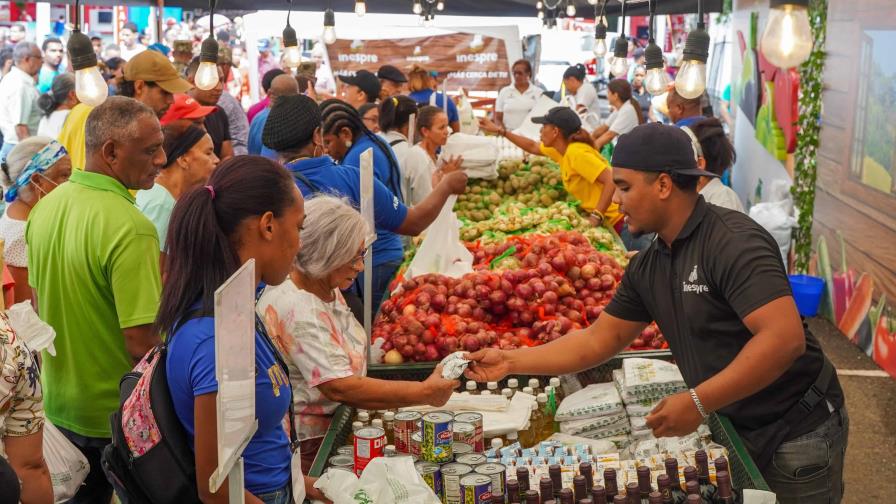
The basic family food basket and inflation in the Dominican Republic have maintained upward trends so far in 2026, with significant increases between January and May, according to data from the Central Bank of the Dominican Republic (BCRD).
How have inflation and the basic food basket evolved in 2026?
The behavior of prices during this period reflects the challenges that Dominican families continue to face in covering their daily expenses.
At the close of May 2026, the basic family food basket averaged 49,268.36 pesos, which represents an increase of 1.1%, that is, 534.08 pesos more so far this year, when in January it cost approximately 48,734.28 pesos, according to data from the Central Bank of the Dominican Republic (BCRD).
The increase has been recorded in all quintiles, and according to the country’s monetary authority, between January and May 2026, the first quintile has risen 182.56 pesos; the second 293.27 pesos; the third 428.64 pesos; the fourth 529.15 pesos, while the fifth quintile is the one with the largest increase, with about 1,378.43 additional pesos.
Regional and sectoral impact of inflation in the Dominican Republic
In some areas of the country, the inflationary impact reflects that the increase in the cost of living has not manifested itself uniformly across the national territory; however, increases in the prices of the country’s main products have been recorded.
In the regions of the country, there has also been an increase in the basic food basket between January and May 2026, with the East region being the most affected, with an increase of 681.43 pesos, followed by the North with 591.94 pesos, in the Ozama with 552.34 pesos, while in the South region, it has only increased by 265.58 pesos.
Inflation continues to be one of the main factors affecting household budgets. In Quisqueya, it stood at 4.98% in January 2026, rising to 5.11% in April, exceeding the Central Bank of the Dominican Republic’s (BCRD) target range (4.0% ± 1.0%), and increasing by another 0.24 percentage points to 5.35% in May.
Services too
The rising cost of services, transportation, and other essential goods has put pressure on the cost of living.
In the services sector, inflation reached 0.42% in May of this year alone, due to an increase in the prices of personal care services, according to the monetary authority.
Furthermore, in year-on-year terms, it increased by 6.6% through the fifth month of 2026 compared with the same period in 2025.
Overall, the transport group was the sector with the greatest contribution to inflation, leading the price increases during the first five months of 2026, with a variation of 2.16%, followed by the services, restaurants-hotels (0.41%), and health (0.36%) sectors.
The sectors with the smallest increases are recreation and culture with a negative variation of -0.98%; food and non-alcoholic beverages with -0.58%; clothing with -0.10%; communications with -0.16%, and furniture with -0.04% until May 2026.
Finally, and as a result of this behavior, Dominican households have faced greater pressures on their purchasing power during the first five months of 2026, following the sustained increase in the cost of the basic food basket and inflation that remains above the target range set by the Central Bank of the Dominican Republic (BCRD).


Purchasing power has declined because household income has not increased at the same rate as inflation. At this scale the low middle class will be considered poor because they cannot afford the commodity price increases.