

What would happen in the Dominican Republic if a double earthquake like the one in Venezuela occurred? Osiris de León explains.


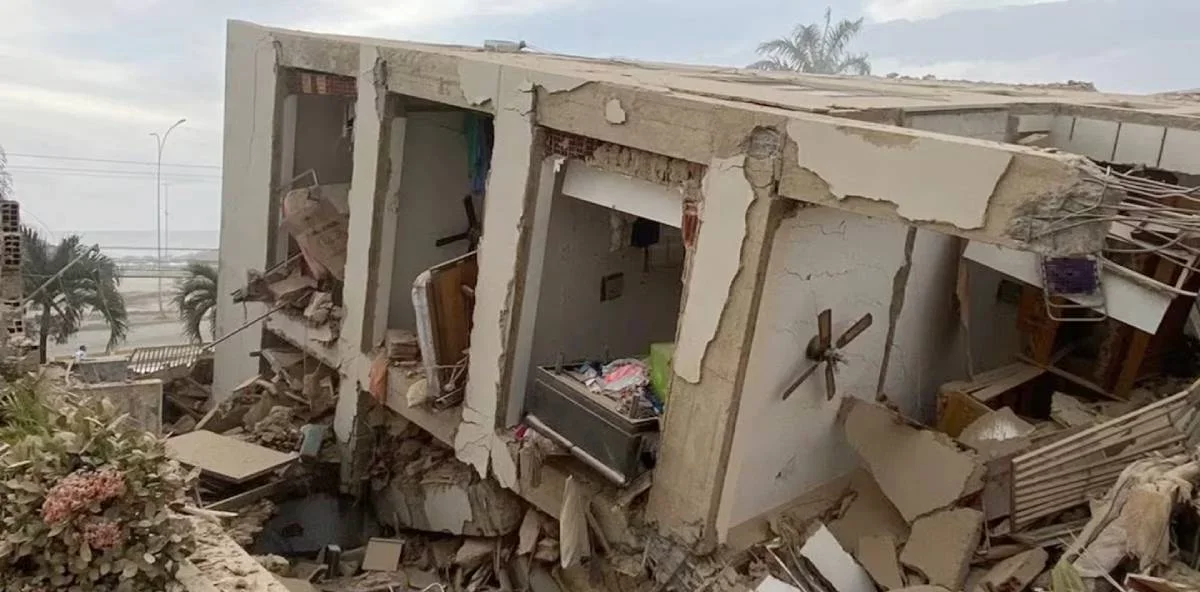
What would happen if a double earthquake like the one in Venezuela occurred in the Dominican Republic? Geologist Osiris de León says the impact would depend mainly on the location of the geological faults and the type of soil where the event occurred.
When comparing the two scenarios, the specialist explained that one difference is that, in Venezuela, the fault responsible for the earthquake runs through densely populated areas.
“In the case of Venezuela, the faults caused by the earthquake pass right over the Maiquetía airport. They pass over the communities of Macuto and La Guaira, which is why there is so much destruction there. Here, the faults don’t pass so close,” he explained in an interview on the radio program La Universidad de la Calle (LA UCA), hosted by Brea Frank.
He indicated that in the Dominican Republic, the geological faults closest to large urban centers are farther away.
“The faults you have here that pass closest to Santo Domingo are 70 kilometers south of Santo Domingo. And those you have that pass north of Puerto Plata are almost 50 kilometers away. This means that, from that point of view, you have a greater distance, and that causes the wave to attenuate and the damage to be relatively less.”
However, he warned that distance is not the only factor that determines the magnitude of the damage.
“It has a second, important component. Soft soils, like those in the Cibao Valley, amplify seismic waves. That’s why the earthquake of December 2, 1562, destroyed Santiago and La Vega.”
De León pointed out that if an earthquake of similar magnitude were to occur near Puerto Plata, Luperón, or Sosúa, the consequences could be equally devastating, or even more so, in several provinces of the Cibao region.
“If an earthquake of similar magnitude were to occur near Puerto Plata, Luperón, or Sosúa, you should expect significant damage. Perhaps as much or even more than what you’ve seen in Venezuela, in the Cibao region, including Santiago, La Vega, Bonao, San Francisco de Macorís, Moca, Villa Tapia, Tenares, and those communities that have grown up on organic soils. These black soils are good for agriculture, but poor for construction and amplify the seismic spectrum,” he explained.
Venezuela today
Venezuela enters its fourth day of a state of emergency this Saturday following the double earthquake that struck on Wednesday. According to official figures at the time of this writing, the disaster has left 920 dead and 3,360 injured, while rescue teams from nine countries are participating in the search for survivors and the recovery of victims.


What would happen? Organized chaos!