
“Extremely Severe” When will the heat wave in the Dominican Republic end, and what dangers does it pose? Forecasts


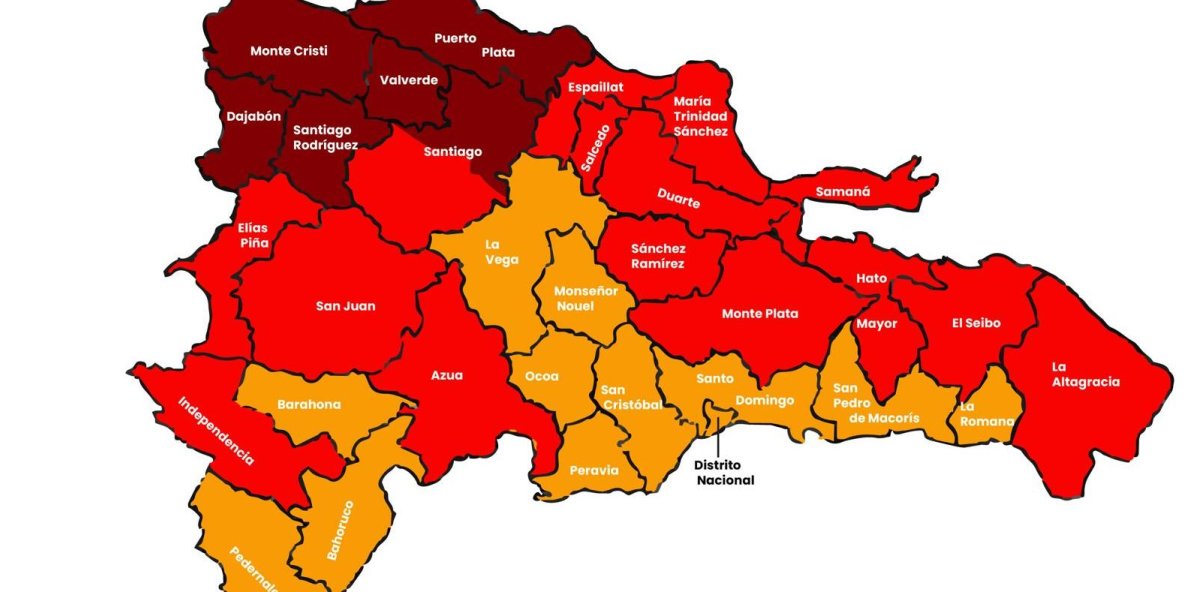
The intense heat affecting the Dominican Republic will not disappear in the coming days. In fact, the country will remain under an extreme heat warning until at least July 14, according to projections from the U.S. National Oceanic and Atmospheric Administration ( NOAA).
This was explained to the newspaper HOY by engineer and Master of Science Saddan Font-Frías, head of the Meteorological Research Department of the Dominican Institute of Meteorology (INDOMET), who pointed out that it is not an isolated episode, but a prolonged event of extreme heat.

MSc. Eng. Saddan Font-Frías M, from the Meteorological Research Department of the Dominican Institute of Meteorology (INDOMET)
During the week of July 1-7, there is a high probability that the combined index of maximum temperature and heat index will exceed 33 degrees Celsius for three or more consecutive days, mainly in the northern, northwestern, and parts of the central regions of the country.
He added that climate models indicate that this behavior will continue between July 8 and 14, consolidating a prolonged period of high temperatures.
“The persistence of high temperatures for several consecutive days represents one of the main risk factors, since the body has less time to recover from accumulated heat stress, increasing the likelihood of heat exhaustion and heat stroke,” he noted.
Why is it so hot?

Extreme heat
Font-Frías explained that this episode is due to a combination of atmospheric conditions that favor the accumulation of heat over the Dominican territory.
He noted that the trade winds continue to carry warm, humid air from the Atlantic and the Caribbean Sea. Added to this is a high-pressure system in the middle levels of the atmosphere and a process of subsidence—the descent of air from high levels toward the surface—which limits the formation of clouds with significant vertical development.
“When air descends, it compresses and heats up. This process acts as a kind of atmospheric lid that reduces the formation of significant rainfall, allows for greater solar radiation, and helps trap heat near the surface,” he explained.
As a result, he said, the country will face a combination of high temperatures, high humidity, and low rainfall—factors that significantly increase the heat index.
Less Rainfall and Higher Water Consumption

The meteorologist also warned that NOAA forecasts a greater-than-50 % probability that precipitation will remain below normal over the coming weeks.
In his view, this scenario poses a twofold challenge for the country.
“High temperaturesincrease water and electricity consumption, while decreased rainfall reduces water availability and increases stress on certain crops. It is a scenario that requires responsible water use and constant monitoring of weather conditions,” he said.
The specialist added that this episode coincides with the near-continuous presence of air masses laden with dust from the Sahara, which contribute to a drier environment, partially reduce cloud cover, and allow greater solar radiation over the Dominican Republic.