

Immigration authorities have deported more than 226,000 this year


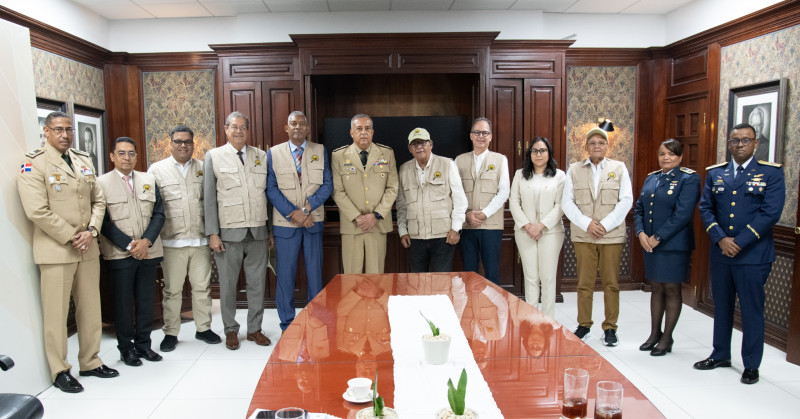
Santo Domingo — The Migration Policy Observatory (OPM) held a field meeting this Wednesday with the country’s migration authorities, headed by the Director General of Migration, Vice Admiral Luis Rafael Lee Ballester (ARD), who reported that to date more than 226,500 foreigners who were in irregular migratory status in Dominican territory have been deported.
The Director of Migration also revealed that, as a result of their migration intelligence and counterintelligence work, they have detected the existence of binational networks, with branches in Haiti and the Dominican Republic, that are dedicated to the illicit trafficking of people into the interior of the country, with well-established routes, both on foot and in vehicular transport.
This first field work meeting of the OPM was led by its president and director of Listín Diario, Miguel Franjul. It included the participation of members of the Executive Commission and the Technical Committee, among them Juan Mera, Feliciano Lacen, Jacinto Pichardo, Federico Jobine Rijo, Miguel Franjul Jr., Igor Bucarelli and Doris Pantaleón.
A representation of his work team accompanied Lee Ballester, made up of Brigadier General Pilot Juan Carlos Vicente Pérez, Director of Migration Intelligence; Colonel Jael Rodríguez Rojas, Administrative and Financial Director; Laura Maríñez Espinal, Director of Immigration; and Colonel Manuel Carrasco, Director of Migration Control.

Juan C. Vicente Pérez, director of Migration Intelligence, demonstrates the technological tool they use. Observed by Jael Rodríguez R. and José Alberto Maldonado.
The worst migration period
The Director of Migration valued the feedback received on the work of the agency, noting that the Dominican Republic is experiencing the worst period in migration issues since the time of Independence, a result of the situation in Haiti with the expansion of gang control.
He noted that this situation began to have a greater impact in 2018, then stabilized somewhat, but resurged in 2021 with the assassination of President Jovenel Moïse. He said that in the last five years, gang control has expanded in Haiti, leading to the displacement of a large part of its population to the interior of the country, with attempts at irregular Migration flows to the Dominican Republic.
In the five provinces
He said that, to that same extent, the work of the Migration Directorate has been intensified, and that through the program of training migration agents it has a presence with offices in the five border provinces, with migration interdiction actions in each of them.
The personnel, he explained, are deployed across all 32 provinces of the country, with crucial tasks in Dajabón, Elías Piña, Monte Cristi, Jimaní, and Pedernales, as well as in the eastern region, Greater Santo Domingo, and the Cibao region. “We are active throughout the entire national territory,” Lee Ballester emphasized.
Those apprehended in the interdiction operations are taken to processing centers located in Higuey, Haina, Santiago and Elías Piña, explained the Director of Migration, and revealed that the Jimaní center will soon be finished and that work is underway on a trust to establish the one in Pedernales.
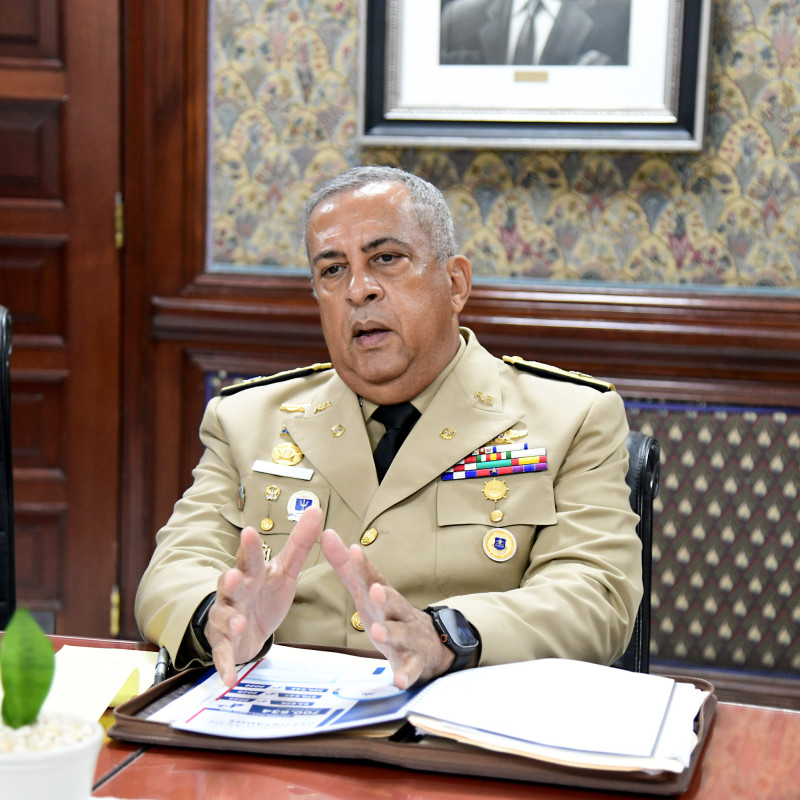
Luis Rafael Lee Ballester, Director of Migration. José Alberto Maldonado
Networks
Referring to the ongoing intelligence and counterintelligence work being carried out, he highlighted the identification of networks or organizations trafficking Haitians that operate in coordination between Haitians and Dominicans.
He added that routes, patterns, and origins have been identified, and that some 15 people have been arrested and are under investigation for acting as ringleaders or guides. He said that routes have been established on foot, crossing different areas to reach Santiago, and other routes have been established using vehicles.
He noted that last year the Migration Directorate deported 380,000 people with irregular immigration status and that there are also voluntary returns of Haitians who have collected their belongings and returned to their country.
He reminded everyone that Migration goes beyond deportations.
Submissions
Lee Ballester highlighted that they have worked on strengthening the legal framework for Migration in relation to the handling of cases in which it is determined that there are bad practices on the part of immigration agents, achieving a synergy with the Public Prosecutor’s Office for the handling of cases in which it detects agents who violate the DGM’s code of ethics and immigration laws.
He said that they have been working on this with the Attorney General of the Republic, Yeni Berenice Reynoso, and the Director of Prosecution of the Public Ministry, Wilson Camacho, and that they have even achieved coercive measures.
He said that whenever an action contrary to the rules is detected, the corresponding measures are taken.
Training of agents
Highlighting that to date they have carried out more than 226,000 deportations of foreigners with irregular immigration status, the Director of Migration pointed out that this represents an average of 1,000 people per day.
He reported that 164 immigration interdiction agents are currently in training in the northern region, whose graduation will be next Sunday, and that they are in the process of recruiting about 300 in Santo Domingo.
These, he explained, will join the 1,195 agents already trained, and that work is also underway to increase transport capacity and equipment to increase operational deployment throughout the country.
Budget
He reported that the Migration Directorate received a budget increase of 2 billion pesos from the Government to strengthen its response capacity and migration control, for a total budget of 5 billion pesos.
He explained that they are in the process of bidding for new trucks, with plans to acquire 60, and an equal number of vans. He said that the transport vehicles will include restrooms to provide greater dignity to the deportation process.
He also highlighted that the policy on the use of force has been strengthened, equipping immigration agents with electric guns.
Immigration officials reported that the evaluation of a facial recognition technology project is in its final phase, and that fleets have been acquired with a platform that allows them to validate the identity of the detained person.
They also indicated that they are working with a Google platform that is an artificial intelligence tool.


Probably a large percentage of that figure return…I know of one who works in maintenance in a building who was deported and in less than a month was back…he claims to have paid RD 20,000 pesos…
Dominican authorities are so corrupt, they’re so easy to bribe it’s sad and laughable at the same time.