
El Niño drastically decreases the levels of dams in the country


Santo Domingo, DR — In its latest report on August 13, the National Oceanic and Atmospheric Administration of the United States indicated that El Niño has more than a 90% chance of continuing to strengthen, reaching a very high intensity, increasing the risk of continued drought and reduced rainfall affecting the Caribbean.
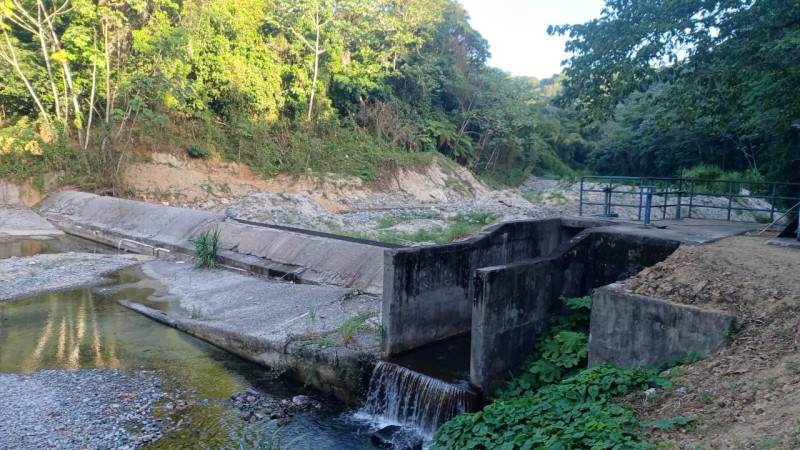
This phenomenon drastically impacts the country’s water supply. Since May, rainfall has decreased in the basins that supply the Higüey, Isa-Mana, Duey, and Isabella rivers, as well as the Nizao river, which supplies water to the Valdesia aqueduct.
According to a report by the Dominican Institute of Meteorology (Indomet), between May and July, it has rained less than normal, resulting in deficits of -46.0% in the fifth month of the year, -54.5% in June, and -45.3% in July.
According to reports from the Santo Domingo Aqueduct and Sewerage Corporation (CAASD), as a result of this situation, the Haina-Manoguayabo aqueduct has a 68% reduction in production. The Isabella aqueduct has a 65% reduction in its production.
Similarly, the absence of rainfall drastically affects the Isa-Mana and Duey aqueducts, reducing their production by more than 60%.
Fidel Sánchez, director of Communications of the CAASD, informed Listín Diario that the Haina Manoguayabo system, which should produce 90 million gallons per day, as of yesterday, Thursday, was producing only 21 million gallons per day. The Isabela aqueduct, which should produce 9 million gallons a day, was producing only 3 million gallons a day until yesterday, Thursday.
The sectors in which this drought has intensified and that were already affected by groundwater shortages are the municipalities of Los Alcarrizos and Pedro Brand, as well as Los Peralejos, Pantoja, and Los Girasoles.
In addition to these, there are residential homes in the Republic of Colombia, such as Puerta de Hierro, Cuesta Hermosa 1, 2, and 3, and sectors of the National District located south of Kennedy Avenue. El Cacique, El Portal, May 30, in the university area, among others.
“An important part of them is supplied by the Haina-Manoguayabo system and they are feeling a situation of difficulty in the service, especially those located in the upper part of these sectors,” said Sánchez.
Indomet’s projections for October-December of this year are that the drought will reach a historic intensity of 69%, “comparable to or higher than the events recorded since 1950.”
“The first four months of the year the rains were above normal, which has helped a little so that these deficits are not causing so much damage in the country because we had a cushion with the rain that had already fallen,” said Juana Sille, a meteorological specialist at Indomet.
The Indomet report forecasts that a single hurricane can generate significant impacts on rainfall production in the country during the remaining months of this hurricane season.
However, the latest forecast from Colorado State University (CSU) and Phil Klotzbach, updated in early August of this year, maintains a forecast of cyclone activity well below normal, with nine named storms and four hurricanes, of which one could reach category 3, 4, or 5.
Reservoir level
According to data from the National Institute of Hydraulic Resources (INDRHI), as of yesterday, Friday, the national volume of water in reservoirs was 1,343.89 million cubic meters (MMC), representing 66.57%.
The Monte Grande dam has 108.13 million cubic meters of water, for 44.7%; Sabana Yegua, 176.02 MMC, for 55.5%; Sabaneta, 31.29 MMC, for 55.8%; Rincón, 36.61 MMC, for 61.6%; Tavera, 88.20 MMC, for 66.9%.
Bao, 126.90 MMC, for 67.6%; Jigüey, 86.59 MMC, for 68.0%; Valdesia, 99.40 MMC, for 76.3%; Hatillo, 300.81 MMC, for 80.2%; and Monción, 289.94 MMC, for 87.8%.