
The Dominican Republic registers a 2.9% increase in employment, reaching 5.27 million employed.


Santo Domingo.- The Central Bank reported that, according to the results of the National Continuous Labor Force Survey (ENCFT), in the second quarter of 2026 the total number of employed in the Dominican economy reached 5,271,005 workers, for a year-on-year increase of 2.9%, equivalent to 147,456 net new employed compared to April-June 2025.
With this result, the employment rate (ER) and the overall participation rate (OPR) stood at 63.2% and 66.8%, respectively, remaining near their historical highs and reflecting high workforce utilization in the region.
In terms of the composition of job creation, of the year-on-year increase of 147,456 net employed registered in the last twelve months, formal workers contributed 74,794 new employed, equivalent to 50.7%, while informal workers contributed the remaining 72,663, for 49.3%.
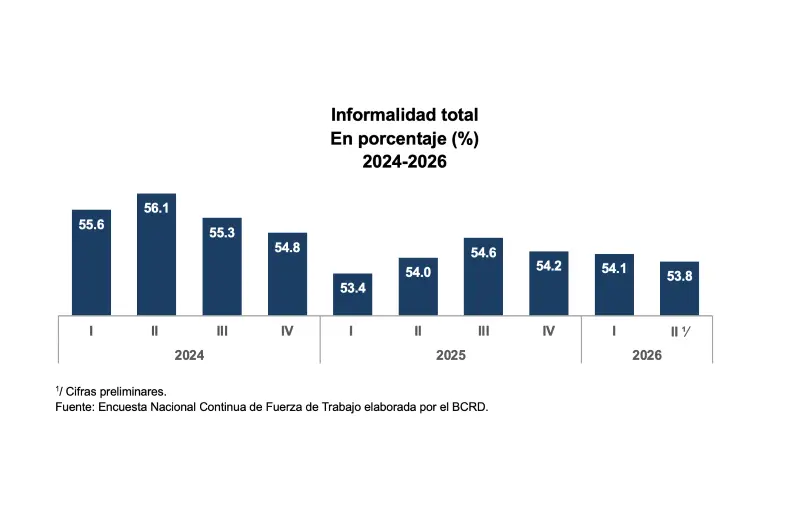
Thus, the total informality rate stood at 53.8% in the second quarter of 2026, below the historical average of 56.7% recorded in the ENCFT series since 2014.
The Central Bank of the Dominican Republic (BCRD) explains that the ENCFT is a probabilistic sampling survey whose main objective is to estimate the link between working-age people and the labor market, as well as to serve as a data source for monitoring the evolution of monetary poverty.
It adds that it is designed to generate representative results at the national level and in a disaggregated manner for the four major regions: Ozama or Metropolitan, North or Cibao, South and East, collecting information continuously in a sample of 8,480 homes on a quarterly basis and a 90% confidence level in the estimation of labor indicators.
From a demographic perspective, of the total of 5,271,005 employed individuals, 57.0% are men and 43.0% are women. In terms of net job creation over the past twelve months, women accounted for the majority of the increase, with 127,742 new jobs, representing 86.6% of the new positions, while men contributed an additional 19,714 jobs.
Regarding indicators of unemployment or underutilization of the workforce, the open unemployment rate, defined as the percentage of unemployed people who are actively seeking employment as a proportion of the labor force, stood at 5.3% in April-June 2026, registering an increase of 0.3 percentage points compared to the 5.0% observed in the same period of the previous year.
As for the labor force underutilization rate SU3, an indicator equivalent to the previously called expanded unemployment rate, which includes both unemployed people who are actively seeking employment and those available to work, even if they are not looking, it stood at 8.7% in April-June 2026, showing an increase of 0.3 percentage points compared to the same quarter of the previous year.
In terms of the dynamics of the labor market transition from April-June 2026 to the same period in 2025, it is observed that 92.6% of employed people maintained their status of being engaged in productive activity, 5.9% of employed people left the labor force, becoming inactive, and the remaining 1.5% went from employment to unemployment.
Likewise, of the total unemployed, 44.0% moved into employment one year later, 28.3% remained unemployed, and the remaining 27.7% became inactive; while, of the total inactive people (outside the labor force), 81.3% maintained their condition in that twelve-month period, 15.9% moved into employment, and 2.8% became active in the search for work, these movements contributing to the increase in the labor force or EAP.