This is the Dominican Republic’s position on sargassum at the EU-Caribbean conference


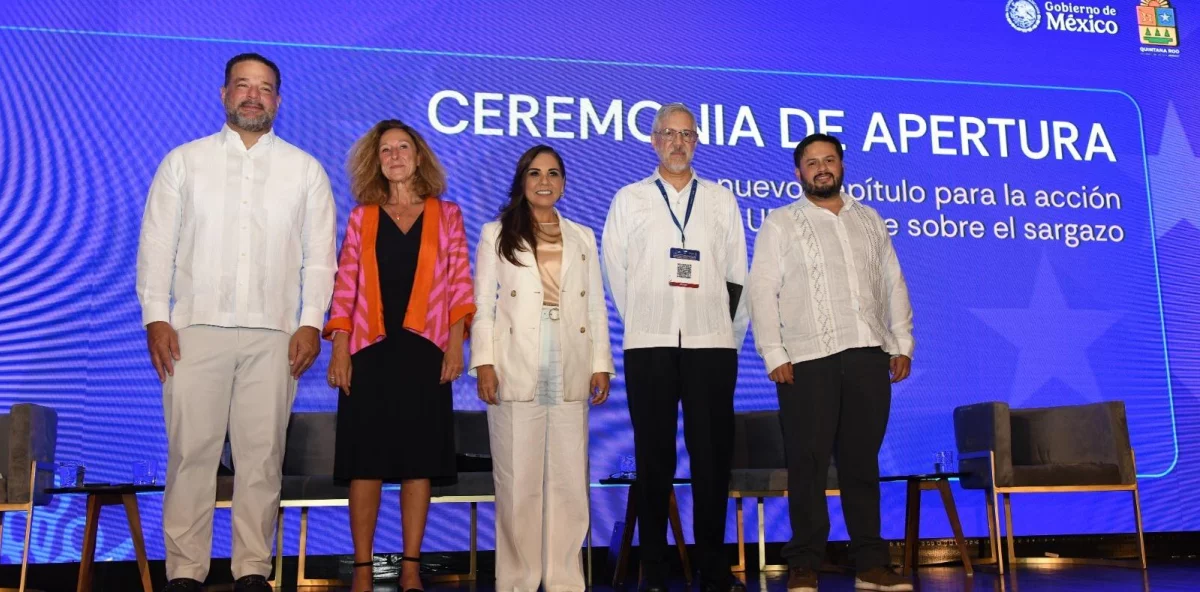
CANCÚN, Quintana Roo (Mexico). – The Minister of Environment and Natural Resources, Paíno Henríquez, raised the need to strengthen a regional response to Sargassum based on anticipation, coordination between sectors, and the exchange of knowledge, during his participation in the Fourth EU-Caribbean Global Gateway Conference on Sargassum.
The meeting brings together 350 representatives from 45 countries and territories to address technological alternatives, financing mechanisms, and models that support progress toward sustainable Sargassum management and its use as a raw material.
During his speech, Henríquez warned that the expansion of Sargassum requires responses that transcend the individual capacities of each country and allow for coordinated efforts to address its effects on coastal ecosystems and economic activities linked to the sea
“Sargassum knows no borders. What happens offshore affects our coasts, ecosystems, fishing, tourism, and the lives of thousands of people. And precisely because it knows no borders, we cannot pretend to face it individually. This is a shared challenge, and we must face it as a team,” Henríquez stated.
The minister explained that the Dominican Republic is shifting from a response focused solely on accumulating Sargassum on its coasts to a more proactive model. To this end, the country is strengthening its monitoring systems using satellite and geospatial data, coordinated with teams working on the ground.
“We need to understand the beach, use the right equipment, measure what we’re doing, and evaluate the results. It’s not simply a matter of showing up with a machine and removing what we find. We have to intervene with the awareness that we are acting upon an ecosystem,” he said.
As part of national actions, the Dominican Republic has set a goal to sustainably manage 150,000 metric tons of Sargassum by 2027. With the support of the European Union, the country also launched an international call for proposals to identify solutions along the value chain, which received 45 proposals from ten countries, evaluated with technical support from the Food and Agriculture Organization of the United Nations (FAO
The Ministry is also exploring ways to transform some of this biomass into useful products and generate new opportunities, based on environmental safety criteria and scientific evidence. The goal is to move towards solutions that are environmentally safe, scientifically sound, and economically viable, connecting knowledge, innovation, and capabilities.
Henríquez stressed that regional cooperation should let countries learn from each other’s experiences and speed up the search for solutions.
“We don’t have to solve the same problem twenty times in twenty different countries. If a solution works, we have to share it. We have to share information, experiences, research, technology, and knowledge. That is true regional cooperation,” he stated.
In that regard, he noted the importance of continuing to strengthen cooperation among the countries of the Greater Caribbean to turn existing knowledge and capabilities into concrete responses to a phenomenon affecting the entire region.
The 4th EU-Caribbean Global Gateway Conference on Sargassum is co-organized by the European Union and the Government of Mexico, through the Ministry of Environment and Natural Resources (Semarnat), in collaboration with the Government of Quintana Roo. The two-day event brings together representatives from governments, the private sector, academia, financial institutions, and international organizations.
For Henríquez, tackling Sargassum will require maintaining the ability to work together, share knowledge, and combine efforts among countries, institutions, science, the private sector, and communities.
“We have to do it with science, with awareness, and together. Because united we can do so much more for our environment,” he concluded.