
How far has the Dominican Republic progressed in reducing poverty and what is missing?


You can have little in your pocket and a lot in your heart. In the Dominican Republic, this idea is usually summed up in one phrase: “That one takes the bread out of his mouth to give it to the other.”
Vice President Raquel Peña appealed to that solidarity at the beginning of her speech at the conference “Towards the eradication of poverty in the Dominican Republic: progress and challenges,” where she said that “a plate of food from a Dominican household, although not too much, there is always for those who need it.”
But beyond Dominicans’ willingness to share, it is worth asking: how far has the country advanced in reducing poverty, and what is missing to help more families get out of it?

The activity featured panelists who reflected on the country’s poverty challenges
“Poverty is not a cold figure: it has a human face, it has a name,” Peña said during the activity, held within the framework of the International Day for the Eradication of Poverty.
Poverty reduction and the remaining goals
According to data presented by the authorities, general monetary poverty in the Dominican Republic fell from 30.7% in 2021 to 17.3% in 2025, after rising to 30.4% in 2020 during the COVID-19 pandemic.
Preliminary figures for 2026 point to a further reduction. According to the data released during the activity, the rate stood at 15.4% in the first quarter and 13.75% in the second, for an average of 14.58% in the first half of the year.

Raquel Peña, Vice President of the Dominican Republic
During his speech, Peña also referred to the RD 2036 Goal Plan’s goal of reducing rural multidimensional poverty to 15% by 2028 and to less than 10% by 2036. This indicator must be distinguished from monetary poverty, since both measure different dimensions of living conditions.
On other indicators, he said urban poverty fell from 25% in 2019 to 15% in the first half of this year, while extreme poverty fell from 8.7% in 2015 to 2.2% in 2026.

Mayra Jiménez, director of Supérate, Guillermo
For her part, Mayra Jiménez, general director of Supérate, described the reduction of poverty as historic and, among the aspirations raised, mentioned the possibility that the Dominican Republic will become “a small country in the world, but that was able to eradicate extreme poverty.”
What is needed to sustain progress?

Rolando Guzmán, director of the newspaper HOY,
Asked by this newspaper about the necessary measures to reduce it in a sustained way and for people to improve their quality of life, the economist and director of the newspaper HOY, Rolando Guzmán, identified three fundamental areas: education and training for work, social protection that strengthens people’s capacities, and the creation of jobs that allow families to generate sufficient income.
Guzmán said education should not be limited to formal academic training, but should also include skills development and a stronger link between training and companies’ needs.
On social protection, he stressed that public policies should not only provide assistance but also help develop people’s capacities so they can improve their livelihoods.
The labor market is another challenge, because opportunities to get decent jobs and earn sufficient income directly influence families’ ability to sustain themselves.
Along the same lines, Mercedes Canaan, executive president of Banco ADOPEM, stressed the importance of strengthening people who have escaped poverty to reduce the risk of returning to it.
The stories behind the numbers

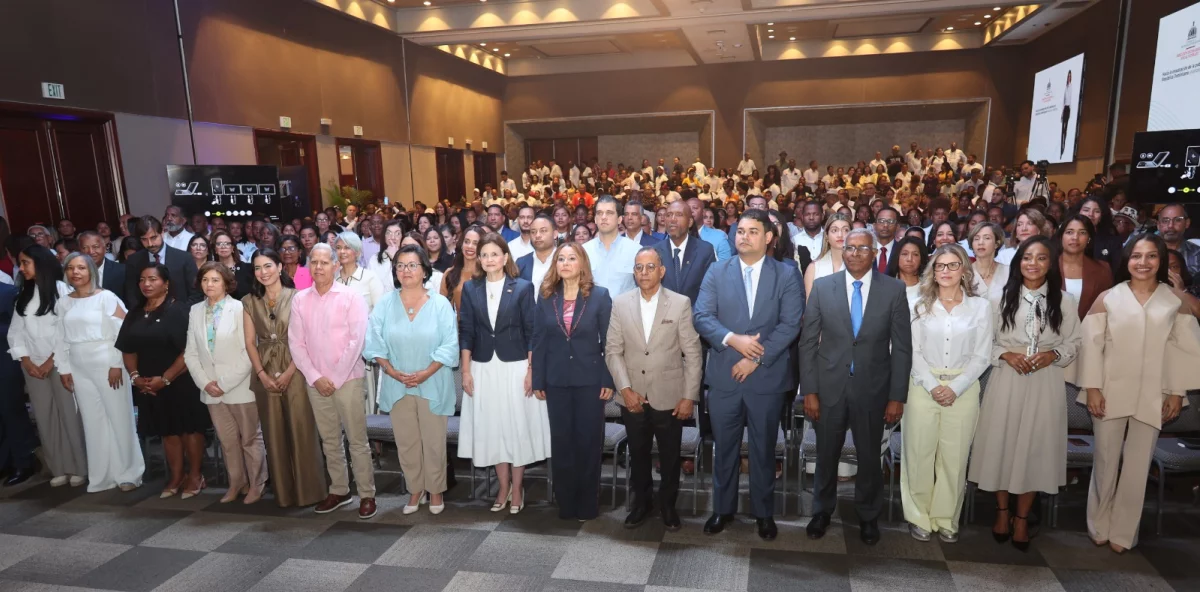
Families who gathered at the activity for the International Day for the Eradication of Poverty
The meeting also included testimonies from families linked to social protection programs, some of whom shared their experiences and the changes experienced in their living conditions.
The testimonies put a face to the figures.