
Cuba’s declining UN support puts the government under growing scrutiny


By Paul Collins
Contributor
For 67 years, Cuba’s rulers have promised equality, prosperity and national dignity. Millions of Cubans have endured chronic shortages, prolonged blackouts, political imprisonment and an exodus driven by a system that has failed them.
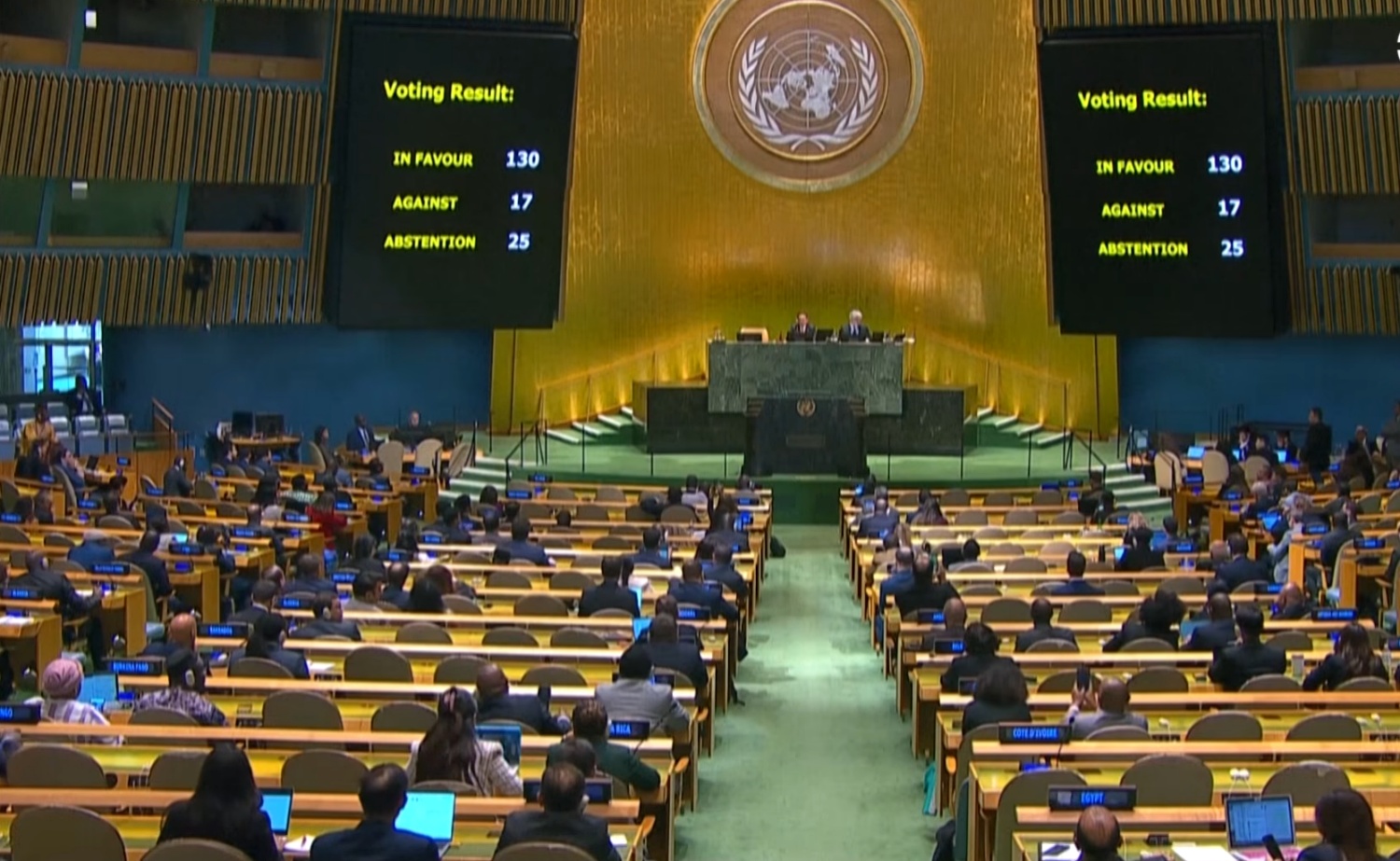
Whenever the consequences become impossible to conceal, the government blames the United States. On October 28, that strategy suffered a diplomatic setback. The United Nations General Assembly adopted Havana’s annual resolution demanding an end to the US economic embargo, but support fell from 165 votes in 2025 to 130 this year. Seventeen countries voted against the resolution, 25 abstained and 21 did not participate.
The measure passed, but the declining support exposed growing reluctance to endorse Havana’s campaign without questioning its own record. US Ambassador Mike Waltz brought that question directly before the world.
Waltz confronted the regime — and the regime answered with a spectacle
Waltz challenged Havana over political repression, the privileges of the ruling elite and the concentration of economic resources in military-linked institutions. He argued that Cuba’s suffering cannot be understood without examining the conduct of those who govern it.
Foreign Minister Bruno Rodríguez Parrilla and members of the Cuban delegation interrupted Waltz, banged on tables and shouted. The presiding officer intervened as tensions escalated.
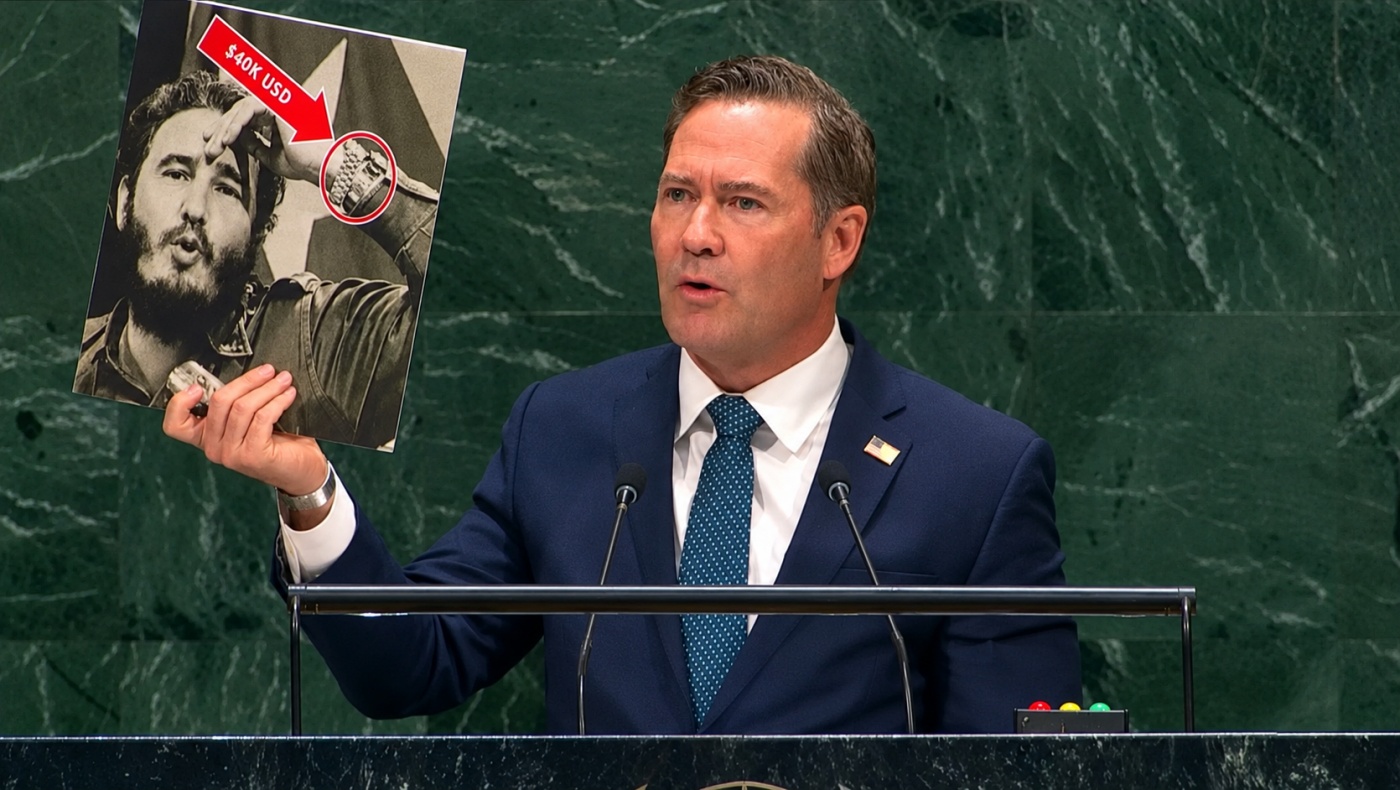
U.S. Ambassador Mike Waltz displays a photograph of Fidel Castro wearing two Rolex watches, which Waltz valued at $40,000 combined in today’s dollars, during a U.N. General Assembly debate on the U.S. embargo against Cuba in New York on October 27, 2026. (Photo: external source)
The confrontation had further consequences. On October 28, Waltz announced that Secretary of State Marco Rubio had signed an order expelling Richard Tur de la Concepción, first secretary of Cuba’s UN mission, following an incident involving an American official’s phone. CubaNet reported the expulsion and described video showing Tur approaching the official and making aggressive gestures.
Waltz’s criticism also focused attention on Grupo de Administración Empresarial S.A. (GAESA), the military conglomerate with extensive commercial interests and limited independent oversight.
A joint investigation by ADN Cuba and Martí Noticias, published on October 22 and 23, documented how fuel imported from the United States through Cuban private businesses reached CIMEX, a GAESA corporation. Based on invoices, internal circulars and shipping records, the investigation identified 21 fuel suppliers, including at least 16 Cuban micro, small and medium-sized enterprises.
One invoice showed CIMEX-Mariel billing a service station nearly US$53,000 for more than 23,000 liters of gasoline. The documents detailed purchase and resale prices, raising questions about transactions involving a military-controlled corporation in a system with little independent oversight.
These findings do not establish individual criminal liability, but they provide grounds for serious scrutiny. CubaNet had previously reported that businesses linked to GAESA, government ministries and members of the Castro family were among those authorized to participate in fuel imports.
The questions are straightforward: who controls Cuba’s resources, who profits from their management, and who can investigate their use independently? Havana could answer with facts and documents. Instead, the confrontation drew attention to its delegation’s conduct.
The embargo cannot absolve Cuba’s rulers
Washington’s sanctions have imposed real costs on Cuba. But acknowledging their impact does not mean accepting the government’s claim that external pressure explains the country’s crisis or absolves its leaders.
Decades of centralized control, failed economic policies, restrictions on private enterprise and opaque management of public resources have compounded the hardship. The state has repeatedly failed to provide basic goods while limiting citizens’ ability to challenge its decisions.
GAESA exemplifies the problem. Its extensive commercial interests operate within a political system in which citizens cannot freely elect an alternative government or exercise effective oversight over powerful institutions. The issue is whether the economy serves the public or entrenches the power of those who control it.
Meanwhile, families struggle to obtain food, medicine and fuel. Blackouts disrupt daily life, young people leave in search of a future, and those who openly challenge the authorities risk harassment, detention or imprisonment.
Cuban physician and activist Alexander Jesús Figueredo Izaguirre has argued that Havana’s campaign against the embargo cannot substitute for free elections and political accountability. Government critic Elaine Castro Castañeda has similarly challenged official propaganda that attributes the country’s hardships almost entirely to Washington.
Their criticism reflects a crucial distinction: defending Cuba does not require defending its rulers. The Cuban people are not the Communist Party, and national dignity does not belong to the ruling elite.
The real victory will belong to the Cuban people
The decline from 165 votes to 130 does not mean the international community has abandoned opposition to the embargo. The resolution passed, and many governments still support it. Nevertheless, fewer endorsed it this year, while more voted against it, abstained or did not participate.
Waltz deserves credit for bringing political prisoners, elite privileges and questions about national resources into the debate. Independent reporting on GAESA and fuel transactions gives substance to the concerns he raised. These issues warrant public answers, not reflexive dismissal.
Cuba needs transparent public finances, genuine opportunities for private enterprise, civil liberties, the release of political prisoners and free and fair elections. It needs institutions capable of investigating corruption without interference from those under investigation.
For 67 years, Cuba’s rulers have asked their people to sacrifice for a promised future. They owe them answers for the present they have created. The world must not confuse standing with Cuba with standing behind its dictatorship. The Cuban people deserve solidarity, freedom and accountability — not another generation of excuses.