
The “El Niño” phenomenon would emerge between May and July 2026 and extend until February 2027


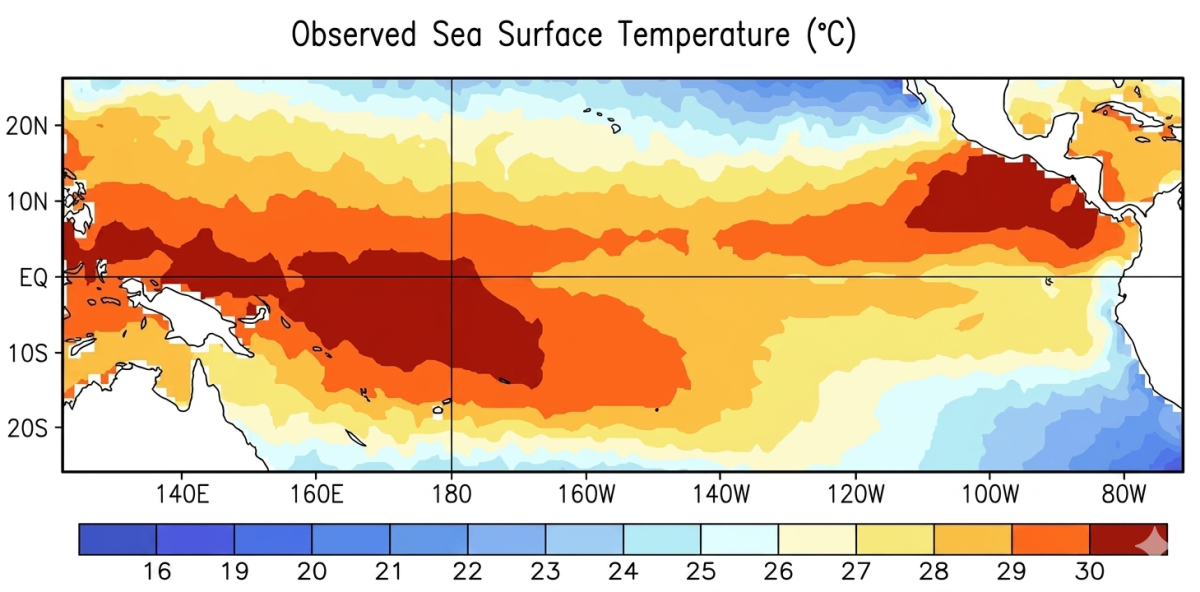
The meteorological phenomenon known as “El Niño,” which arises from the anomalous warming of the surface waters of the Pacific Ocean, and which threatens millions of vulnerable people in the face of the climate crisis and rising prices, according to the United Nations, would emerge between the months of May and July of this year.
The National Weather Service’s Climate Prediction Center (NWS-CPC) issued its forecast for the El Niño climate event on Thursday. “El Niño is likely to develop soon (82% chance in May-July 2026) and continue through the Northern Hemisphere winter of 2026-2027 (96% chance in December 2026 and February 2027),” the agency stated.
The NWS-CPC noted that this is due to record-high temperatures in the equatorial subsurface and low-level westerly wind anomalies over the western equatorial Pacific, which were evident at high levels over the central and east-central Pacific.

El Niño is expected to arrive this year and last until early 2027.
However, he noted that the most intense El Niño events in the historical record are characterized by significant ocean-atmosphere coupling during the summer, and it remains to be seen whether this will occur in 2026. He indicated that the strongest events of the phenomenon do not guarantee more severe impacts; “they only increase the probability of certain impacts.”

Expert records indicate that the phenomenon will occur this year.
This alert was summarized by Gloria Ceballos, director of the Dominican National Institute of Meteorology (Indomet), on her X account.
Several days ago, the Food and Agriculture Organization of the United Nations (FAO), the International Fund for Agricultural Development (IFAD), and the World Food Program (WFP) discussed early action measures, preparedness, and resilience-building to extreme weather events.
According to these organizations, more than 33 million people suffer from hunger, 167 million face moderate or severe food insecurity, and more than 181 million cannot afford a healthy diet in the Americas; and they add that the region accounts for 22% of global losses from agricultural disasters, valued at $713 billion.
The “El Niño” phenomenon could push more families into “a situation of vulnerability, by causing aridity in the Dry Corridor of Central America (an arid expanse, hit by poverty and vulnerable to the climate crisis) and altering precipitation and temperature patterns in the region,” the entities warned in a statement.