
Trash landing in paradise


By Clayton Gush and Renn Loren
Patriotism shouldn’t end when Independence Day celebrations end.
Every February 27, on Dominican Independence Day, something wonderful happens. Scores of schoolchildren in immaculate red, white, and blue uniforms march proudly through the streets, beating drums and celebrating their country’s independence. It’s genuinely moving. You can see the pride in their faces.
Orgullo patrio. National pride. It’s deeply ingrained in Dominican culture, and I’ve always admired it.
Over the years, though, I’ve noticed something else, and it troubles me.
Patriotism shouldn’t be something we dust off for national holidays. It should show up in how we treat our country the other 364 days of the year.
Imagine visiting the Dominican Republic for the first time. As your plane descends into Puerto Plata, you’re greeted by lush green mountains, palm-fringed beaches and an ocean shimmering in shades of sapphire and turquoise.
Paradise.
Then you leave the airport.
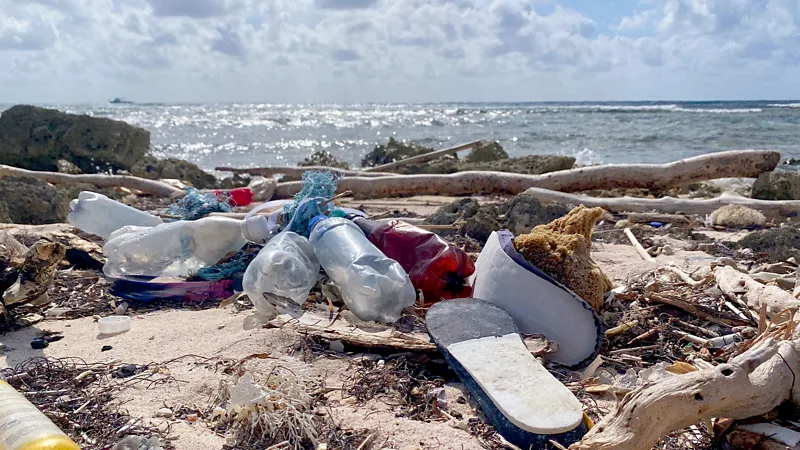
Along the highway, plastic bottles, food wrappers and discarded containers litter the roadside vegetation. Hardly the tropical welcome you imagined.
I’ve lived here long enough to watch motorcyclists casually toss bottles into the bushes and motorists throw bags of rubbish out their windows without a second thought.
I sometimes wonder what goes through their minds. Perhaps they figure the grass will grow, the bushes will fill in, and eventually nobody will notice.
Unfortunately, nature doesn’t work that way.
A plastic bottle doesn’t disappear because a banana tree grows over it. Much of this rubbish persists for decades, gradually breaking into smaller fragments. Some washes into drains, rivers and eventually the ocean.
The same ocean that attracts millions of visitors to this island.
And then there are the rivers. I’ve seen waterways so choked with rubbish that the water itself is barely visible. Ravines become makeshift dumping grounds, and heavy rains eventually sweep their contents downstream.
Beyond the environmental damage lies an obvious economic contradiction.
Natural beauty is one of the Dominican Republic’s greatest assets. Tourism puts food on tables, pays school fees, and supports entire communities. Yet far too many are remarkably willing to litter the roads leading to those beautiful beaches.
Of course, the Dominican Republic hardly has a monopoly on littering.
The United States faced a similar problem during the 1960s and 1970s, when disposable packaging and the conveniences of modern consumerism became increasingly prevalent.
In 1971, Keep America Beautiful and the Ad Council launched one of television’s most memorable public service announcements.
Actor Iron Eyes Cody, portraying a Native American, paddles through polluted waters before reaching a highway. Someone throws a bag of rubbish at his feet. The camera closes in on his face as a single tear rolls down his cheek.
The message was simple: “People Start Pollution. People Can Stop It.”
There was some irony involved. Cody, who publicly identified as Native American, was actually of Italian ancestry. The advertisement was controversial for other reasons, too, but its message made an impression.
It helped make littering something people were increasingly embarrassed to be caught doing.
I remember admonishing my own father for throwing an empty soda can out the window of his 1969 Ford Mustang. Apparently, the message had reached at least one young environmentalist.
Perhaps we need something similar here.
Not that I’m suggesting someone stand beside the highway outside Puerto Plata shedding a tear over a discarded Presidente bottle.
Then again, perhaps that’s exactly what we need.
Fortunately, many people already care. I’ve watched Dominicans and expatriates sacrifice their weekends to clean beaches, hauling away bags of rubbish that others couldn’t be bothered to dispose of properly.
Community volunteers, local organizations and businesses have worked tirelessly to address the problem. They deserve recognition—and considerably more support.
Another problem deserves attention: the astonishing scarcity of public rubbish bins. Along many roads, in neighborhoods, and even in busy public areas, it can be remarkably difficult to find somewhere to dispose of an empty bottle or food wrapper. In some communities, regular household rubbish collection is inadequate or nonexistent. We cannot reasonably expect clean streets without providing the infrastructure to keep them clean.
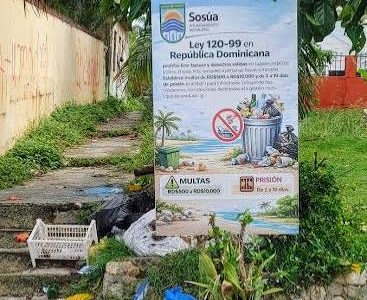
The Dominican Republic has laws against improper waste disposal, but enforcement remains a concern.
But infrastructure is only half the equation. The absence of a rubbish bin doesn’t oblige anyone to throw their rubbish into the bushes. Keep it in the car, carry it home, dispose of it when you can. Ultimately, it comes down to personal pride and consideration for others. If you genuinely take pride in your surroundings, you don’t casually turn them into a dumping ground.
A clean country requires both the means to dispose of rubbish responsibly and the willingness to use them.
Waste management has also improved.
On September 18, 2026, President Luis Abinader inaugurated a modern waste-management facility in Puerto Plata, representing an investment of approximately RD$1.6 billion. It’s an important step toward addressing the region’s longstanding waste-disposal problems.
But you can build the most sophisticated waste-processing facility in the Caribbean, and it won’t retrieve the plastic bottle someone throws into the bushes on the way home.
That particular problem exists somewhere between the ears.
And responsibility doesn’t belong exclusively to Dominicans.
I’ve lived here for many years, raised my children here, built businesses here, and developed a profound affection for this country and its people.
This is my home.
I wasn’t born Dominican, but that doesn’t prevent me from taking pride in the country I’ve chosen to live in.
You don’t have to be born somewhere to take pride in it.
Nor does that pride require some grand environmental initiative.
Keep the empty bottle until you find a rubbish bin. Pick up litter that isn’t yours. Teach your children not to throw rubbish from car windows. If you own a business, look at the roadside outside your premises.
We had a tradition whenever we left a beach, campsite, or other public place: everyone picked up ten pieces of litter before leaving.
It’s not complicated.
The Dominican Republic certainly faces more pressing problems than discarded water bottles. But unlike challenges that require years of legislation, substantial investment, or political wrangling, we can all address this today.
Stewardship. We hear it far too little, and it should be second nature.
I keep thinking about those schoolchildren marching on February 27. The flags, the drums, the enthusiasm. That pride is genuine, and worth celebrating.
Wouldn’t it be wonderful to see the same pride reflected in our neighborhoods, beaches, rivers, and countryside?
Not just on Independence Day, but on an ordinary Tuesday afternoon when nobody’s watching.
Loving your country isn’t simply about celebrating its history or honoring its independence. It’s about caring for what you’ve inherited—and what you’ll eventually leave behind.
The Dominican Republic is an extraordinarily beautiful country. Its people have every reason to be proud, and those of us fortunate enough to call it home should share that pride.
I’d just like to see a little more of it reflected along the roadsides and rivers.
Let’s make sure the view from the road lives up to the view from the sky.
Orgullo patrio. Every day.