
Former Dominican Foreign Minister discusses diplomacy, Haiti and U.S ties in Washington


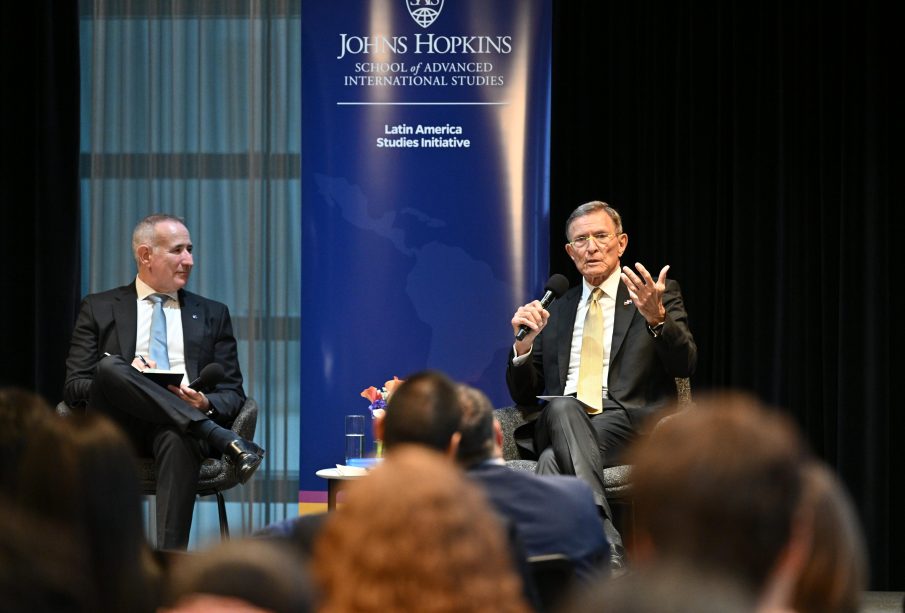
Washington, D.C.- Former Dominican Foreign Minister Roberto Álvarez recently visited Washington, D.C., where he shared reflections on his six years leading the country’s foreign policy during the annual meeting of the Latin American Studies Program at Johns Hopkins University’s School of Advanced International Studies (SAIS).
Álvarez, who is also an ambassador emeritus and a SAIS alumnus, participated in a conversation with faculty, students and alumni at the Bloomberg Center, moderated by Jim Marckwardt. The discussion covered Dominican Republic-U.S. relations, the ability of smaller nations to influence international affairs through diplomacy and alliances, and efforts to strengthen the international response to Haiti’s crisis.
The former foreign minister also addressed the challenge of balancing trade commitments with food security, using rice under the CAFTA-DR agreement as an example.
During his Washington visit, Álvarez met with Organization of American States (OAS) Secretary General Albert Ramdin to discuss developments in Haiti and Nicaragua, electoral processes and challenges facing democracy across the Western Hemisphere. They also explored opportunities for cooperation on regional issues.
Álvarez reaffirmed his commitment to supporting efforts to strengthen democracy in the Americas, while Ramdin praised his experience and perspective on regional affairs.
As part of his visit, Álvarez donated two volumes to the OAS Columbus Library documenting the Dominican Republic’s diplomatic response to the Haitian crisis between 2020–2024 and 2024–2026. The publications compile speeches, official positions and diplomatic initiatives, contributing to the preservation of the country’s diplomatic record.
Reflecting on his time at SAIS, Álvarez highlighted the importance of academic training in shaping his work as foreign minister. He recalled a 1983 lecture by Professor Simon Serfaty on U.S. foreign policy and the strategic importance of the Strait of Hormuz, which he said helped develop the historical and geopolitical framework he later applied to international affairs.
He also emphasized that effective public decision-making requires accountability, the ability to acknowledge mistakes and the capacity to connect academic knowledge with the practical demands of diplomacy.