
“Traces of a Transformation” addresses progress in police reform


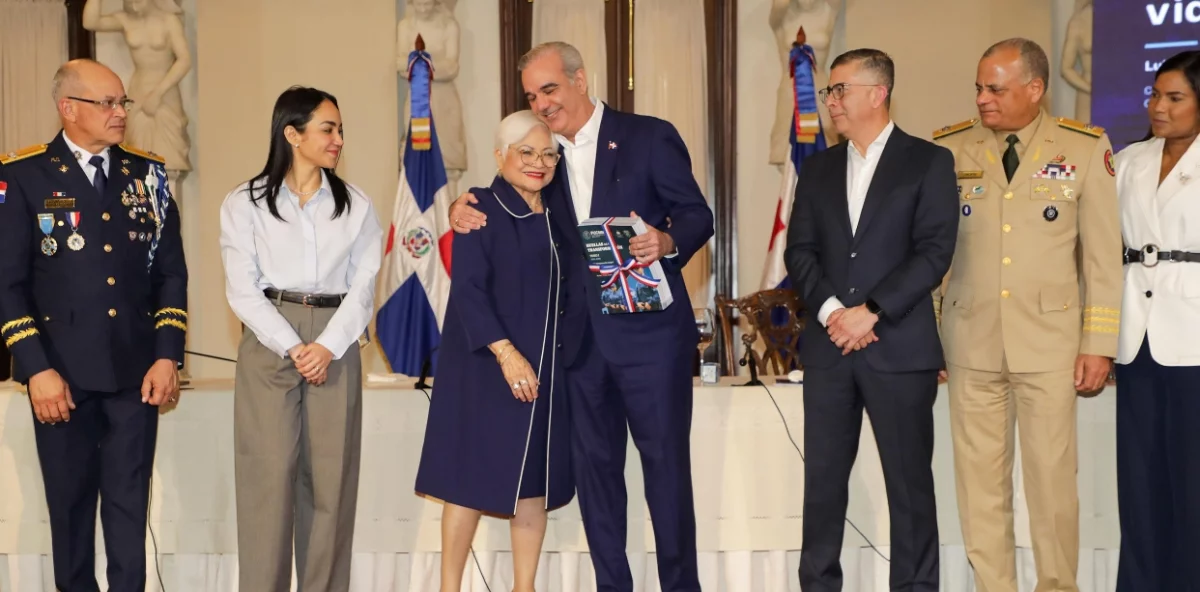
The book “Traces of a Transformation,” a two-volume work that compiles the actions, progress, and main milestones of the first five years of the police reform and modernization process, was launched yesterday. President Luis Abinader presided over the event.
Writer and historian Mu-Kien Adriana Sang Ben prepared the first volume, 431 pages, while the executive commissioner for Police Reform, Luis Ernesto García Hernández, prepared the second, 469 pages, with input from internal and external participants.
The publication documents the decisions, experiences, and testimonies of the institutional transformation process developed between 2021 and 2025.
During the ceremony, held in the Caryatids Hall of the National Palace, the Minister of the Interior and Police, Mu-Kien Adriana Sang Ben, explained that the work aims to create a historical record and reference tool that explains the changes made and provides continuity to the process.
Luis Ernesto García Hernández highlighted advances in the reform process, including an 185% increase in salaries for the lowest ranks, the inauguration of more than 100 police stations, and an increase from 12% to 35% of agents dedicated to patrolling.
He also reported that nearly 14,000 officers have graduated and around 16,000 have received training or are being trained under the new curriculum.
In addition, more than 10,000 body cameras have been installed to strengthen police supervision and control.
The commissioner maintained that the reform is an ongoing process that requires political will, evaluation of results, and stronger institutional values to build a more professional, modern police force closer to the population.
The jurist Julio César Castaños Guzmán, who was in charge of presenting the work, highlighted that the reform process had as its starting point the murder of the evangelical pastors Joel Díaz and Elizabeth Muñoz, in March 2021.
He also highlighted the stages of police dignification, patrol modernization, and institutional consolidation planned through 2028.
Attendees included the Minister of Defense, Lieutenant General Carlos Antonio Fernández Onofre; the Director General of the National Police, Major General Ernesto Rafael Rodríguez García; the Minister of Labor, Eddy Olivares; and the Minister of Public Works, Eduardo Estrella. Also in attendance were the President of the National Directorate for Drug Control (DNCD), Vice Admiral José Manuel Cabrera Ulloa, and the Attorney General of the Republic, Yeni Berenice Reynoso, among other officials.
Quiet City
In the morning, the Minister of the Presidency, José Ignacio Paliza, representing President Luis Abinader, participated in the inauguration of the facilities and the relaunch of Ciudad Tranquila (Ciutran), now a Mixed Military Police Regiment.
The initiative is part of the Armed Forces’ modernization process and strengthens their capabilities to support the National Police in preserving citizen security.
This transformation represents a strategic advance in the organization of the Armed Forces, consolidating a permanent and specialized military unit prepared to carry out operations supporting citizen security, preventive patrols, crowd control, urban operations, protection of critical infrastructure, and assistance to civil authorities, strengthening the State’s response capacity to situations requiring coordinated intervention by its security institutions. The Minister of Defense, Lieutenant General Carlos Antonio Fernández Onofre (ERD), explained that Ciudad Tranquila (Safe City) began operations in 2006 as a military task force and has two decades of operational experience.