
Driving in the Dominican Republic


Clayton Gush —
Drive Like Everyone’s Trying to Kill You
I’ve lived and driven in the Dominican Republic for well over a decade. I’ve covered thousands of miles on everything from modern highways to mountain roads that barely qualify as roads. I’ve seen quite a bit, and I’ve had a few accidents myself.
If there’s one piece of advice I’d give anyone getting behind the wheel here, it’s this:
Drive like everyone else on the road is trying to kill you.
Now, before anyone gets offended, I’m not suggesting Dominican drivers are out to get you. I’ve seen plenty of expats and tourists driving just as carelessly, sometimes worse. Bad driving isn’t a nationality. It’s a behavior.
I’m talking about defensive driving. Anticipating what might happen rather than simply reacting to what’s happening.
When I was teaching my daughters to drive here, I spent a lot of time emphasizing a few simple principles. Some are common sense. Others I’ve learned the hard way.
Green Doesn’t Always Mean Go
One of the most important lessons I taught my daughters was never to accelerate blindly when a traffic light turns green.
Take a second. Look left. Look right. Make sure the intersection is clear.
It’s not unusual for someone to try squeezing through a yellow light that’s already turned red. And it doesn’t matter who’s driving. Getting hit by someone running a red light is going to hurt just as much regardless of their nationality.
I make a point of stopping at red lights, even when the road appears empty. It’s the law, and I believe we should all set an example.
A green light gives you permission to proceed. It doesn’t guarantee the road is clear.
Learn to Drive Like a Lone Wolf
This is something I’ve practiced for years.
Whenever possible, I try to create space around my vehicle.
If I’m following another car too closely, I’ll ease off. If someone is tailgating me, I’ll find a safe opportunity to let them pass. If I’m surrounded by vehicles traveling at different speeds, I’ll adjust my position to avoid being boxed in.
I call it driving like a lone wolf.
You don’t want to be part of a tightly packed group of vehicles if you can avoid it. The more space you have around your car, the more options you have when something unexpected happens.
That doesn’t mean speeding up recklessly or slowing down enough to become an obstacle. It means maintaining a comfortable buffer whenever traffic conditions allow.
Watch Your Blind Spots
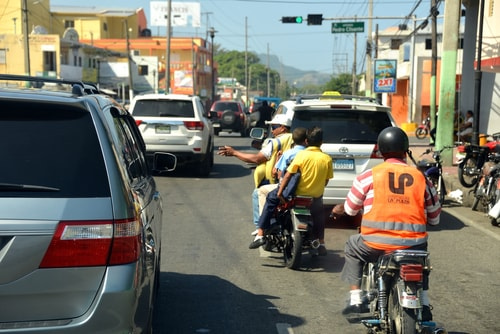
Motorcycles are an essential part of everyday transportation in the Dominican Republic. They’re economical, practical, and often the easiest way to get around.
But they’re also easy to miss.
One thing I repeatedly emphasized to my daughters was never to assume there’s nothing beside you, especially on the right.
Before turning, check your mirrors, signal early, check your blind spot, and look again.
A motorcycle may have moved into that space since you last checked. The same applies when changing lanes or pulling away from the curb.
Look twice.
It takes a second and could save someone’s life.
Know Where Your Tires Are
This is one of those driving habits that can make a surprising difference.
Many drivers tend to position their vehicle with the driver’s side wheels relatively close to the centerline.
On some Dominican roads, I’ve found it better to give myself a little more room from oncoming traffic.
But there’s a balance.
Move too far toward the shoulder and you may encounter pedestrians, motorcycles, drainage ditches, broken pavement, or potholes.
The important thing is knowing exactly where your tires are traveling and maintaining a safe position within your lane.
Pay attention to the road surface ahead, not just the vehicle in front of you.
Slow Down. You’ll Get There.
Speed makes a tremendous difference in both your ability to avoid an accident and the severity of one if it happens.
The faster you’re traveling, the less time you have to react. And the consequences of a collision increase dramatically with speed.
Here, road conditions can change quickly.
A motorcycle might emerge from a side street. A vehicle might stop unexpectedly. A pedestrian might step into the road. A pothole might be hiding in the shadow of a tree.
None of these situations is particularly unusual, and all are easier to deal with when you’re traveling at a reasonable speed.
I’m not suggesting everyone should crawl along at 20 kilometers per hour. Just drive at a speed appropriate for the road, traffic, and visibility.
Arriving five minutes earlier isn’t worth the risk.
Your Car Needs Attention, Too
The Dominican Republic can be hard on vehicles. Heat, humidity, rough roads, potholes, and frequent short trips all take their toll.
Batteries are one example. High temperatures can shorten their useful life, and the last thing you want is to find yourself stranded with a dead battery.
Have yours tested periodically, especially as it gets older.
Tires deserve just as much attention.
Between the heat, road surfaces, and occasional sharp debris, they can wear or become damaged faster than you might expect.
Fortunately, we have plenty of gomerías, the neighborhood tire shops that can repair punctures and replace tires without costing a fortune.
I’ve found places like David Tire in Sosúa, along with numerous smaller gomerías, useful for tire repairs and replacements.
And if money is tight, remember that decent used tires are often available.
A properly inspected used tire with good tread can be a reasonable temporary alternative to continuing to drive on dangerously worn tires. Just make sure it’s the correct size, isn’t too old, and has no structural damage.
New tires are preferable when you can afford them, but whatever you do, don’t ignore bald or damaged tires.
Especially during the rainy season.
A Dashcam Might Be Your Best Witness
I’d recommend investing in a dashcam, preferably one that records both front and rear.
If you’re involved in an accident or a dispute over a traffic violation, video footage can help establish what actually happened.
It’s not a guarantee that a dispute will be resolved in your favor, but it’s better than relying entirely on conflicting accounts.
Make sure it’s recording properly, the memory card works, and the date and time are correct.
A camera that wasn’t recording isn’t much use.
Know the Law and Carry Your Documents
Dominican Law 63-17 requires drivers to be properly licensed and motor vehicles to carry valid insurance.
Keep your driver’s license, vehicle registration (matrícula), and proof of insurance available. Make sure your annual vehicle tax sticker (marbete) is current when required.
If you’re visiting, verify that your foreign license is valid for your circumstances. If you’re living here, check the requirements for obtaining a Dominican license. INTRANT provides a conversion process for eligible foreign residents.
It’s also worth reviewing your insurance coverage. The legally required minimum may not provide the protection you’d want after a serious accident.
And the basics still apply. Wear your seat belt, put the phone down, and never drive impaired. If you’re drinking, arrange a designated driver or another safe way home.
These are responsibilities we should all understand, regardless of where we learned to drive.
Leave the Road Rage at Home
This is especially important for visitors and expats.
Driving in the Dominican Republic may be different from what you’re used to back home. Traffic moves differently, driving habits vary, and occasionally your patience will be tested.
But remember, if you’re visiting, you’re a guest in this country. You can’t expect everyone to drive the way they do in your hometown.
Don’t shout, make threatening gestures, chase someone down, or try to teach another driver a lesson.
You don’t know who you’re dealing with, and a moment of anger can turn into something much more serious.
I’ve lived here for years, and I still get frustrated occasionally. But getting angry has never made traffic move faster or another driver behave better.
Let them go. Give yourself some space and carry on.
You might have the right of way, but being right isn’t worth getting hurt over.
Don’t Assume. Anticipate.
I’ve had accidents here despite years of practicing defensive driving.
You can do everything reasonably well and still find yourself in a situation you couldn’t entirely control.
Defensive driving doesn’t make you invincible. It simply improves your chances of avoiding trouble.
And I’ve also seen tremendous kindness on Dominican roads. People stop to help strangers, drivers make room for one another, and complete strangers work together to get a broken vehicle off the road.
There’s a lot to appreciate about driving here, from the beautiful scenery to the freedom of exploring this remarkable country.
But the roads demand your attention.
Whether you’re Dominican, an expat, a tourist, or someone who has just rented a car for the first time, the same principles apply.
It Starts With Us
We can complain about traffic, motorcycles, road conditions, and other drivers all day long.
But ultimately, we can only control how we drive.
When I taught my daughters to drive, I wanted them to understand that driving is a responsibility. Every time you get behind the wheel, your decisions affect not only your own safety but also the safety of everyone sharing the road.
That’s true in the Dominican Republic, and it’s true everywhere else.
So I’ll leave you with the same advice I’ve been giving for years.
Drive like everyone else is trying to kill you.
Not because they are, but because anticipating the unexpected, leaving yourself room to maneuver, and paying attention to everything around you gives you a much better chance of getting home safely.
And that’s the whole point.
⸻
I’ve shared a few lessons I’ve learned driving in the Dominican Republic. What would you add? Whether you’re Dominican or an expat, I’d love to hear your best advice for staying safe on our roads.