
Are there venomous snakes in the Dominican Republic? Veterinarian explains what to do in case of a bite.


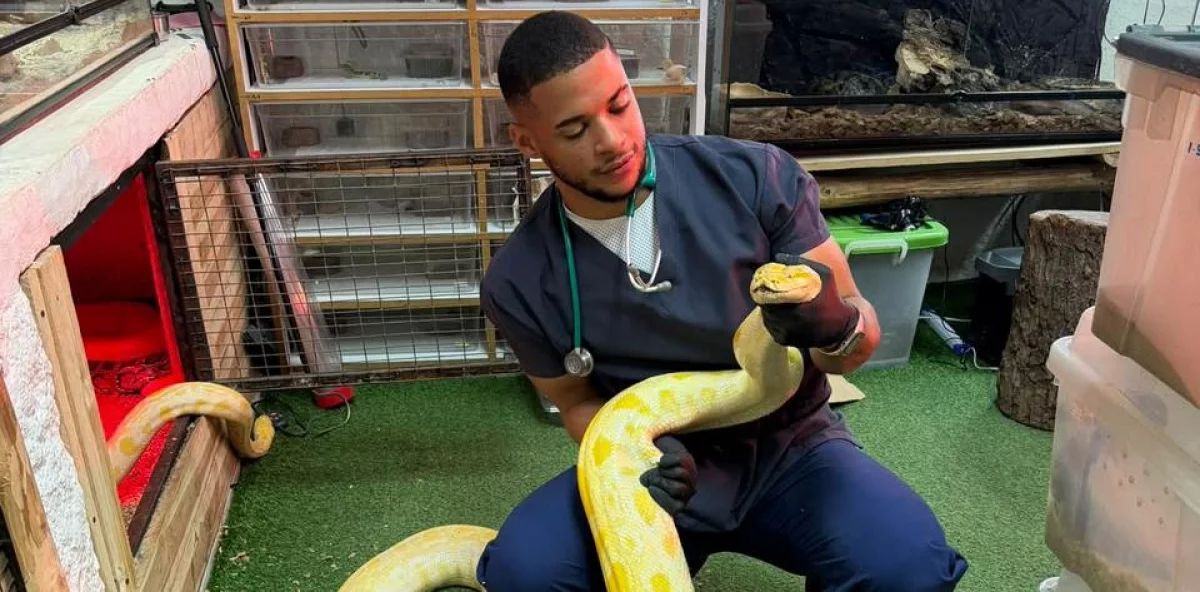
A snake ? Run! That’s probably the reaction of many people who come face to face with one. And if, after the initial shock, the question arises of whether it might be poisonous.
Dr. Miguel Smith Cardona, a veterinarian specializing in wild animals, explained to the newspaper Hoy that there are no reptiles of medical importance in the country.
“In the Dominican Republic we do not have venomous snakes of medical importance to humans, that is to say, we do not have true vipers, rattlesnakes or coral snakes capable of producing potentially fatal poisoning as occurs in other countries of America,” the specialist explained.
The clarification comes in light of International Snakebite Awareness Day, which is commemorated every September 19 and seeks to draw attention to the risks associated with snakebites.
What kind of snakes do we have?
The fact that there are no medically important venomous snakes in the country does not mean that these reptiles are not present.
According to Smith Cardona, there are approximately 25 species of snakes in the Dominican Republic.
These include the Hispaniolan boa (Chilabothrus striatus), Ford’s boa (Chilabothrus fordii), the graceful boa (Chilabothrus gracilis), the green vine snake (Uromacer oxyrhynchus), as well as other species of the genera Uromacer and Hypsirhynchus.
Also present are the Hispaniolan racer (Haitiophis anomalus), the Hispaniolan dwarf boa (Tropidophis haetianus), and several species of blind snakes of the genus Typhlops.

Photo provided by Dr. Miguel Smith Cardona
Therefore, there are boas, racers, vine snakes, small dwarf boas, and blind snakes, with different characteristics and behaviors.
But can they bite?
Yes. Although they are not medically significant poisons, some may bite if they feel threatened, are restrained, or are cornered.
“The Hispaniolan, Ford’s and gracile boas are constrictors and do not possess venom; their bite would be mainly mechanical, with small wounds, bleeding and pain,” the veterinarian explained.
In other species, reactions may vary.
Smith Cardona explained that some snakes of the genus Uromacer possess rear fangs and secretions that they use to immobilize small prey. In humans, he indicated, they can cause mild local reactions such as burning, numbness, or swelling, although they are not considered medically significant.
Racers, such as Haitiophis and several species of Hypsirhynchus, often try to flee and may bite if grabbed or cornered . Dwarf boas, on the other hand, are small and inconspicuous, while blind snakes of the genus Typhlops are tiny and subterranean.
What to do if a bite occurs?

Photo provided by Dr. Miguel Smith Cardona
The fact that there is no risk of life-threatening poisoning does not mean that a bite should be taken lightly.
“In boas and other non-venomous snakes, the bite would mainly produce wounds, pain, bleeding, and local inflammation,” explained Smith Cardona.
Therefore, in the event of a bite, it is recommended to wash the area well and receive medical evaluation, due to the possibility of contamination or infection.
The specialist also makes an important point: not all species would cause exactly the same reactions. While in boas the injury would be primarily mechanical, some snakes can cause only mild local discomfort.
Regarding behavior, Smith Cardona points out that snakes do not usually chase or attack people.
“In all cases, the predominant behavior towards humans is to flee or defend oneself, not to pursue or attack people,” he stated.