
Community members in Las Lavas, Santiago, report health problems and demand a halt to mining activity


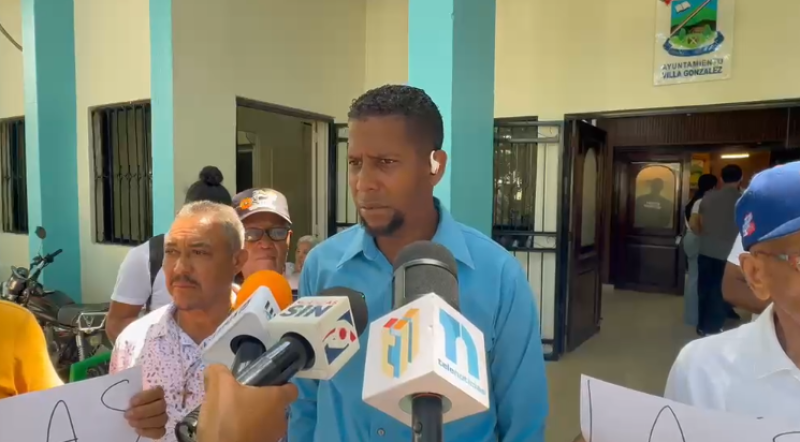
Dust, respiratory illnesses, and concerns for children’s health are among the main complaints of residents of Las Lavas, in the municipality of Villa González, Santiago, who are demanding a halt to mining activities taking place near the community.
Community members claim that, in recent months, at least five people have died, allegedly due to the environmental conditions of the area, although it has not yet been officially established that these deaths were caused by mining activity.
During a security meeting led by the Deputy Minister of the Interior and Police, Ángela Jáquez, Mayor Cesar Álvarez, members of the General Directorate of Traffic and Land Transportation Security (Digesett), and other authorities, residents presented their concerns to representatives of the authorities and people linked to mining activities.
Rubén Darío Peña Lendóf, president of the community movement Unidos por Las Lavas, stated that in the vicinity of the community there are more than 20 points of extraction of materials in an area that, he said, does not exceed one square kilometer.
“We have more than 20 mines in less than one square kilometer,” said Peña Lendóf, who assured that the operations extract sand, gravel and stones from the hills near the community.
Public Health Survey
The complaints from community members were accompanied during the meeting by the results of a survey conducted by the Ministry of Public Health in the area.
Dr. Rafael Polanco, from the Provincial Directorate of Public Health of Santiago, explained that the survey was conducted through face-to-face interviews and included 486 people from the families evaluated.
Among the reported conditions, respiratory allergies accounted for 56%, followed by the common cold at 46.7%, bronchial asthma at 31.3%, rhinitis at 30%, and chronic obstructive pulmonary disease (COPD) at 26.7%. Dermatological conditions, tonsillitis, conjunctivitis, gastroenteritis, and cancer were also reported.
The report also recorded respiratory distress in 63.3% of responses and chronic respiratory illness in 66.7% of responses. Public Health clarified that these two indicators correspond to different questions on the survey and should not be interpreted as equivalent.
In that regard, Polanco emphasized that the survey was not conducted through phone calls, but directly with the residents.
“The survey was done face-to-face, meaning we didn’t call people by phone without knowing who we were surveying, questioning, or investigating.”
They are calling for the mines to be closed.
For the residents, the survey results confirm the concern they have held for years about the environmental conditions in Las Lavas, which has about 2,016 people, according to a census conducted by the community members themselves.
Peña Lendof argued that the dust generated by mining operations has changed residents’ daily lives.
“We can’t eat at the table, we can’t rub ourselves with a clean sheet, we can’t bring a family member to visit us, because they want to leave right away; their clothes get dirty with dust. You can’t breathe,” she said.
Residents are demanding that the authorities also investigate the permits for the operations, since, according to the leaders, around 90% of the mines do not have the proper permits, a claim they attribute to an inspection carried out in collaboration with an Environment commission.
Measures Proposed
In response to the complaints, Vice Minister Ángela Jáquez said that the objective of the meeting is to find solutions to the conflict and prevent the measures adopted from creating other problems.
Jáquez proposed that the City Council approve a resolution prohibiting trucks from entering and exiting during school entry and exit times, and that vehicles violating the provision be fined.
He also proposed the urgent development of an environmental remediation plan, with the participation of the involved actors and the Ministry of Environment, as the governing body in this matter.
“We need to start looking for serious solutions. There is no magic formula,” said Jáquez, who said he expects results to begin appearing in the community within three months.
The community members, however, maintain their demand that mining activities be halted. One of their representatives warned that if the authorities do not intervene within the next 15 days, they will call a 48-hour strike in Villa González.