
Dominican government approves RD$2.04 trillion State Budget for 2027


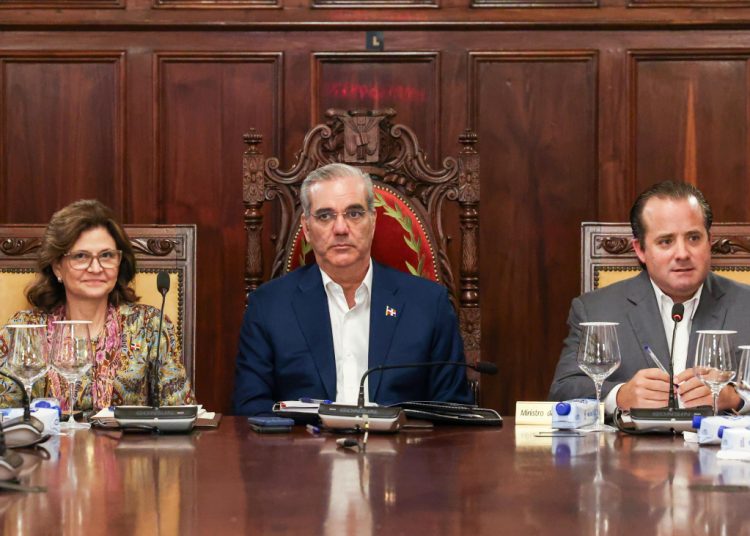
Santo Domingo.- President Luis Abinader and Vice President Raquel Peña led the 60th Council of Ministers meeting, where the General State Budget Bill for 2027, totaling approximately RD$2.037 trillion, was approved.
The proposal projects RD$1.51 trillion in revenues, equivalent to 15.7% of GDP, and a spending ceiling of RD$1.838 trillion, or 19.2% of GDP. The government’s macroeconomic framework estimates 4.75% real GDP growth and average inflation of around 4.5% in 2027.
Finance and Economy Minister Magín Díaz said the budget was prepared amid an economy that continues to show resilience, with growth of 4.5%, declining inflation and international reserves above US$15 billion.
According to Budget Director José Rijo Presbot, capital spending would increase 19.7% compared with the initial 2026 budget, while current spending would rise 12.3%.
The proposal prioritizes education, health, social protection, infrastructure, citizen and border security, and institutional strengthening, in line with the government’s Meta RD 2036 objectives.
Among the projects included are hospital construction and expansion, Primary Care Units, the National Emergency Network, highways, integrated transportation systems, drinking water and sanitation projects, housing improvements, the Santiago monorail, and increased capacity for Santo Domingo Metro Line 2.
The government also plans to maintain the allocation of 4% of GDP to education, supporting the Ten-Year Education Plan Horizon 2034, technical and vocational training, and expansion of the school transportation system.
The budget bill is expected to be submitted to the National Congress before October 1 for consideration.
Territorial planning bill
The Council of Ministers also reviewed a draft bill to establish the National Territorial Planning Plan as a legally binding framework.
The initiative, based on Law 368-22 on Territorial Planning, Land Use and Human Settlements, seeks to coordinate national, regional and municipal planning while promoting more sustainable land use.
The proposal incorporates environmental sustainability, risk management and climate-change adaptation into territorial planning, with the stated goal of protecting natural resources and improving the organization of human settlements.