
Emidom is still evaluating technology and costs for exploiting rare earths in Pedernales.


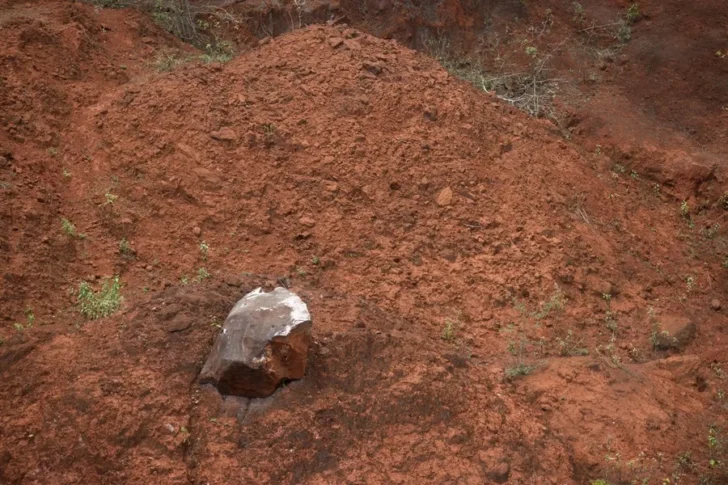
Miguel Díaz, vice president of Emidom, explained to ACENTO that the 150 million tons announced by President Luis Abinader are the project’s starting point, but its commercial exploitation will depend on completing several technical stages.
“Under the regulation, the material whose viability is demonstrated by these studies is declared a reserve, and on that basis an industry is built,” Díaz told ACENTO.
The project is being developed in the Ávila Mining Fiscal Reserve in Pedernales, under the guidance of the Emidom Board of Directors and in accordance with the international standard NI 43-101, which sets requirements for presenting technical and scientific information on mining projects.
Díaz stated that the “quality of the ore is backed by more than 5,000 samples analyzed in international laboratories,” and added that the company is still investigating how to process the material and will validate the selected metallurgical route on a pilot scale.

No defined investment costs
Emidom does not yet have a definitive figure for the cost of developing a rare earth mining operation in Pedernales, nor an estimate that would allow establishing the capital investment or the cost of extraction and processing per ton.
Díaz explained that these calculations will depend on resource certification and the definition of the processing route.
Both elements will form the basis of the feasibility study, whose results will allow evaluation of the viability of use.
“To announce a number before that study would be to report without evidence,” said the vice president of the state-owned company.
The country is investigating how to process the mineral.
The Dominican Republic still lacks a defined processing technology for the Pedernales deposit. According to Díaz, Emidom is conducting specific metallurgical research because of the material’s characteristics.
The vice president explained that it is a karst bauxite with its own mineralogy, so the technology used must be adapted to the deposit’s characteristics.
The company maintains technical exchanges with laboratories, research centers and technology providers in several countries.
However, Díaz said the selection of technologies and partners will depend on the results of ongoing studies and on criteria of transparency, legal compliance, and national interest.
The program also includes strengthening national analytical capabilities and training specialized personnel.
He added that the infrastructure will be sized based on technical results and must comply with the environmental and social criteria established by the Board of Directors.
Emidom envisions processing beyond extraction
The project is not limited to mineral extraction.
According to Díaz, the Board of Directors’ guidelines contemplate extracting and recovering rare earths and other critical minerals, under circular economy principles that allow evaluation of the use of the removed material.
Emidom assured that it is working according to the official schedule and will communicate progress when it is technically supported.
The company did not offer specific dates for the conclusion of the studies or for the start of a possible mining operation.
The Minister of Energy and Mines, Joel Santos, reported that the rare earth project is located about 30 kilometers from the tourist area.
In response to questions about global competition for control of critical minerals, especially in the context of China‘s influence in the rare earth market, Santos said the country is not seeking to enter geopolitical disputes.
“We don’t have to get involved in any battle. We are a sovereign country, and we work in the best interests of the Dominican Republic,” he said.
The minister reiterated that it is still too early to define the future exploitation model, as decisions will depend on the economic and technical feasibility studies underway.