
From Remittances to IP: The Dominican Republic’s next economic Play


By Jonathan Joel Mentor | @jonathanjmentor
The Dominican Republic does not have one economy. It has two.
The first is the one we know how to describe: tourism, free zones, construction, foreign investment and macroeconomic stability.
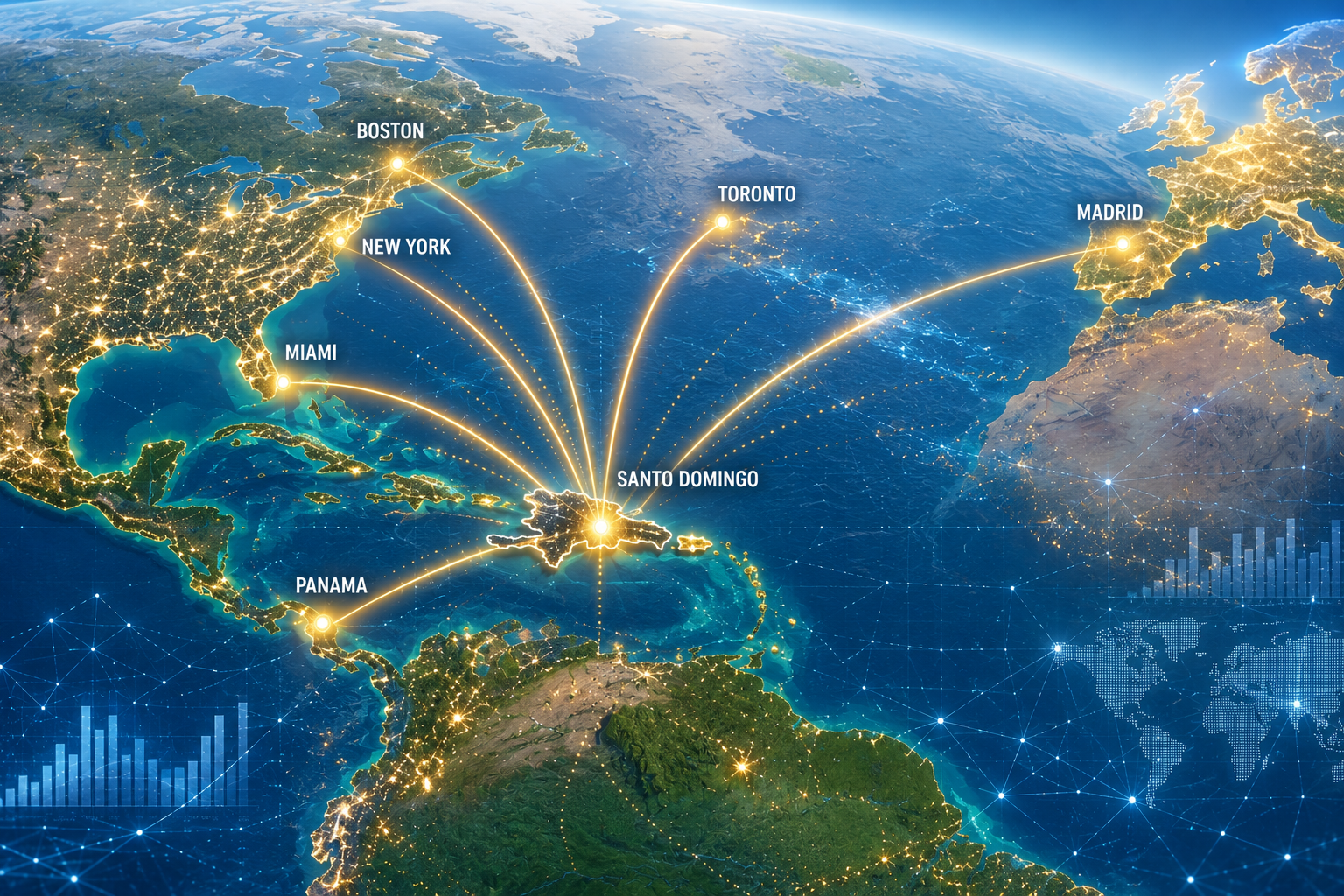
The second exists beyond Dominican territory. It lives in New York, Madrid, Miami, Toronto, Boston and Panama, inside the companies, universities, banks, hospitals and institutions where Dominicans abroad are learning, earning, building and operating.
We usually notice this second economy when the money arrives.
In 2024, remittances to the Dominican Republic exceeded US$10 billion. They supported households, education, housing and consumption across the country. Their importance is unquestionable.
But remittances show only the most visible part of the diaspora’s economic value.
Behind each transfer is a much larger reservoir of expertise, savings, credit, professional relationships and market knowledge. Nearly three million Dominicans live abroad, many of them embedded in some of the world’s most advanced economies.
Yet the Dominican Republic continues to treat this population primarily as a source of cash, culture and political symbolism.
We celebrate the transfer while ignoring the machinery that produced it.
That may be one of the greatest blind spots in the country’s current economic strategy.
THE SUCCESS OF THE OLD MODEL
The Dominican growth story deserves respect. The country has expanded faster than much of Latin America and the Caribbean, reduced poverty and built a larger middle class. Tourism, free zones and construction have created jobs, infrastructure and foreign exchange.
This is not an argument against that model. It is an argument that the model has a ceiling.
Much of Dominican growth has depended on accumulating more capital, labor, hotel rooms, buildings and industrial capacity. That can continue producing activity, but it cannot indefinitely substitute for stronger productivity, better institutions and the creation of assets the country owns and can scale internationally.
The vulnerabilities are already visible. Human-capital outcomes remain weak. Climate exposure threatens infrastructure. Energy costs continue to burden the economy. Institutional uncertainty discourages more sophisticated investment. Many talented Dominicans still leave because they believe their ambitions will move faster elsewhere.
The country is therefore caught in an awkward position: too successful to present itself as a marginal economy, but too dependent on traditional sectors to claim that it has become a knowledge economy.
Another hotel will create value. Another tower may generate wealth. Another outsourcing operation may provide jobs.
But none of them answers the central question of the next Dominican decade: What does the country intend to own?
A DISTRIBUTED DOMINICAN REPUBLIC
The diaspora is often discussed as though it sits outside the national economy, connected mainly through remittances and occasional visits. A better interpretation is that the Dominican Republic has developed a distributed professional class operating inside other countries’ institutions.
Dominican engineers are building financial and technological systems in the United States. Dominican product managers in Spain are developing services used across Europe and Latin America. Dominican executives in Miami and Panama are managing logistics, finance and regional trade.
This capacity is real, but barely visible in Dominican economic statistics.
A software product created jointly by a developer in Santiago and a data scientist in New York may generate foreign revenue and own valuable technology, yet remain outside the categories through which Dominican institutions understand production and exports.
The country has produced, partly through migration, a global base of talent and market access.
Economically, it still treats that base like an offshore emergency fund. That is convenient. It is not strategy.
REMITTANCES ARE CASHFLOW, NOT CAPITAL STRUCTURE
Remittances are essential. They reduce hardship, stabilize households and bring foreign currency into the economy. But they are not ownership.
A Dominican professional works inside a foreign company, using foreign infrastructure and intellectual property, then transfers part of the resulting income home. The Dominican Republic benefits from the distribution of value, but usually does not own the company, platform or technology that produced it.
The more important question is whether the country can convert diaspora income, expertise and relationships into productive assets: companies that export, intellectual property that can be licensed and regional systems that generate recurring revenue.
The Dominican Republic has become highly capable of receiving money from its diaspora. It has not yet become equally capable of building with it. That distinction separates an economy that is sustained from one that is transformed.
THE EXPORTS WE DO NOT KNOW HOW TO COUNT
Dominican exports are still imagined largely in physical terms: agriculture, manufactured goods, tourism and free-zone production.
But the next generation of exports will not always fit inside a container, hotel room or industrial park.
Software, algorithms, data products, licensing rights, digital platforms and proprietary systems can be built across several countries and sold repeatedly without being tied to one location.
Once these assets are recognized as Dominican exports, the geography of production changes.
A founder in Santo Domingo, an engineer in New Jersey and a commercial strategist in Madrid can co-own the same product, sell it across several markets and generate hard-currency revenue.
This matters because ownership is where long-term economic power accumulates. A country cannot build a knowledge economy merely by attracting foreign companies that own knowledge. It must also produce enterprises and institutions capable of owning knowledge themselves.
This is where the shift becomes politically and institutionally uncomfortable. Physical assets are visible. They can be permitted, inaugurated, photographed and controlled through familiar networks.
Intellectual property is harder to see. It can move, scale and remain in the hands of people who are less dependent on domestic gatekeepers.
The challenge is therefore not only economic. It is a question of who gets to own the next growth model.
WHY THE SYSTEM PREFERS CEREMONY
If the opportunity is so clear, why has it not become central to national development strategy?
Because the current arrangement satisfies nearly every institution involved.
The Central Bank measures remittances. Consular institutions protect citizens abroad. Government agencies organize diaspora events. Political leaders celebrate Dominicans overseas.
These activities have value.
But the diaspora is still treated more often as an audience, constituency or source of support than as a co-author of industrial policy, a supplier of technology or an investor in productive assets.
That distinction preserves the existing balance of power. The ceremony is easy to control. Authorship is not.
Inviting a successful Dominican executive to speak at a conference is straightforward. Giving that executive influence over an investment vehicle, export strategy or corporate innovation mandate is another proposition entirely.
The first provides visibility. The second redistributes authority. No conspiracy is required. Institutional incentives are enough.
FROM RECOGNITION TO ARCHITECTURE
A more serious model begins by formally recognizing diaspora-backed intellectual property as Dominican economic production.
If the country does not classify these assets, it cannot measure, finance or promote them.
National export and innovation strategies should explicitly include software, algorithms, data products, digital platforms and other intellectual assets. Institutions should track not only how many startups are created, but how much Dominican-owned recurring revenue is generated abroad and who owns the underlying intellectual property.
The next step is to build credible investment and commercialization vehicles.
Diaspora investors are still too often approached through patriotic language: support your country, help your community, invest in Dominican entrepreneurs.
Sentiment may open the door, but it cannot replace governance, risk discipline or returns.
A modern diaspora investment facility could combine guarantees, revenue-based financing, professional management and co-investment from development institutions and private capital. Its purpose should be to support companies producing exportable intellectual property, not merely redirect more diaspora savings into real estate or traditional small businesses.
The third requirement is to turn major Dominican institutions into buyers.
Banks, insurers, telecommunications companies, logistics groups, universities and public agencies should be commissioning products with Dominican professionals abroad.
A bank could build risk infrastructure with Dominican data specialists in New York and Madrid. An insurer could develop climate products with Dominican actuaries across several markets. A logistics company could create regional systems with Dominican operators embedded in Caribbean trade corridors.
These should not be framed as charity, sponsorship or ecosystem support.
They should be commercial mandates with budgets, executive owners, procurement pathways and measurable results.
The diaspora becomes part of the productive economy when it enters the value chain—not when it is added to a guest list. Finally, diaspora operators must be placed inside the rooms where capital and priorities are determined.
The country does not need another ceremonial council. It needs qualified founders, investors, engineers and executives participating in investment committees, export strategy and digital-infrastructure planning. This is not about replacing local talent.
It is about connecting capabilities that geography and bureaucracy currently keep apart.
THE CHOICE AHEAD
The Dominican Republic does not need to abandon tourism, construction, free zones or foreign investment.
But countries do not secure their future by defending only what already works. They do so by identifying the next source of advantage before everyone else does.
The diaspora is already producing knowledge, managing complex systems and building inside international markets. The productive base exists. What remains missing is the architecture connecting that capacity to Dominican ownership.
The country can continue celebrating the success of Dominicans abroad after that success has been created elsewhere.
Or it can build the institutions, investment vehicles and commercial relationships required to participate in creating that value from the beginning. The Dominican Republic already exports talent.
The danger is that it will continue exporting people while importing the platforms, systems and intellectual property those same people later help someone else build.
Markets will not wait for Dominican policy to catch up.
Neither will capital. And intellectual property does not need permission to leave. The question is not whether a global Dominican knowledge economy will emerge. It is already emerging. The question is who will own it when it does.
—————————————————————-
Jonathan Joel Mentor is the CEO of Successment and architect of the Digital Nomad Summit™, scaling startups and challenging institutions to evolve. UN World Summit Award Nominee & ADOEXPO National Excellence in Exportation Award Winner www.jonathanjmentor.co | digitalnomadsummit.co