
Human capital: Does the Dominican Republic have what it takes to respond to new investments in high technology?


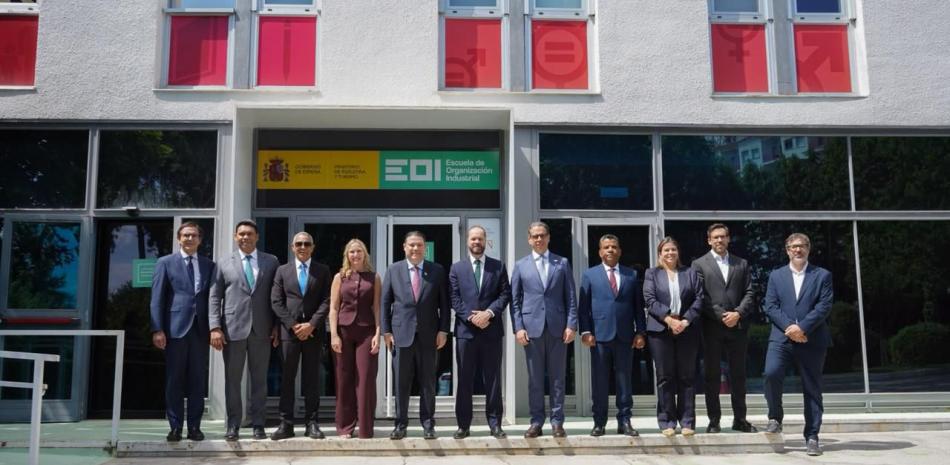
When Spanish businessmen asked the Minister of Industry, Commerce, and SMEs if the Dominican Republic has the human capital to sustain a semiconductor industry, Eduardo “Yayo” Sanz Lovatón answered without hesitation: “We do.”
But behind that sense of security lies a more complex reality. One that the Government itself acknowledges in its policies and that the figures from the Dominican university system reflect as an initiative still in progress.
However, during his visit to Madrid, Spain, where he met with numerous Spanish businesspeople, the minister presented a plan to persuade potential investors to invest in sectors beyond tourism.
The program, developed with the support of the Ministry of Women, will be delivered in a blended learning format with seven online modules and a final in-person module in Santo Domingo. Training areas include women’s leadership, project management, digital transformation and Industry 4.0, quality management, and the circular economy.
“With this alliance, the Dominican Republic and Spain reaffirm their cooperative ties, promoting female talent as a key driver for the 4.0 industrial transformation,” said Sanz Lovatón during the signing.
The agreement with EOI is not accidental in its approach. Although women are the majority in Dominican universities, they remain a minority in STEM fields: of the 91,163 students enrolled in these areas in 2024, 64,893 are men, and only 26,270 are women, according to data from the Ministry of Higher Education, Science and Technology (Mescyt).
The EOI scholarships are not the Government’s only initiative. Yayo highlighted progress on the National Strategy for the Promotion of the Semiconductor Industry (ENFIS), with partnerships ranging from Dominican universities to US institutions.
The challenges
The initial question is not insignificant. Semiconductors, the chips that power everything from cars to artificial intelligence data centers, require engineers and technicians.
specialized, physicists, mathematicians, and, in general, profiles that are not the ones that produce the most in the Dominican university system today.
According to data from the Ministry of Higher Education, Science and Technology (MESCyT) for 2024, total higher education enrollment in the Dominican Republic reached 520,524 students. Of that total, STEM (science, technology, engineering, and mathematics) fields accounted for only 91,163 students, approximately 17.5%.
The most popular fields of study continue to be Medicine, Law, and Accounting. According to a study by the National Association of Young Entrepreneurs, only 12% of young people enroll in high-employability, high-paying fields, namely STEM and languages.
For Sanz Lovatón, the strategy is clear: if investments in semiconductors and advanced manufacturing materialize, the job market will send clearer signals to young people about what to study. “The nature of these technologies is that they are constantly changing. So we continue to create opportunities to prepare our people,” he concluded.