
Judges hang up their robes and caps during a nationwide work stoppage


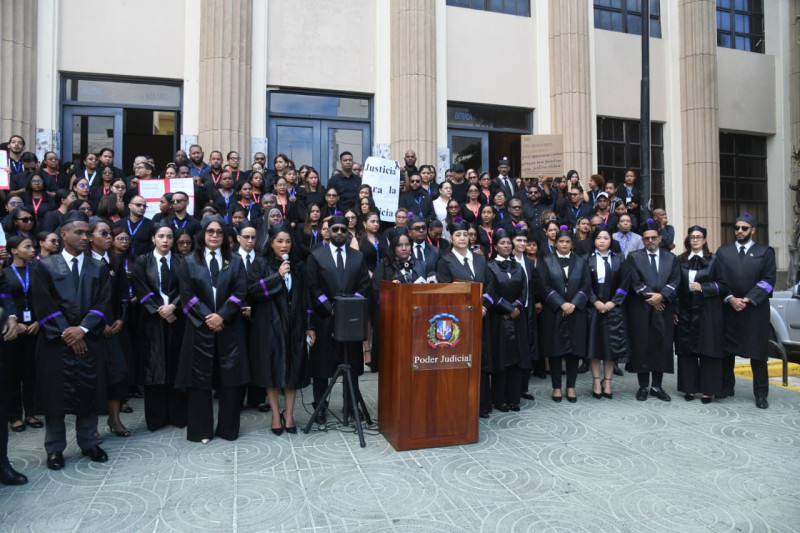
Santo Domingo — Nearly 400 judges from different jurisdictions nationwide hung up their robes and caps yesterday, Thursday, while other judicial employees stood with their arms crossed, demanding a profound transformation in their working conditions and remuneration.
The justices of the peace, of first instance, and of appeal courts, after reading a manifesto in each jurisdiction, canceled the hearing schedules, except for the Permanent Attention courts, which allowed hearings on coercive measures.
The nationwide work stoppage was called by the Association of Judges of the Dominican Republic (Asojurd), the Network of Judges of the Dominican Republic, the Association of Dominican Judges for Democracy (Judemo), the Association of Justices of the Peace, and judges independently of the unions that called for it.
The historic day of peaceful protest included the unanimous reading of the “Manifesto for the Dignity of Justice” under the slogan “Let dignity begin at home!” in the Palace of Justice of Ciudad Nueva, the Judicial City of Santo Domingo East, the Real Estate Jurisdiction, and in the various Palaces of Justice of the country.
Prior to the reading of the manifesto, in the different jurisdictions, the National Anthem and the Anthem of the Judicial Power were solemnly sung, an act in which the judicial servants, dressed in black and carrying signs with phrases alluding to the protest, among them the phrase “justice for justice,” stood out.
At the Palace of Justice in Ciudad Nueva, the manifesto was read by Magistrate Suinda Brito, who mentioned among the precarious situations the critical lack of personnel, which causes a single magistrate or employee to assume the workload of up to three or four people.
He also mentioned the completely outdated salaries in light of the high cost of living and the enormous responsibilities of their positions, as well as the massive resignations of administrative staff due to chronic exhaustion.
Similarly, severe neglect of the physical plants of multiple courts and a lack of protection in the courthouses.
They argue that justice cannot be sustained solely by the vocation, personal sacrifice, and individual commitment of those who operate the system, since it requires material, human, and salary resources to provide timely, efficient, and impartial service.
The most critical point of the complaint lay in the glaring economic disparity within the Judiciary, criticizing the fact that while the courts operate with basic deficiencies, the internal management spheres handle million-dollar budgets for travel, lodging, restaurants, advertising, events, and influencers.
They cited as an example that certain secretaries or employees at the top earn administrative salaries that far exceed those of any sitting judge.
The work stoppage was supported by the Bar Association, various legal professionals’ associations, and jurists, including Carlos Olivares.
Olivares expressed his firm support for the strike called, describing the magistrates’ salary situation as unacceptable.
He emphasized the need to support the judicial sector, noting that it is high time they stopped earning miserable wages and being disrespected.
Prosecutors express support
Likewise, the Dominican Association of Prosecutors (Fiscaldom) expressed its support and solidarity with the work stoppage, demanding salary improvements and other demands aimed at strengthening the justice system.
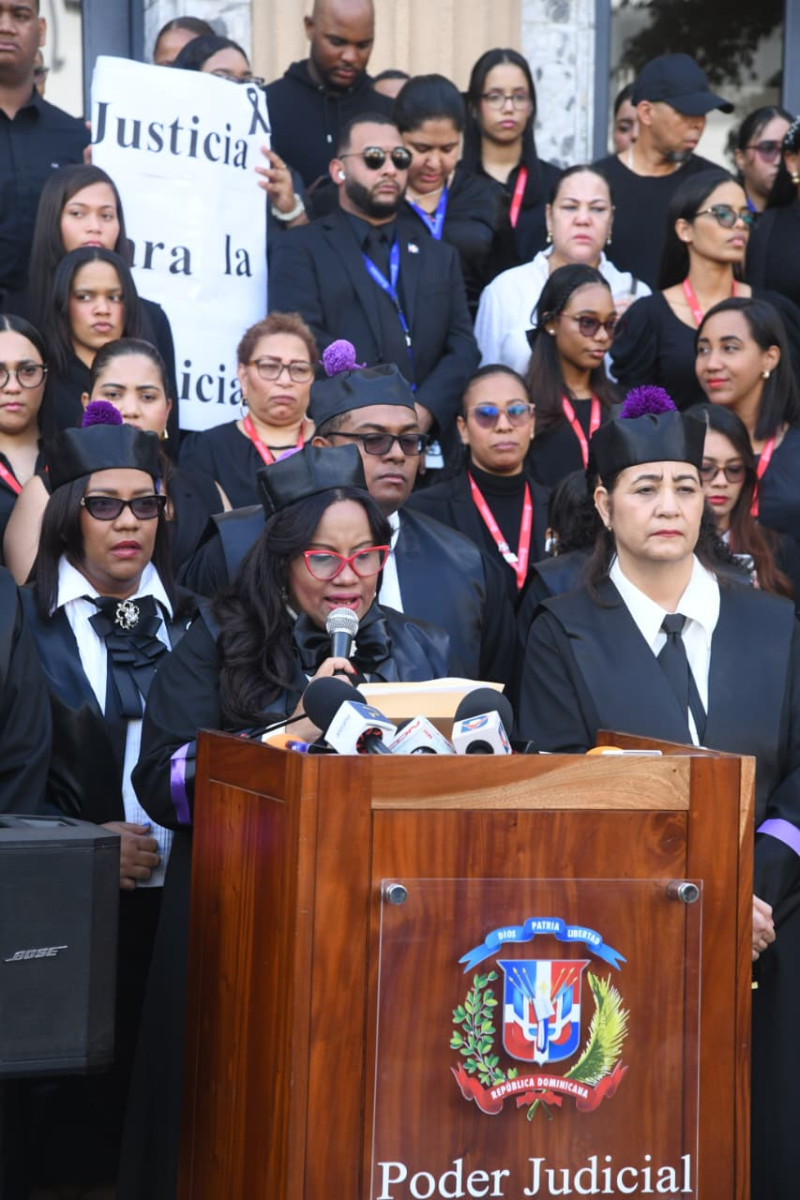
The judges read a manifesto under the slogan “Let dignity begin at home!” LEONEL MATOS/LD
He affirmed that he recognizes the right of organizations to file claims and make demands aimed at improving the working, salary, and institutional conditions of public servants, always within respect for the legal framework and the principles of social democracy and the rule of law.
The entity reiterated its support for the judges’ aspirations and emphasized the importance of ensuring dignified conditions for those in the judicial system, as this contributes to institutional strengthening and better delivery of justice.
Fiscaldom also urged the competent authorities to promote spaces for frank, respectful, and timely dialogue that allow them to address the demands presented and move towards fair and sustainable solutions for the benefit of the entire justice system.
They join in Santiago
The area outside the Palace of Justice in Santiago was dressed in black this Thursday, as dozens of judges, court staff, and lawyers gathered to support the national strike demanding improved working conditions within the Judiciary.
Representatives from different jurisdictions united under slogans opposing excessive workloads, wage inequality, and what they describe as the “industrialization of justice,” resulting in the cancellation of around 200 hearings.
During the demonstration, judges recalled that the Judicial Council first responded to the group’s demands on May 19th. However, they described the proposals as “vague, conditional, and ineffective.”
They explained that the proposal includes a salary indexation subject to approval by the Ministry of Finance, without defined dates or clear implementation mechanisms. They also pointed out that judicial mobility was reduced to a “roadmap” without concrete measures.
The judges also complained that issues such as horizontal substitution, salary inequalities generated by the current remuneration manual, and mobility within the administrative career remain unanswered.
Under the slogan “let dignity begin at home,” the protesters also questioned the management of resources within the judicial system.
In that regard, they pointed out that the Judiciary has spent more than RD$400 million on international air tickets and accommodations since 2021, while they claim that structural and salary deficiencies persist within the courts.
They also denounced the institutional silence regarding more than 18 communications sent by judges since May 2021, requesting solutions to various problems.
Despite the work stoppage, the judges assured that urgent services would continue to operate normally. They indicated that the single-judge courtrooms, the Second Court of Instruction, and the Permanent Attention Office would remain open.
Among the main demands raised are a lack of staff, a shortage of judges, low salaries, excessive workloads, mass resignations among administrative employees, deterioration of judicial infrastructure, and deficiencies in security within courthouses.
The protesters said they remained open to dialogue, although they warned that further actions could occur if they did not receive concrete answers from the Judicial Council.