
Strong wave of uncertainty in the country and South America due to the migration pact with the U.S.


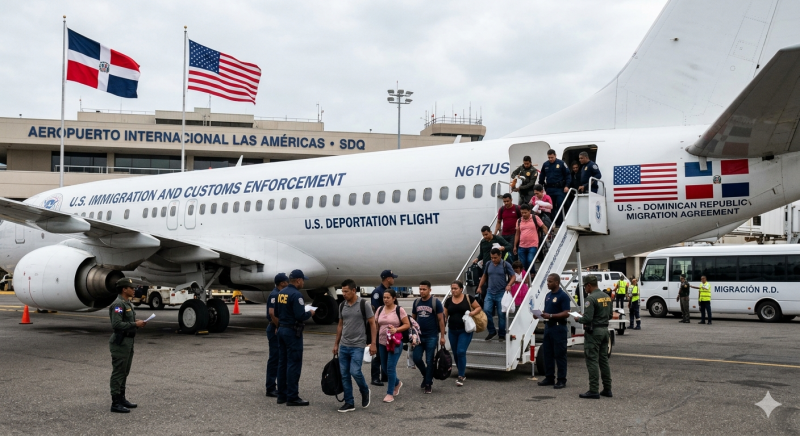
Santo Domingo, Dominican Republic— The signing of the recent migration agreement between the Government of Luis Abinader and the United States, which allows the transit and temporary entry of foreign migrants, has generated strong social unrest in the Dominican Republic, and this wave of uncertainty has also crossed borders, reaching Panama, Costa Rica, and Ecuador.
In these countries, partners in the Alliance for Development in Democracy (ADD) fear that painful injuries to national integrity will occur, a feeling that has already stirred the fibers of Dominican patriotism.
While the administrations of this quartet try to convince their citizens that they will apply a shield to the pact under the pretext of “national security” and “strategic stability,” a strong popular outcry has risen in the streets and in public opinion, demanding the protection of sovereignty and the monitoring of human rights.
It is no secret that the national debate on this issue has entered the deepest political sphere, brought to the forefront, and with increasing firmness and severity, analysts and civil sectors are concerned about whether the region, including the country, is heading towards subordination, becoming a “pawn” of the United States in the hemisphere.
Following the signing of these agreements, the popular reaction in Panama, Costa Rica, and Ecuador has been diverse, ranging from relief over security controls to deep concern about sovereignty and human rights.
A reading of the reactions collected by the national and international press in these countries after the signing of the migration pacts makes it clear that the governments of the signatory countries have a serious problem convincing their citizens of the feasibility of their decisions.
Costa Rica, which agreed to receive up to 25 deported migrants of various nationalities per week from the U.S. to process their return, has had the most immediate reaction, similar to that of the Dominican Republic, since it signed a similar agreement in March of this year.
The internal reaction there has been highly polarized. Thus, while the Government defends the pact as a sign of being a “strategic ally,” police unions and human rights groups have questioned the lack of operational resources to manage these flows.
Costa Rican media see the Dominican agreement as a validation of their own Government’s strategy, consolidating a bloc of “transit recipient” countries in the Caribbean and Central America.
For its part, Panama views the Dominican agreement from a national security perspective, having achieved historic milestones in reducing the flow through the Darien Gap in early 2026.
The Panamanian administration, which already has its own memorandum with the United States for repatriation flights financed by Washington, welcomes other countries in the region assuming shares of responsibility in the processing of migrants.
Panama recently received interceptor boats and technological support from the United States. For that country, the Dominican Republic’s agreement helps to alleviate the rising migratory pressure from the south by offering return options before migrants re-enter irregular migration routes.
Under Daniel Noboa’s Government, Ecuador has maintained a de facto rapprochement with the Dominican Republic. During May 2026, the two countries are negotiating a Partial Trade Agreement. This explains the official Ecuadorian reaction to the migration issue and provides it with strong diplomatic support.
Although Ecuador has not signed a “deportation transit” agreement as explicit as those of the Dominican Republic or Costa Rica, local media highlight that Noboa seeks to consolidate the Abinader Government as his key ally for regional stability.
In all cases, including those of the Dominican Republic, Panama, and Costa Rica, the United States covers 100% of the costs, which their governments see as a way to strengthen their migration agencies without affecting the national budget.
Analysts from these countries argue that by accepting these memoranda, the four signatories, including the United States, differentiate themselves from less cooperative regimes in the region, obtaining in return benefits such as inclusion in the Global Entry program, as in the Dominican Republic, or investments in infrastructure.
The big debate in the media of Panama, Costa Rica, and Ecuador, and already on the lips of the Dominican people, is whether these countries are becoming “safe third countries”, in fact.
Governments, such as the Dominican Government, insist that the presence of deportees here will be “temporary transit.” At the same time, the political opposition in the other three countries also warns of possible risks to sovereignty.
Besides the fact that it is unknown why the deportees will not be sent directly to their countries of origin, it is also unknown how long their temporary stay will last, where they will be housed, and what disciplinary rules they will have to follow.
Meanwhile, the public reaction in those three countries has been mixed. On the one hand, there has been relief at the return of security control, and on the other, deep concern about sovereignty and human rights.
The Government’s positions and the details of the debate surrounding this memorandum, as explained by Foreign Minister Roberto Álvarez in press conferences and in an institutional video, clarify the agreement’s non-binding and temporary nature.
Trying to calm public opinion, the Ministry of Foreign Affairs has explained that the pact does not apply to Haitians, people with criminal records will not be admitted, and unaccompanied minors are “totally excluded”.
Nor does it make the country a permanent recipient of refugees; migrants in transit will not enter the Dominican immigration system, nor will they be able to request refuge here, and each case and profile will be evaluated and authorized by the Dominican authorities before setting foot on the territory.
It establishes that deportees will arrive in a controlled, temporary transit condition, not for settlement, for citizens of third countries who have been deported from the United States.
The people transferred will remain on Dominican soil for only a few days while flights and logistics are coordinated to return them to their countries of origin.
The Government maintains that the agreement is not legally binding and can be unilaterally canceled by either party at any time. Therefore, the Government argues that it does not require approval from Congress or the Constitutional Court.
In contrast, civil society, opposition groups, and geopolitical analysts denounce a lack of transparency, as they were not consulted in advance by Congress, and warn about the logistical pressure, operational costs, and the risk of subordinating national sovereignty to the United States’ agenda.