
Temporary Camú River passage reconnects Santiago and Puerto Plata amid bridge reconstruction


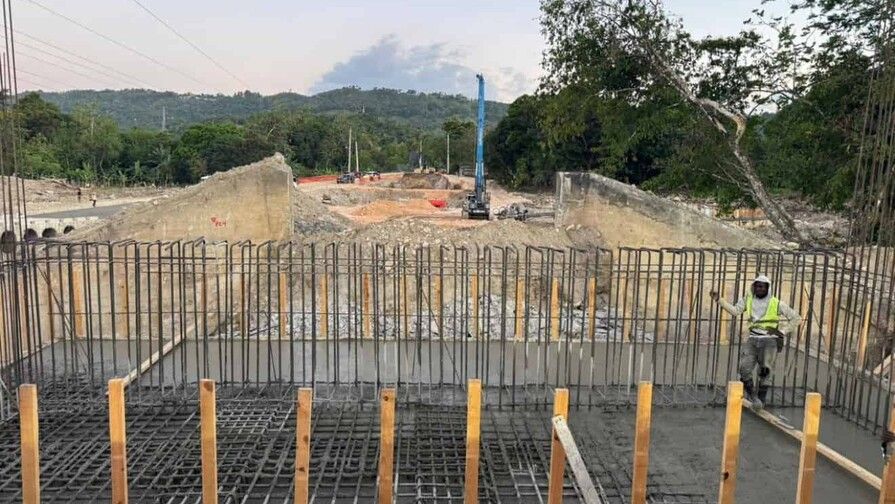
Santo Domingo.- The Dominican Republic’s Ministry of Public Works and Communications (MOPC) has enabled a temporary detour over the Camú River in Yásica to restore traffic flow between Santiago and Puerto Plata through the scenic Tourist Highway, while construction advances on a new permanent bridge following the collapse of the previous structure earlier this year.
The temporary solution, which opened Monday afternoon, consists of a two-lane concrete ford built parallel to the new bridge currently under development. The measure is intended to ease transportation disruptions along the important Santiago–Puerto Plata corridor, a key route for tourism, commerce, logistics, and residential connectivity in the country’s northern region.
Authorities said construction crews are operating around the clock, seven days a week, in an effort to accelerate completion of the permanent structure. According to the MOPC, foundation piles for the bridge’s abutments and support piers have already been completed, while fabrication of structural beams has surpassed 40% progress. Reinforcement and concrete work continue simultaneously across the project site.
The original Camú River bridge collapsed in April after severe rainfall and flooding caused unusually strong river currents in the area. Officials had reportedly closed the bridge prior to the collapse as a precautionary measure, preventing injuries or fatalities.
The loss of the crossing significantly affected transportation between Santiago and Puerto Plata, forcing motorists and cargo operators to rely on longer alternative routes through Navarrete, increasing congestion and travel times. The disruption also impacted tourism-related activity and communities that depend heavily on the Tourist Highway corridor.
In response, the government ordered the immediate demolition of the damaged structure and commissioned the construction of a completely new bridge designed to meet higher engineering and flood-resilience standards. The new infrastructure is expected to span approximately 135 meters and serve as a long-term solution for one of the region’s most strategic transportation links.
Technical investigations into the collapse were also launched by the National Office of Seismic Evaluation and Vulnerability of Infrastructure and Buildings (ONESVIE), while public works officials continue emphasizing that the project remains a national priority due to its economic importance for the northern coast and tourism sector.