

The Santiago Monorail: the hidden side of a multi-million dollar investment


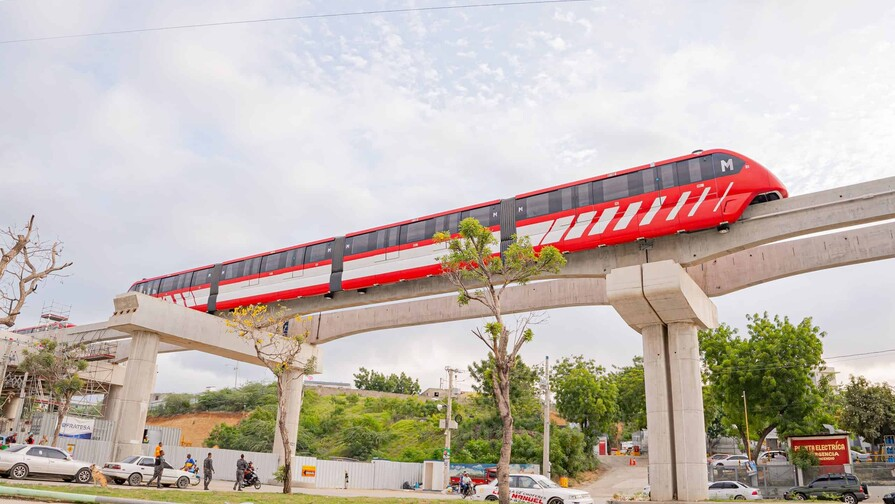
A recent opinion piece highlighted the benefits of Santiago’s Monorriel: modernity, urban transformation, reduced travel times, and an improved city image. This is the project‘s public face, the one promoted by its supporters.
But every major public investment has another side: how it was decided, what alternatives were evaluated, how much it cost initially, how much it costs today, when it was supposed to end, and who assumes the risks when the project is delayed or becomes more expensive.
That’s the fundamental issue. It’s not about denying that Santiago needs modern public transportation. It’s about asking whether this was the best solution for the general public interest, or whether the city ended up adapting to technology, contracts, and business interests that were already predetermined.
1. The visible narrative : modernity and urban promise
The Santiago Monorail has been presented as a landmark project for the city: modern, visible, and capable of transforming urban mobility. Its promoters highlight the reduction in travel times, its integration with the cable car system, and its positive impact on Santiago‘s image.
And elevated railway infrastructure indeed conveys a sense of modernity and progress. That’s the visible face of the project and the one that usually dominates the public debate.
But large public investments should not be evaluated solely on their visual or symbolic impact. They should also be analyzed in terms of planning, costs, financial sustainability, and the alternatives that could have been considered before committing billions of dollars in public resources.
That’s where the other side of the coin begins.
2. The uncomfortable question: public interest or a conditional solution?
The central question is not whether the monorail works as a technology. The question is different: was it chosen because it was the best solution for Santiago, or because it best fit a pre-existing technological, business, and financial offering?
In best practices for public investment, the mobility problem is defined first, alternatives are compared, and finally, the most suitable solution is chosen. In this case, the available information suggests a reverse process: a technology defined early on, separate contracts, external financing, and a city forced to adapt to the project.
When that happens, the public interest is compromised. Not because all business involvement is negative, but because businesses must serve the public project, not replace the planning that is the responsibility of the State.
3. Planning, demand, and the forgotten alternative
An urban transport project of this magnitude should not be based on technology but on the actual demand for mobility. First, the number of people traveling, their origins and destinations, their travel times, and the required level of service are identified. Then, possible solutions are compared: articulated buses, dedicated bus lanes, cable cars, trams, subways, or monorails.
That comparison must be made using the same yardstick: initial investment, operation and maintenance, replacements, required subsidies, urban impact, construction risks, and future capacity. It’s not enough to say that a project is modern or that it will carry many passengers.
When that evaluation is not published in full, the decision ceases to be verifiable. And a public investment of this scale cannot rely solely on official statements.
The PIMUS 2019 study, conducted by the Spanish company IDOM and financed by the IDB, did not propose an isolated project but rather an integrated network for the entire city. It began by modeling Santiago‘s mobility, identifying corridors with the highest demand, and sizing the supply according to the key parameter in urban transport: passengers per hour in each direction.
The results were clear: the busiest trunk corridors saw peak-hour traffic of around 1,150–1,300 passengers per hour in each direction, with a maximum of nearly 1,400. With these levels of demand, the technically reasonable alternative was not an oversized rail system but higher-capacity buses, including articulated ones, operating in dedicated and semi-dedicated lanes.
The plan envisioned a trunk-feeder network with main corridors and feeder routes capable of covering a significant portion of the city and expanding gradually as demand increased. The estimated investment was around $471 million, including fleet, stations, fare collection, and road improvements.
The monorail, on the other hand, concentrates a much larger investment in a single corridor and offers a declared capacity of 20,000 passengers per hour in each direction, far exceeding the demand that the base study itself had identified for Santiago.
4. Separate contracts , encapsulated technology , and increasing cost overruns
The contract for the Santiago Monorail was structured into separate packages. First, the civil works were awarded in March 2022 to the Santiago Monorail Transportation System Consortium (CSTM), made up of Grupo Estrella and Sofratesa, for 25,028 million pesos, equivalent at the time to about 450 million dollars.
That was the original amount of the civil works contract. However, significant modifications to the project have subsequently been made, including adjustments to the route and the construction of a tunnel to bypass the Santiago Monument area. All of this will likely lead to significant increases in the final cost of the project, although the updated consolidated amount is not yet publicly available.
The technological components included: rolling stock, electromechanical systems, signaling, telecommunications, power supply, and commissioning. This second phase was directly awarded, without a new competitive public bidding process, to the French companies Alstom and Sofratesa, for an amount of approximately 500 million euros.
And that’s where one of the project‘s most delicate aspects comes in: technological encapsulation. When a civil engineering project is built first and designed for a specific railway technology, the electromechanical system supplier is no longer truly competing on a level playing field. The infrastructure itself dictates clearances, beams, stations, interfaces, and technical requirements.
In practice, the first contract ends up defining the second. The State loses room to compare technologies, review alternatives, or negotiate better economic and operational conditions.
Thus, a project that was initially presented as costing around $450 million for the civil works has evolved, according to later official statements, towards figures close to $1,200–$1,300 million, concentrated in a single corridor of the city.
5. Eighteen months on contract, more than forty-eight in reality
The civil works contract for the Santiago Monorail originally stipulated an 18-month execution period. The contract was awarded in March 2022, and according to that schedule, the main works should have been completed between the end of 2023 and the beginning of 2024, after which testing and operation would begin.
However, the reality has been quite different. Public statements from Fitram (Trust for the Development of the Mass Transit System of the Dominican Republic) and its executive director have repeatedly pushed back the projected completion dates. Initially, the end of 2025 was mentioned, then the first quarter of 2026, and subsequently operational testing and trial runs toward the end of 2026.
A significant part of these delays seems to be explained by the fact that several fundamental elements of the project remained open after the award: detailed engineering, interferences, land release, urban adjustments, and institutional coordination.
And that point is important. In large urban rail projects, when the complete technical specifications are not finalized before contract award, the risks of modifications, time extensions, and subsequent cost overruns increase significantly.
The problem isn’t just the delay. The problem is that each additional year of construction and commissioning also increases the financial, operational, and fiscal costs ultimately borne by the State.
6. Trust , fragmented contracting , and insufficient traceability
The Santiago Monorail also reveals an institutional problem. Fitram operates as a public trust and manages resources allocated to mass transit, but this structure should not lower the transparency standards required for any public investment.
When a project is divided into packages—civil works, electromechanical systems, rolling stock, supervision, financing, and operation—traceability becomes more complex. Therefore, it is essential to clearly publish the updated total cost, contracts, addenda, quantities, adjustments, current schedule, risk matrix, and associated fiscal commitments.
Transparency isn’t demonstrated simply by stating that the trust is audited. It’s demonstrated by allowing citizens to trace the entire flow of public funds: how much was contracted, how much has been paid, how much remains to be paid, what was modified, why it was modified, and who assumes each risk.
Without that information, the debate gets caught between official propaganda and general criticism. And an investment of this magnitude needs much more than trust: it needs verifiable public accountability.
The Santiago Monorail project is not an isolated case. It is part of a wave of investment and debt in public transportation, driven in recent years by multilateral loans, sovereign guarantees, public trusts, and large technology contracts associated with urban rail systems. These schemes include projects such as the expansion of the Santo Domingo Metro, urban cable cars, and monorails in Santiago and Santo Domingo.
The problem isn’t investing in public transportation. The problem is doing so without publishing, with the same rigor, the comparative studies, timelines, risk matrices, updated costs, and tax obligations that would allow us to verify whether these investments are effectively solving mobility problems or simply accumulating public debt and visible infrastructure.
7. Santiago needed a system , not a technological showcase
The debate isn’t whether the monorail will be a visible, modern, or eye-catching structure. It almost certainly will be. The question is whether it was the best solution for Santiago, given its final cost and the available alternatives.
A city doesn’t need infrastructure to admire, but rather systems that work, integrate neighborhoods, reduce travel times, are financially sustainable, and can grow with real demand. That was the logic behind the IDB/IDOM study: a comprehensive, phased network tailored to the mobility needs of the entire city.
The Santiago Monorail illustrates what happens when technology ultimately trumps planning. The visible aspect is an elevated train. The hidden side is a multi-billion-dollar investment, concentrated in a single corridor, with escalating costs, delays, and unanswered questions.
Santiago deserved more than an iconic building. It deserved a better-planned, better-compared, and more transparent public decision.


Oh, to have the benefit of hindsight. It is always easy to look back and say, if we had known then what we know now, we might have done something different.
With a project the magnitude of what is written, there should be no question or reason to settle on the argument that hindsight is 2020 perfect, A project of this magnitude required planing , planing and more planing, so that one one can say oops ! in hind site ! in planing you address all the issues mentioned with no room for error, the only thing that can change your outcome after extensively planing it, is an “Act of God” clause hurricane, flooding,, earthquake or a revolution or simply you didn’t have the money to start in the first place… but that takes years of planing and it seems they sacrificed years of planing for a quick fix, for very expensive eye candy !
when you plane for Eighteen months on contract, more than forty-eight in reality that is called a disaster , probably from the lack of planing…. the feasibility study flew out the window a long time ago ! it probably went from a good project to very bad economic decision to build, but guess what they have a shinny new thing up there and lets just pray it works and is safe.
I hope they budgeted for safety inspection s and regular maintenance even if its not performing as planned
Hello, I do not doubt the figures of PIMUS of 2019, but without naming the trunk, which had 1400 ppdh, we can not compare it to the recent route. Yes, 18 months (for civil works, I guess) was very ambitious, if You do not have any experience with this type of track construction before. But wishes of the politics are commonly too ambitious. And in this case, there was several serious changes in routing and type of track (e.g. tunneling the monument) after contract signing, which was for sure ending in an expansion of construction time. Which, of course, happened. The success of the system will be dependend on an intelligent system of feeder buses, which connect the monorail stations to outside neighborhoods in the same frequency as the trains are running.