
Today marks 67 years after June 14: the feat that broke the dictatorship from within


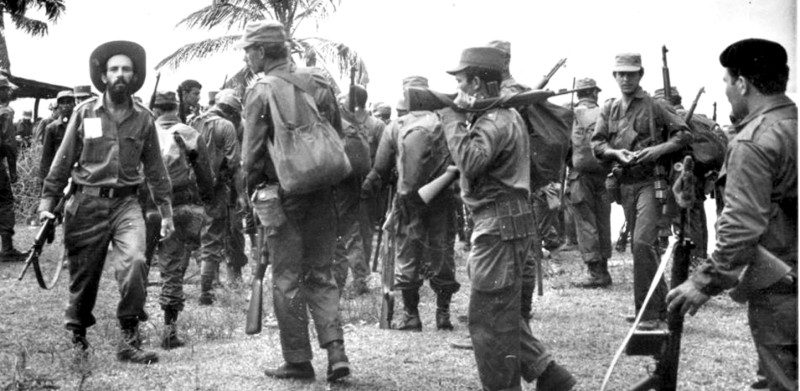
Santo Domingo — Sixty-seven years ago, the Constanza, Maimón, and Estero Hondo expedition took place. This historic event sowed the seeds of rebellion and awakened the people’s conscience, later giving birth to the revolutionary movement led by Manolo Tavárez Justo.
The story told in books, anecdotes, and journalistic accounts was consulted to recall the patriotic action undertaken by the expeditionaries, who are remembered for a feat that marked the country’s return to democracy.
At approximately 3:00 p.m. on Sunday, June 14, 1959, a Curtiss C-46 cargo plane took off from a runway in El Aguacate, Cuba. It had been painted with the colors and insignia of the Dominican Air Force to enter the country without raising suspicion. It was piloted by Captain Juan de Dios Ventura Simón, a former member of Trujillo’s Air Force, and 54 armed men accompanied.
This group of men was diverse. Along with the Dominican commander, Enrique Jiménez, Moya traveled fighters of various nationalities: Cubans, Venezuelans, Puerto Ricans, Spaniards, Americans, and a Guatemalan. Young men with different ideologies and circumstances had come together around a common goal: to overthrow Rafael Leonidas Trujillo, who had ruled the Dominican Republic for 29 years.
According to the accounts, the complete plan involved more than just that one plane. Two speedboats, named Carmen Elsa and Tinima, had set sail on Saturday, the 13th, from the La Chiva dock in Punta Arena, Nipe Bay, Cuba. On board were another 144 expeditionaries who were supposed to disembark on June 14 at Maimón and Estero Hondo, on the northern coast. Ultimately, they did not land due to sabotage and bad weather, arriving six days late.
The plane landed on time at a small airstrip in Constanza. At that moment, the soldiers on guard weren’t expecting any flights, and the initial confusion worked in the newcomers’ favor. Records indicate there was a confrontation with the patrol, several soldiers and an officer were killed, and the expedition members managed to disembark with heavy backpacks on their shoulders, just as the aircraft left the area to return to Cuba.
Meanwhile, in Santo Domingo, dictator Trujillo reacted by deploying some 3,000 soldiers, along with trucks and airplanes. At dawn on June 15, Constanza became a war zone due to bombings by the Dominican Air Force. While the Government attacked, the expeditionaries fled into the mountains to evade the constant bombardment.
Six days later, the boats finally reached land. The Carmen Elsa landed at Maimón, with a group led by José Horacio Rodríguez, and the Tinima landed at Estero Hondo, commanded by José Antonio Campos Navarro. The landings were met with resistance from the Army and Air Force, with the deployment of an additional 3,000 soldiers. There were no survivors from the maritime front.
After the military forces’ attack ended, the regime triumphantly emphasized that it was “the peasant people” who had defeated the expeditionaries with simple machetes, clubs, and even stones.
At that time, a huge campaign was launched around that image: heroic songs, merengues, poems, contests, rallies. But the reality was quite different. A good number of the expeditionaries were captu”ed and “el”minated” in the torture centers maintained by the Trujillo regime.
The survivors can be counted on one hand. Those who survived were the Dominicans Poncio Pou Saleta, Mayobanex Vargas, and Francisco Medardo Germán, and the Cubans Delio Gómez Ochoa, a veteran of the Sierra Maestra, and Pablito Mirabal, a teenager.
As a military event, the expedition was a complete defeat. As a political event, it had a profound impact on groups opposed to the Government. The brutal repression unleashed against the members of the June 14 Movement generated widespread outrage, increasing the already existing levels of discontent against the regime.
Between 1959 and 1960, a group of young people began to organize quietly. Led by Manolo Tavárez Justo and Minerva Mirabal, who took their name from that expedition, they gave birth to the June 14 Revolutionary Movement (1J4), which became one of the most important political forces in the country in the following years and one of those that contributed to the end of the regime.
As one of the reminders of that feat, Law 264-97 was created, which declared June 14 as the Day of the Immortal Race, and the Mausoleum of the Center of Heroes guards the remains in Santo Domingo.