 Smaller
 Bigger
ISFODOSU students showcase future of education at 5th Scientific Research Congress
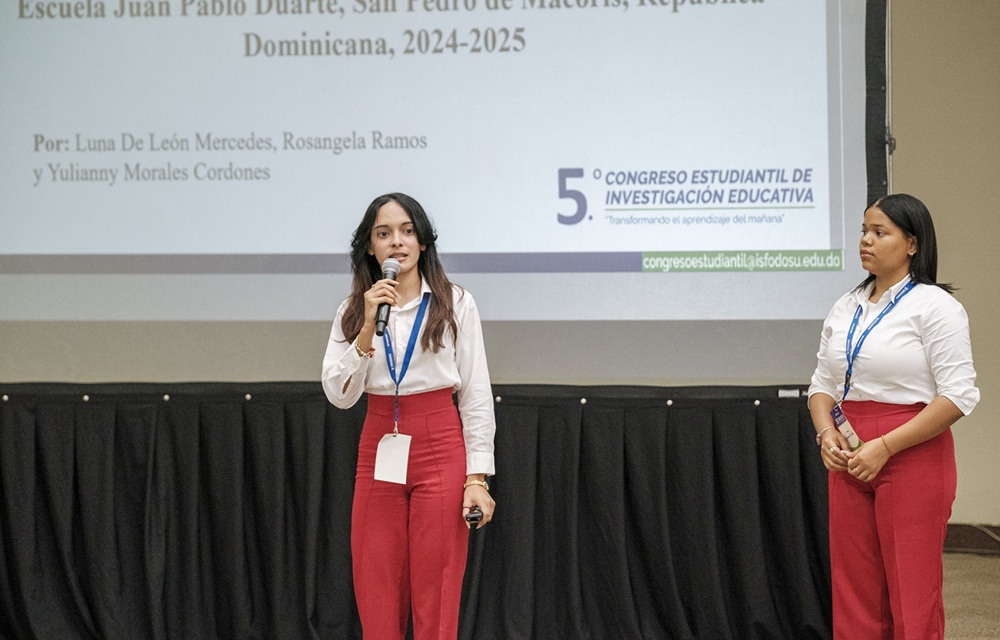

Santo Domingo.- Over 400 students from various campuses of the Instituto Superior de Formación Docente Salome Ureña (ISFODOSU) gathered for the 5th Annual Student Scientific Research Congress, themed “Transforming Tomorrow’s Learning,” on July 29, 2025. The event featured 148 presentations and more than 30 poster displays, all focused on innovative approaches to education.
The research was organized into six thematic areas: Physical Education, School Sports, and Healthy Lifestyles; Innovative Teaching Strategies for Social Sciences, Spanish, and Arts; Pedagogical Strategies for Inclusive Education; Innovations in Mathematics and Natural Sciences; and the Integration of Technology and Pedagogy in Teacher Training. The congress aims to foster critical thinking and research skills among undergraduate students through collaboration and the exchange of knowledge.
Research Highlights from the Host Campus (FEM)
The Félix Evaristo Mejía (FEM) campus, which hosted the event, presented two notable studies. One project, authored by Angely R. Sosa and Lauri Fabián Ferrer, explored “The Impact of Teacher Attitude on Academic Performance and Student Motivation.” Their findings demonstrated that a teacher’s positive and empathetic attitude is key to creating an environment that boosts student confidence and engagement, ultimately leading to improved academic and socioemotional outcomes.
Another research team, led by Carlos José Berroa Victorio, investigated “Artificial Intelligence and the Environmental Challenge: An Analysis of its Ecological Footprint.” The students highlighted the often-overlooked environmental costs of AI, such as CO2 emissions and the mining of rare minerals needed for its components.
Student wellness and teaching strategies at EMH
Students from the Eugenio María de Hostos (EMH) campus also made significant contributions. Hendy Rafael Del Villar presented research on “Ailments and Physical Activity in University Students,” which found that a significant number of students suffer from physical and emotional discomfort, including stress and sleep disturbances. The study suggested that promoting physical activity programs could help reduce these symptoms and improve overall well-being.
Additionally, students Gustavo Adolfo García Flores, Angel Antonio García Rodríguez, and Reynaldo Jesús Rojas Tavarez presented their work on “Pedagogical Strategies to Foster Acceptance Among Students in Physical Education Classes,” aiming to develop tools that increase student participation in PE.
Gamification and ethnobotany from JVM
The Juan Vicente Moscoso (JVM) campus showcased two distinct research topics. Yaderlyn Zorrilla and Joelvis Bautista’s study on “Gamification to Increase Motivation in Elementary School” revealed that incorporating games is an effective way to make learning more engaging and meaningful for young students. Another team, led by Katherin Esther Jhonson Jhonson and others, conducted an “Ethnobotanical Inventory of Medicinal Plants” in La Romana, documenting the common uses of various plants among the local population.
Literacy and Learning Styles at UM
From the Urania Montás (UM) campus, student Josué Manuel Mañón Casado presented his findings on the “Reading Comprehension Levels of 6th-Grade Students,” which showed that while students have strong literal comprehension, they struggle with inferential and critical reading.
Another team from UM, including Jazmín Brito Montero and Lisbeth Wildania Mateo, explored “Learning Styles in Future Educators.” Their research highlighted the importance of understanding and adapting teaching methods to predominant learning styles—visual, auditory, and kinesthetic—to ensure student success in higher education.
Geographic innovation and playful learning at EPH and LNNM
Students from the Emilio Prud’Homme (EPH) campus introduced a study on “Google Maps and Seterra for Developing Geographic Skills,” showing that integrating these digital tools transformed geography from a passive subject into an interactive and contextualized experience for high school students.
The Luis Napoleón Núñez Molina (LNNM) campus presented research on “Playful Activities to Foster Student Participation,” arguing that using games creates a protected and engaging environment for students. Additionally, another team from LNNM evaluated the “Efficacy of Plant Recognition Apps as a Learning Tool in High School Biology,” finding that apps like PlantNet and PictureThis were highly effective for supporting active and autonomous learning.