
 Smaller
 Bigger
Elidenia Velásquez’s new poems: a luminous confrontation with shadow
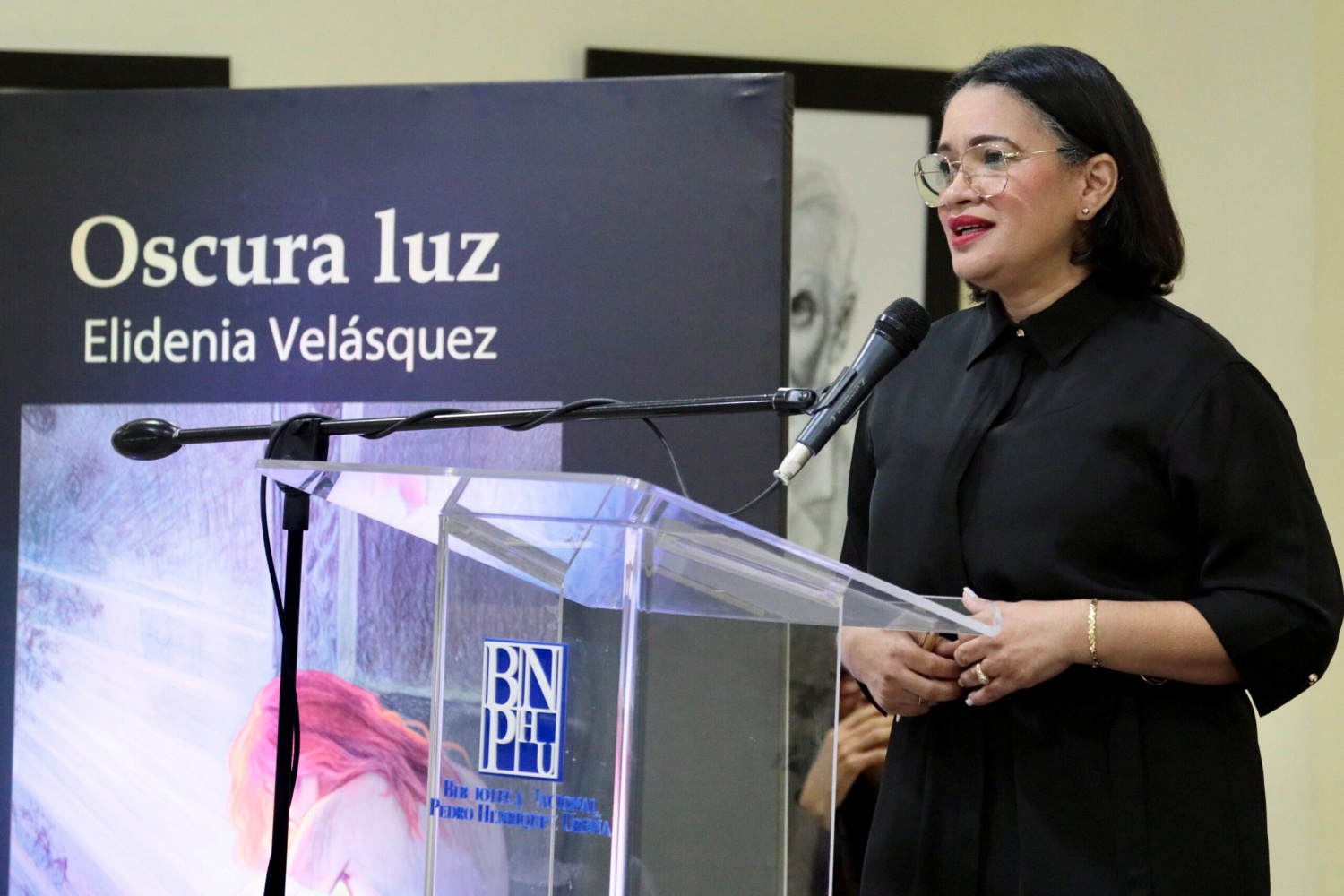
Santo Domingo.- Elidenia Velásquez presented her new poetry collection Oscura luz on 4 September at the Aída Cartagena Portalatín Hall of the Biblioteca Nacional Pedro Henríquez Ureña, in a well-attended launch organized by Río de Oro Editores. The reading brought together writers, critics and cultural figures and positioned the book as a notable entry in this season’s literary offerings.
Rafael J. Rodríguez Pérez, editor and president of Río de Oro Editores, opened the event with an essay titled La poesía, esa oscura luz que nos ilumina, in which he praised Velásquez’s clearer, more assertive voice and suggested that Oscura luz reads as a book of declarations rather than discreet hints. Bruno Rosario Candelier framed the collection as a work that “traverses darkness to shine with its own light,” an image that critics at the launch seized on to describe the book’s tense balance between shadow and illumination.
Published by Río de Oro within the Cierva Blanca series, Oscura luz represents Velásquez’s fourth poetry volume and her sixth book overall. The collection carries a prologue by Indhira Itsuki, a presentation by Candelier and an epilogue by Esteban A. Torres Marte; the cover, designed by artist Carla Baker, visually echoes the book’s oxymoronic title.
Velásquez, born in Villa La Mata (Sánchez Ramírez) in 1977, balances a parallel career in medicine: she works as a neurologist and university professor. This year she joined the Academia Dominicana de la Lengua as a corresponding member, a milestone that underlines her growing standing within the national literary canon and helps explain the strong institutional turnout at the launch.
Reviewers at the event highlighted the collection’s sustained amatory vein now cast in a firmer, more declarative register: poems that refuse easy consolation and instead insist on transformation by way of feeling. In that sense, Oscura luz consolidates Velásquez’s trajectory as a poet who mixes emotional intensity with formal precision, and it reaffirms her place among contemporary Dominican voices that bridge professional life and literary commitment