

 Smaller
 Bigger
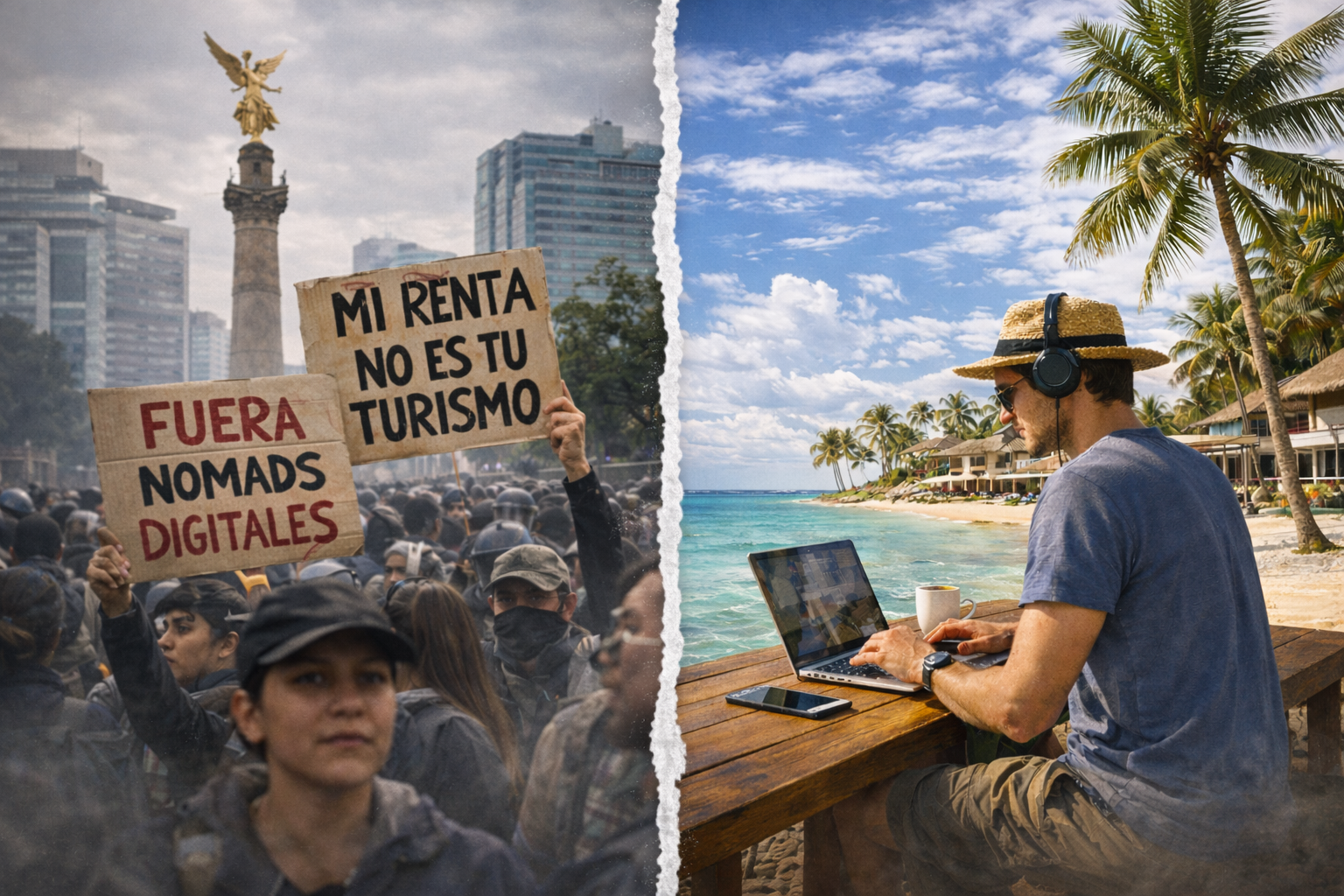
Mexico’s anti digital nomad backlash is Dominican Republic’s warning
By Jonathan Joel Mentor | @jonathanjmentor
Mexico City didn’t wake up one morning hating digital nomads.
The anger that’s now spilling into protests and community organizing didn’t start with a laptop on a café table. It started with a government that treated a global shift in how people work as a tourism niche, not as something that would rewire housing markets, neighborhood identities, and political patience.
Today, Mexico is the poster child for what happens when a country lets the “remote work boom” run on autopilot. If the Dominican Republic is paying attention, it should see one thing clearly:
We are not special.
If we copy the same laziness, we get the same explosion.
The fantasy that broke
For years, a simple story sold well in ministries and conference stages across the region: digital nomads are like tourists, just richer and with better cameras. Let them in, let the dollars flow, and the rest will sort itself out.
That fantasy works as long as nomads are a trickle.
Once they show up by the thousands, stay for months instead of days, rent housing instead of hotel rooms, and begin to reshape entire neighborhoods, the “tourist with a laptop” script collapses fast. Local residents don’t care what you call them. They care that their rent doubled in three years, their favorite spots turned into English-speaking bubbles, and their lives got more expensive without their incomes moving in the same direction.
Mexico is paying that bill now. The Dominican Republic is still pretending the invoice won’t reach us.
DR is already in the game — officially or not
Walk through Piantini, Punta Cana, parts of the Colonial Zone or Las Terrenas and you can already see the pattern: people who clearly don’t behave like tourists, who are here for quarters, not weekends.
They’re on Zoom at odd hours, negotiating salaries in currencies stronger than ours, paying premium rent through platforms the tax authorities barely see, and living on the thin line between “visitor” and “resident” that our laws never anticipated.
We can keep saying “we’re not like Mexico” if it makes us feel better.
But reality doesn’t care. Economically, we’re already in the same game:
- landlords quietly optimizing for foreign tenants,
- coworking spaces surviving on long-term foreign clients,
- local cafes and services recalibrating prices to what the dollar crowd will tolerate,
- government agencies still treating everyone as either tourist, formal expat, or ghost.
The difference between us and Mexico is not that they “went too far” and we have not. The difference is timing. They wasted years. We still have a small window left.
What actually went wrong in Mexico
It’s convenient — and wrong — to blame everything on nomads.
The real failure was institutional. Mexico never built an architecture to answer basic questions:
Who, exactly, is here?
For how long?
Where are they staying?
What pressure does that put on housing supply?
What obligations do they have to the cities they reshape?
Those questions were ignored until they became unignorable. At that point, neighborhoods were already transformed, resentment had already solidified, and politicians had to choose between doing nothing and overreacting. Neither path ends well.
A state that doesn’t measure, doesn’t govern. A state that doesn’t govern leaves the field to speculation, platforms, and improvisation. That is exactly what we are doing now.
What we should be building instead
If the Dominican Republic wants the upside of global talent without the street anger, it needs to stop pretending this is a branding problem and admit it’s a systems problem.
We need to know who’s here and why. That means a simple, digital registration for long-stay remote workers — not a bureaucratic odyssey, but a three-minute process that links migration data, basic income verification, and length of stay. If you choose to live and work here for months, the state should at least know you exist.
We need to decide what kind of housing market we want. If every “nice” neighborhood quietly converts half its inventory into short-term or medium-term rentals, don’t act surprised when Dominican middle-class families get pushed out. Mexico’s mistake wasn’t welcoming foreigners. It was letting housing turn into a free-for-all with no guardrails, until a social problem became a political one.
We need to think about integration as infrastructure. A nomad who spends six months here without ever collaborating with a university, a local company, a community space or a startup ecosystem is a lost opportunity. Every other country that is ahead of us — from Portugal to Costa Rica — learned that you either design integration or you get parallel cities: one where English is the default and everything feels “global”, and another where locals silently watch prices go up.
We need fiscal clarity. Not to punish people, but to avoid the gray zones that create resentment. A transparent, modest cost to participate in the Dominican system is very different from arbitrary enforcement or ignoring everything until the backlash arrives.
None of this is science fiction. It’s basic statecraft. We already build frameworks like this for tourism, for free zones, for investment incentives. The difference is that those policies were designed for an economy of factories, resorts, and containers — not for an economy where value travels on fiber, not in cargo.
Who designs the rules when talent moves faster than law?
This is the real question behind Mexico’s crisis and our own future: who gets to write the new rules when capital, work and people move faster than the legal code?
If the answer is “no one”, platforms will do it for us. The housing market will be managed by booking engines. Neighborhood composition will be decided by whoever can pay the most, with no regard for long-term residents. Our data will be collected, monetized and exported without any strategy.
If the answer is “the same people who designed our frameworks for all-inclusive resorts and industrial parks”, we will get an elegant PDF, a press conference, and very little that actually speaks the language of remote work, global risk, and digital infrastructure.
What we need is something that doesn’t exist yet: a Dominican institution that understands that innovation, mobility and data are now the same conversation.
Call it what you want — an office for transborder innovation, a national mobility and data council — but it needs teeth, not slogans. It needs access to BCRD, Migration, tax authorities, urban planners and the private sector. And it needs a clear mandate: make sure global talent strengthens the country instead of hollowing it out.
Why this matters now, not “one day”
It’s easy to say we’ll deal with all this “when the numbers grow more”. That is precisely how countries sleepwalk into crisis.
By the time protests appear, three things are already true:
– someone has been quietly getting very rich on the blind spots,
– someone else has been slowly squeezed out of their neighborhood,
– and the political system is suddenly forced to choose a side.
Smart states act while the tensions are still invisible. They don’t wait for anger to become a hashtag.
The Dominican Republic has a narrow but real advantage: we can still watch Mexico and treat it as a mirror, not a spectacle. The names of the neighborhoods are different. The dynamic is the same.
Where this conversation actually happens
This isn’t a hotel lobby discussion. It’s not an Instagram caption. It’s a negotiation about sovereignty, class, urban future and who gets to belong.
Over the next year, one of the few places in the region where this will be argued in the open — with investors, policymakers, founders and operators in the same room — is Digital Nomad Summit 2026 in Santo Domingo.
Not as a lifestyle panel. As a fight over what model this country chooses before the pressure gets loud.
Mexico is not a scandal to react to. It’s a draft of our own future if we stay passive.
The only real question is whether the Dominican Republic wants to become a case study in how to manage this wave—or just the next headline about a city that waited too long to admit the rules had changed.
Jonathan Joel Mentor is the CEO of Successment and architect of the Digital Nomad Summit™, scaling startups and challenging institutions to evolve. UN World Summit Award Nominee & ADOEXPO National Excellence in Exportation Award Winner www.jonathanjmentor.co | digitalnomadsummit.co
















Might be the best thing I have read here. Interesting!
Thank you. I appreciate your support.
Agreed!! Probably the most succinct description of what is happening and potentially about to happen without course corrections or controls. When is the summit?
The Digital Nomad Summit – Santo Domingo (DNS) is August 6-7 at Hotel Catalonia. More info at http://www.digitalnomadsummit.co
Garbage article
May I ask why? If you can point out the discrepencies, I can take a better look.
This article lays out the inept migration division of this gov. It is so broken. It takes me an entire 8 hour day in the capital, with my 20 year experience, to renew my residency temporal. That is with knowing what I need going into it. Some agents demand certain things that other agents previously did not. Laws change randomly from year to year and there is zero clarity on it. Take the marbete renewal for example. In 2026 its changing again. It will be a permanent marbete and you will just renew on the DIGISETT app year to year. Verification will be done by scanning a QR code. It may work out to be less of a headache however, theres always unforeseen issues when they change things like this. Oh and prices are double or tripling. This whole agency needs to be reformed and modernized at DGM.
These are exactly the type of topics I’ll be leading at the Digital Nomad Summit. Voices like yours matter if we are going to turn a conversation into action.
I agree. There needs to be a foreigner tax(similar to a sales tax) controlled by the government.
Prices need to be affordable for the locals as there income is not comparable. With the tax both the government and the merchant benefit.
I would also argue, that revenues raised from a Digital Nomad visa should contribute protecting local Dominicans most vulnerable to digital nomadism. I would also argue for structured intergration and collaboration between digital nomads and local entrepreneurs.
Jonathan@successment.co
Tax the digital nomads!
That would be counter productive to the entire concept. A Digital Nomad Visa is a more innovative way to generate revenue from Digital Nomads – only if it includes incentives for local integration and the revenue raised goes towards a public budget to shield locals most affected by Digital Nomadism.