 Smaller
 Bigger
Free Trade Zones generate more than 200,000 jobs
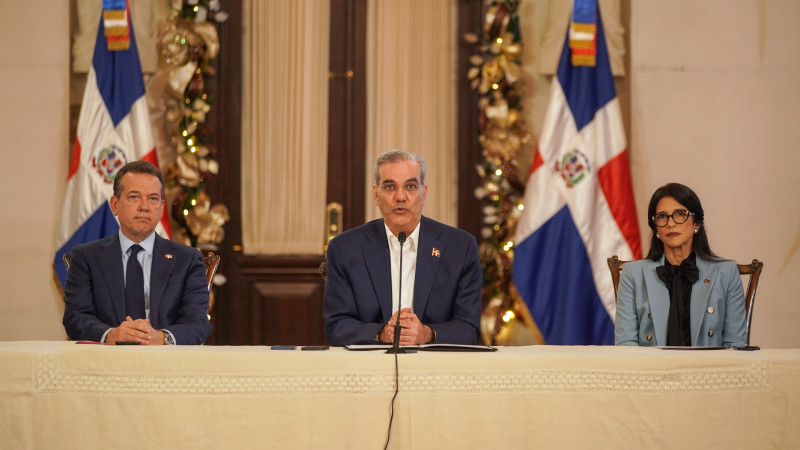
President Luis Abinader with Minister Víctor -Ito- Bisonó and the president of Adozona, Claudia Pellerano.
The free zone sector reached its historical maximum of 200,134 direct jobs in October of this year, consolidating itself as one of the main engines of economic and social growth in the country.
The announcement was made during a ceremony led by the President of the Republic, Luis Abinader; the Minister of Industry, Commerce, and Mipymes, Ito Bisonó; the president of Adozona, Claudia Pellerano, and the director of the National Council of Free Zones, Daniel Liranzo, together with representatives of the public and private sectors, academia, and international organizations.
The event highlighted that between April 2020, the lowest point of employment due to the pandemic, and October 2025, employment in free zones increased from 119,974 to 200,134 jobs, for an accumulated growth of 67% in five years.
President Luis Abinader highlighted the importance of this milestone by indicating that “it is a figure that represents decent work, real opportunities and renewed confidence in the Dominican Republic,” while reiterating that “this is the result of a sustained strategy, the commitment of workers, the drive of the private sector and public policies aimed at generating quality jobs, attracting new investments and strengthening the country’s competitiveness.”
“Since 2020 we have been working to bring jobs where there were none before. We reopened parks that had been closed for more than 15 years and built new productive spaces such as the one in San Juan de la Maguana. All this effort translates today into more than 200,000 jobs and an economy that moves forward with people at the center,” emphasized Minister Ito Bisonó.
All this is generated in a context of expansion of industrial parks, productive diversification, and strengthening of the technical capabilities of our human talent.
Minister Bisonó highlighted that “as of November 2025, the value of exports from the free zone sector amounts to US$7,936.1 million, being led by subsectors such as medical devices, tobacco and its derivatives, as well as electrical and electronic products.”
While Claudia Pellerano, president of Adozona, said, “The sector has evolved from traditional manufacturing to knowledge-intensive productive ecosystems, where activities such as services, medical devices, electrical, electronic and logistics add up to tens of thousands of specialized jobs. In October 2025, services registered 45,460 jobs, an increase of 6.03% compared to October last year. This diversification is supported by training: between 2020 and October 2025, 24,494 training actions were developed, accumulating 606,292 hours of technical training, in coordination with Infotep and the companies of the sector, which allows increasing productivity and the salary trajectory of the collaborators.”
Technification of employment in the ZF sector
The MICM highlighted that the free trade zone model has undergone a profound transformation in its labor composition. Between 2004 and 2024, operator participation dropped from 86% to 63.4%, resulting in more than 39,000 fewer positions in traditional functions. In parallel, technical jobs increased from 9.1% to 25.3%, tripling in two decades, while administrative positions doubled from 4.9% to 11.3%. This change reflects the transition towards higher-value-added activities, including medical manufacturing, electronics, global services, and logistics.
Women’s participation and investment
Women, accounting for more than 106,000 workers, occupy 54% of the employment generated in free trade zones. In addition, there is a strong productive linkage with local industry: local purchases from free zones increased from RD$83 billion in 2020 to more than RD$155.4 billion in 2024, a 87% increase. In terms of investment, the accumulated investment in the regime reached US$7,735.7 million in 2024, an increase of 49% from 2020.