

 Smaller
 Bigger
Despite conflicts, Dominican Republic seeks to strengthen relations with China
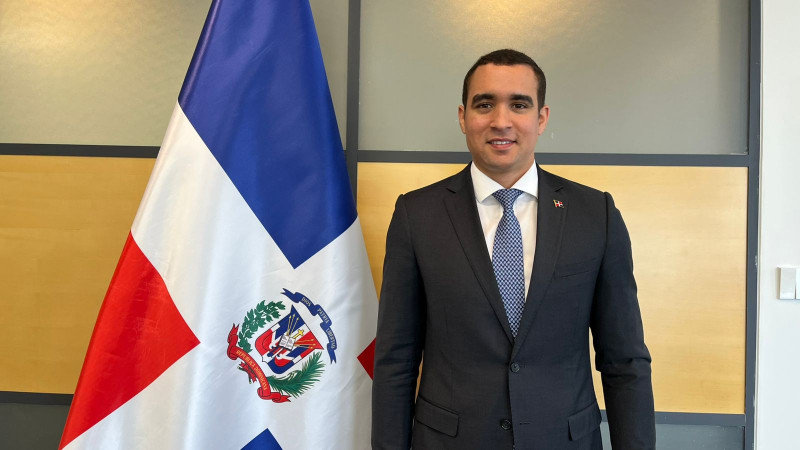
José Julio Gómez, Dominican ambassador to China, discusses plans with that nation.ld
Beijing, China — The fact that the Dominican Republic has become “one of the most reliable partners of the United States,” as President Luis Abinader recently stated, is no obstacle to the government’s efforts to “deepen” trade relations with China. This was explained by the Dominican ambassador to the People’s Republic of China, José Julio Gómez, in an exclusive interview with Listín Diario.
According to the diplomat, among the plans he has been developing since arriving at the emEmbassyast February, on instructions from the government, is to open the investment market to Chinese businesspeople in areas that do not compete with those of the United States and Dominican industrialists.
“There are sectors where we are focused. Obviously, we do not want, from this Embassy, and we will not do so on the instructions of the president, to seek companies that will compete not only with American companies, but above all with companies from the Dominican Republic. That is not the idea. The idea is to seek companies here in China that can provide a service to the Dominican Republic, make investments in sectors where there is no presence,” explained the ambassador, describing relations between the two countries as “good and stable.”
The government is seeking a greater Chinese presence in the country’s sectors, including electrical equipment companies,” railways, trains, tracks, trams,” textile manufacturing, and free trade zones that allow Dominicans to create jobs.
In addition, José Julio Gómez announced that he has been in contact with a Chinese company interested in establishing itself in the country to distribute goods to retailers and wholesalers who sell and want to sell products from China.
“The preliminary project presented to us is to establish a free trade zone not far from the capital to import products from China for sale to the retail market. In other words, instead of buying in China, stores in the Dominican Republic would buy Chinese products there, but at a lower price because they would not have to pay for the import and export logistics chain,” said the ambassador.
In addition to this strategy and to “balance” trade between the two countries, which, despite exceeding $5 billion in 2024, leaves the Dominican Republic at a disadvantage with a deficit of more than $2 billion, the government seeks to increase the level of Dominican exports, both in the agricultural and service sectors, “under a strategy already in place to open up markets. “This is even though the country does not have a free trade agreement with China,” nor a trade agreement that allows the Dominican Republic to enter that Asian market on a preferential basis.”
“Hass avocados can now enter China. We have a quota of 70,000 cigars here. We can only bring in five brands, which is a negligible amount. The idea is to increase this to 1 million cigars, and we were in negotiations with Chinese customs to achieve this, because we sell a lot of cigar leaves, around $50 million. Obviously, the strategy is to diversify the brands of cigars that enter here and increase the quota from 400,000 cigars to 1 million cigars,” explained the diplomat, noting that the country is the largest exporter of cigars in the world and that about five brands arrive in China.
He added that his work is not focused on geopolitical issues, as he only seeks to “identify opportunities that the Dominican Republic may have in this market and, of course, provide our institutions and the private sector with the information necessary to develop these projects.”
605 Dominicans live in China
The phrase “Dominicans are everywhere” is no less accurate in China. This Asian country, which has a 12-hour time difference from the Dominican Republic, has 605 Dominicans. However, the figure could vary according to the census carried out by the EmbasEmbassyonfirm.
Ambassador José Julio Gómez says these people work in companies that import products, manufacturing plants, technology companies, multinationals, and other areas.
In addition to providing various consular services, the ambassador explained that as soon as he learns of a Dominican’s presence in China, whether for study or other reasons, he invites them to visit the EmbasEmbassy’slities and provides them with any guidance they need.
“If we find out that a Dominican has arrived in China and has not contacted the embassy, I personally or my staff will write to them directly to find out how long they will be staying, what they are doing, and to let them know that the Embassy of the Dominican Republic is there to serve them in any way they need,” he explained, listing the other nine officials who accompany him in his consular work.
Like President Luis Abinader, Ambassador José Julio Gómez said he devotes 80% of his time to consular work, starting his workday at “4:40 in the morning” and averaging “16 hours of work” daily. “Fifteen to sixteen hours of work. But I am alone; my wife and son are in the Dominican Republic. But I did almost the same thing in the Dominican Republic,” he laughed.
Changes in consular service
When asked about the number of changes in the diplomatic service under this administration, José Julio Gómez assured that as part of the “reform process of the Foreign Ministry,” in which he participated. At the same time, he was deputy minister of Foreign Affairs, compliance with the regulation establishing that diplomats must be rotated every four years was established, as this rule “was not previously enforced.” The Dominican Republic did not previously comply with two critical elements of diplomacy: rotation and alternation.
Rotation means that officials have to rotate to another embassy every so often. Because I am not assigned here to live. I am assigned to carry out a mission. I fulfill it, so I have to move on. That is the nature of diplomacy. And alternation means that after eight years abroad, you have to return to the country for a minimum of two years and a maximum of four,” he explained.
He also pointed out that the administration of President Luis Abinader, led by Foreign Minister Roberto Álvarez, has been able to reduce the number of diplomatic officials from 4,300 to about 2,000.” We had the fifth largest mission in the world at the United Nations, with 68 officials. Only surpassed by India, China, Russia, and the United States. Imagine that. It was reduced to 2,000, and today there are 2,000 officials. There is a salary scale, there is a resolution that establishes the number of officials for eaEmbassyssy. In other words, what President Abinader and Foreign Minister Álvarez have done is definitely worthy of admiration,” he concluded.














“in area that do not compete with the US”… So the DR government is actually working to protect interest of other nations… How about letting the US and China to compete, it will result in lower prices and better quality for the people of the DR…