 Smaller
 Bigger
Government responds to Inter-American Commission on Human Rights: “No State can be forced to assume the protection of another”
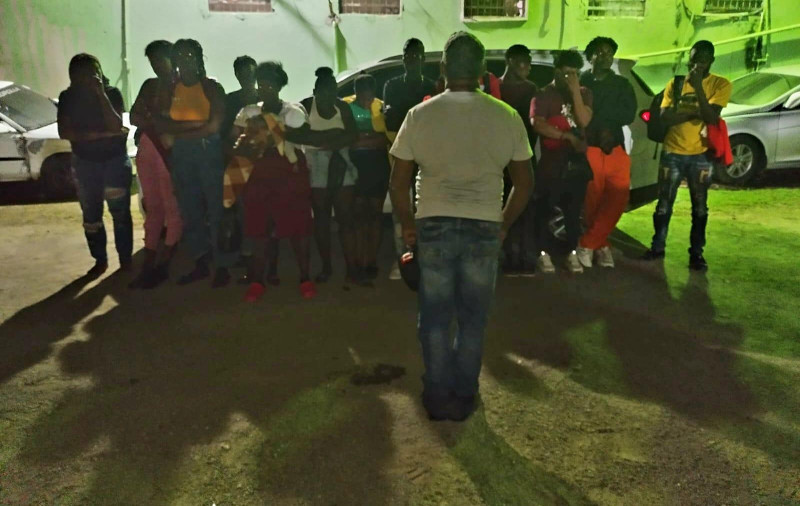
The Dominican government issued a response, stating that the Dominican Republic has "the right and the obligation" to regulate the entry, stay, and departure of people in its territory.
In their response, Dominican authorities stated that they are committed to protecting human rights, but are obligated to comply with and enforce their internal regulations.
They also stated that the crisis in Haiti has generated “migratory pressure,” which the Dominican Republic has had to bear disproportionately for decades.
He also stated that the country’s immigration measures are due to the need to manage the aforementioned migratory flow and to avoid the negative effects this situation may have on Dominican territory.
“No State can be forced to assume the protection or provision of services to the population of another State in the event of the collapse of the latter,” read part of the statement.
“In this regard, we reject the Commission’s call to apply the principle of non-refoulement generally to all migrants in irregular migratory status, as this would be equivalent to forcing the Dominican State to accept any Haitian citizen who wishes to enter our territory, even irregularly,” the document continued.
THE FULL ANSWER FOLLOWS:
“RESPONSE OF THE DOMINICAN GOVERNMENT TO THE IACHR STATEMENT OF FEBRUARY 6, 2026”
The Dominican Republic notes the statement issued yesterday by the Inter-American Commission on Human Rights (IACHR) regarding the State’s migration policies. In this context, it clearly and responsibly states its position, reaffirming its long-standing commitment to protecting human rights and, simultaneously, to the legitimate implementation of its domestic legal framework.
The migration phenomenon facing the country must be analyzed within its regional context. The prolonged political, security, and humanitarian crisis in Haiti has generated sustained and exceptional migratory pressure. For decades, the Dominican State has assumed, with a sense of solidarity and human responsibility, a disproportionate burden in the face of a crisis that transcends its borders.
In exercising its sovereignty, the Dominican Republic has the right and the obligation to regulate the entry, stay, and departure of persons from its territory. This power is neither discretionary nor arbitrary: it is exercised in accordance with the Constitution, national legislation, and international human rights standards. As the Inter-American system itself has repeatedly recognized, the power to define migration policies constitutes an essential attribute of state sovereignty.
The measures adopted by the Dominican Government respond to the legitimate need to manage an extraordinary migratory flow in an orderly manner to avoid its negative impact on social cohesion and public spending. No state can be forced to assume the protection or provision of services for the population of another state in the event of the latter’s collapse.
In this regard, we reject the Commission’s call to apply the principle of non-refoulement generally to all migrants in irregular migratory status, as this would be equivalent to forcing the Dominican State to accept any Haitian citizen who wishes to enter our territory, even irregularly.
On previous occasions, the Dominican government has stated that the Haitian crisis does not preclude compliance with Dominican immigration laws. The Haitian crisis constitutes a regional challenge that requires a collective response. There is no Dominican solution to the Haitian crisis. The Dominican Republic will continue to actively advocate in multilateral forums for effective, supportive, and shared international action.
In the area of health, the Dominican Republic reaffirms that no person is denied emergency medical care on the basis of their immigration status. Coordination protocols between health and immigration authorities aim to streamline service delivery amid high demand, while enhancing protection for pregnant women, children, and patients with special needs.
In immigration processing centers, the State has been implementing progressive improvements to infrastructure, sanitary conditions, and basic medical care, with internal oversight mechanisms and coordination with relevant institutions. The Dominican Republic maintains a zero-tolerance policy toward any inhuman or degrading treatment.
The Dominican State notes with concern that the IACHR statement appears to prioritize unverified allegations over official information submitted by national authorities. It reiterates its willingness to engage in a technical and transparent exchange of data and emphasizes that any assessment must incorporate verifiable sources and the regional context that explains the exceptional migratory pressure.
The protection of human rights and the defense of national interests are not conflicting objectives. The orderly and sovereign management of migration is essential for preserving institutional stability and guaranteeing the rights of all persons under the State’s jurisdiction.
In that spirit, the Dominican Republic reiterates its willingness to deepen technical cooperation with the IACHR based on mutual respect and good faith. The country values the Inter-American system as a forum for dialogue and maintains open institutional channels to advance balanced solutions that protect human rights and respect Dominican sovereignty.