

 Smaller
 Bigger
Duquesa Landfill enters first phase of environmental transformation
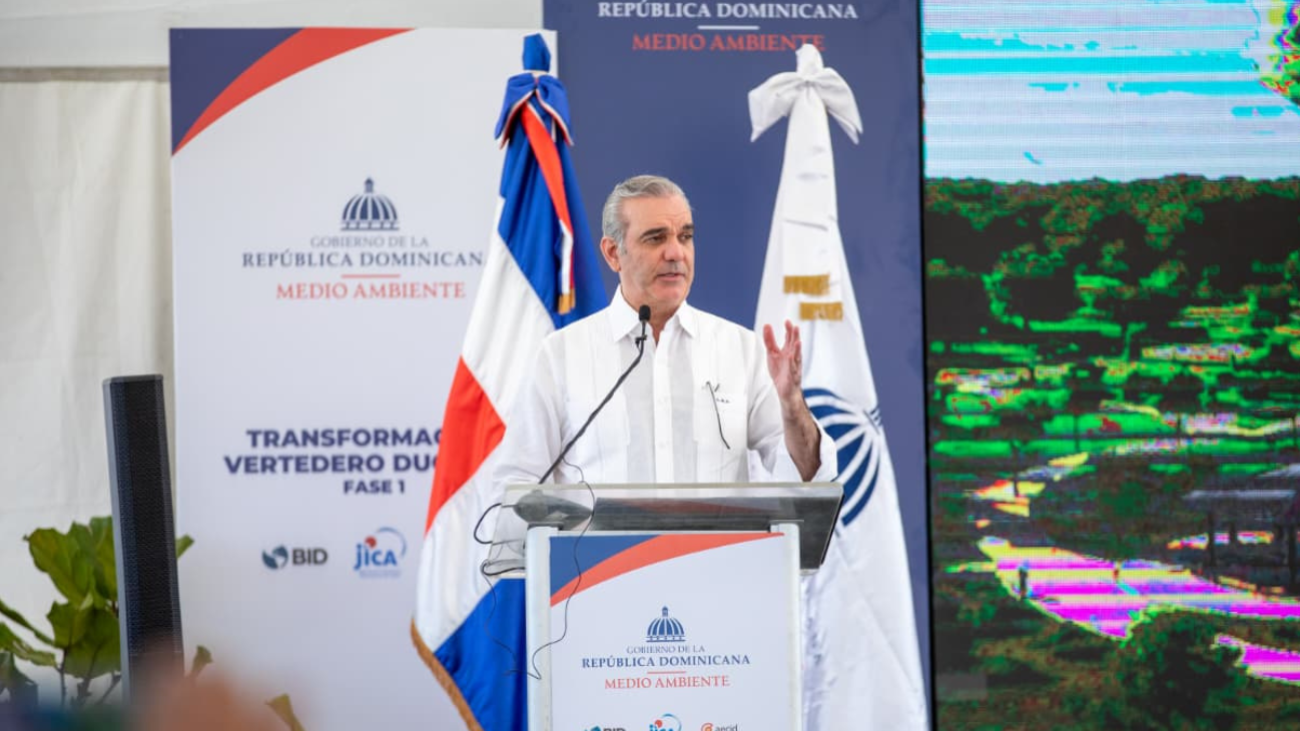
Santo Domingo.- President Luis Abinader on Tuesday launched the first phase of the transformation of the Duquesa landfill, a major environmental intervention designed to protect public health, mitigate environmental damage, and advance toward a sustainable solid waste management model in Greater Santo Domingo, benefiting approximately 3.8 million residents.
The project involves a US$110 million investment and is being implemented under the Comprehensive and Sustainable Solid Waste Management Program for Greater Santo Domingo, led by the Ministry of Environment and Natural Resources through its Vice Ministry of Environmental Management. The initiative is supported by international financing from the Inter-American Development Bank (IDB), the Japan International Cooperation Agency (JICA), and the Spanish Agency for International Development Cooperation (AECID).
During the launch, President Abinader stated that the initiative goes beyond closing a landfill, describing it as a comprehensive environmental transformation based on engineering solutions, risk control, and ecological restoration to recover a space degraded over decades. He recalled that recurring fires and toxic smoke at Duquesa had severely affected nearby communities, making urgent intervention unavoidable.
The president emphasized that solid waste management has been a priority since 2020, including the creation of a solid waste management trust, which has enabled the transformation of 30 landfills nationwide and the progressive elimination of open-air dumps. He added that the Duquesa project, along with the cleanup of the Gurabo ravine in Santiago, will serve as a national benchmark for modern waste management.
Environment Minister Paíno Henríquez described Duquesa as the country’s largest environmental liability, containing more than 30 million tons of waste, and noted that the site has now remained fire-free for an extended period. He explained that the first phase includes soil stabilization, leachate and gas management, runoff control, slope reshaping, and the sealing of critical areas, laying the technical foundation for environmental recovery.
Henríquez also highlighted the project’s social and environmental components, which include recreational infrastructure such as sports fields, children’s play areas, an outdoor gym, an amphitheater, and a five-kilometer recreational circuit for the communities of El Casabe and Batey Duquesa. The plan also предусматриes the formalization and inclusion of waste pickers and is expected to mitigate approximately 140,000 tons of CO₂ equivalent per year through greenhouse gas capture.













These are the types of projects that are boring but critical to the long term development of the country.