

 Smaller
 Bigger
The National Electric System claims to have improved its services.
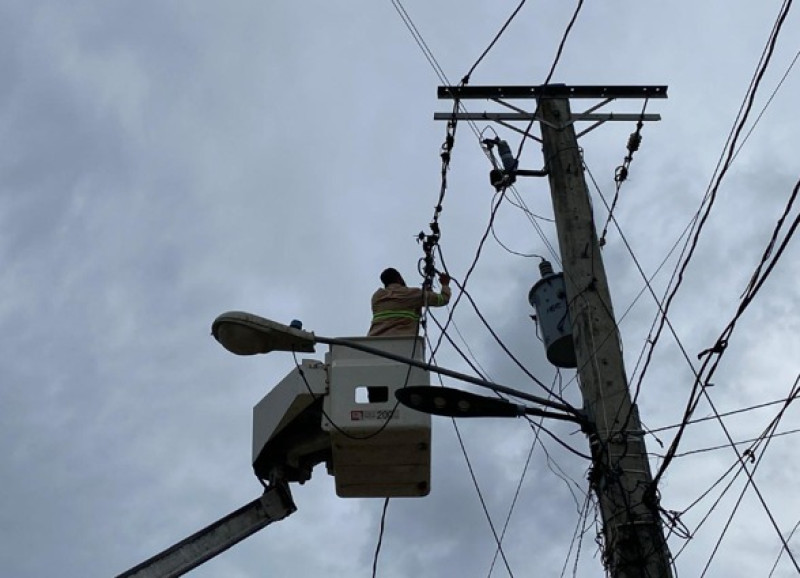
The power service experienced problems on Wednesday, but is now improving after Unit 2 at Punta Catalina came back online. External Source
Santo Domingo, DR — Before three o’clock in the afternoon this Thursday, the National Interconnected Electric System (SENI) recorded an electricity generation of 3,337.3 megawatts (MW), and had the Punta Catalina 1 and 2 generators online in order of merit (priority for using cheaper energy) with regular operations.
On Wednesday, the Punta Catalina 2 generator was out of service due to internal causes, while Punta Catalina 1 was providing 341.25 megawatts. Other plants (nine in total) were also out of service, resulting in a generation deficit of 78.57% and a 1.63% deficit in the transmission system, which left several circuits offline on Wednesday, the 13th. That day, the Punta Catalina 1 unit contributed 341.25 mg to the system.
Total actual generation was 2,419.1 megawatts from thermal plants (67%); 27% came from solar plants, 1% from hydroelectric plants, and 5% from wind power.
By mid-afternoon, the Superintendency of Electricity (SIE) had recorded an energy demand of 3,613.75 megawatts (MW), with a programming of 3,418.67 MW, while the redispatch arrived at 3,701 MW.
High temperatures lead to increased consumption, especially in homes during the school holidays, when almost everyone is at home and air conditioners and fans are used more, refrigerators are opened more, and electric stoves, televisions, and other electrical appliances are turned on more.
The plants online yesterday were: the two Punta Catalina units, I and 2; the two Itabo units, 1 and 2; Quisqueya 1 and 2, running on natural gas (NG); San Pedro NG; Cespm 1, 2, and 3, running on natural gas; Estrella del Mar 3 CCT; Estrella del Mar CCP; Barahona coal; and Pimentel 4, among others in the thermal sector.
The electricity sector, despite improvements, continues to place a burden on public finances due to the high Government subsidy required to prevent electricity rates from rising, especially during periods of increasing fuel derivative prices, such as fuel oil and diesel. This is also due to network issues and other investments that would reduce distributors’ losses.
In 2024, the Government allocated RD$92.97 billion in subsidies to the electricity sector, and this year, 2025, the annual budget includes an allocation of RD$90.445 billion for these purposes.
EDES
The Superintendency of Electricity (SIE) indicates that, as of June 2025, in terms of the quality of service offered by distribution companies to users, the greatest number of interruptions occurred in Edenorte, followed by Edeeste and then Edesur, the latter with the best performance.
The distributor with the greatest unavailability of electrical service was Edeeste.
It indicates that the average monthly duration of power outages per customer was 29.66 hours per month in Edeeste, 12.12 hours in Edesur, and 10.86 hours in Edenorte.
It also records the duration of power outages. In July, the average duration per customer was 0.50 hours at Edenorte, 0.67 hours at Edesur, and 1.53 hours per outage at the Edeeste distributor.
Learn more
On Wednesday, there were nine out
Unavailable
The generating units that were outside the SENI due to fuel management last Wednesday were Bersal, Inka km22, Palenque, San Lorenzo 1, and Sultana del Este.
Due to internal reasons, Punta Catalina 2, Haina TG, and Energas 4 were out, while San Felipe was in the final phase of a test.
When a generator goes out due to an event, this shortfall is covered by other, more expensive generators. External
















Trying to make a bad situation look good? Think the word “improved” used by the National Electric System vocabulary has to be defined when nine units were unavailable.
I am impressed that everything is well monitored. The problems are known. Now, the hard part. Solutions.