
 Smaller
 Bigger
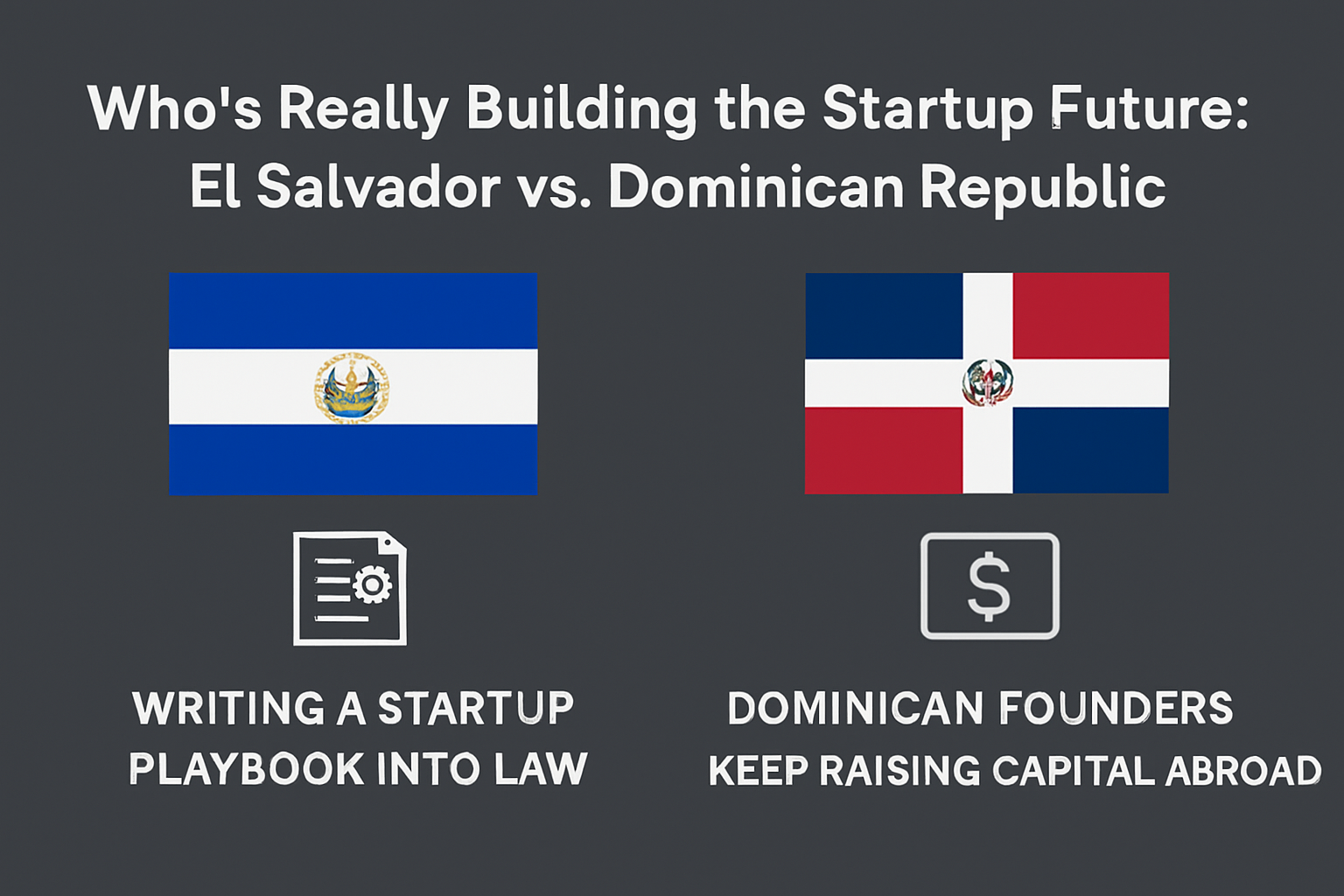
Who’s really building the startup future: El Salvador vs. Dominican Republic
By Jonathan Joel Mentor | @jonathanjmentor
If you’re a Dominican entrepreneur, digital nomad, or investor, you’ve probably noticed something uncomfortable:
Dominican founders keep raising capital abroad.
El Salvador keeps changing its laws to attract them.
One side exports talent and ideas. The other quietly rewrites the rules to receive them.
This isn’t about who has better beaches. It’s about which country is actually building the legal and financial infrastructure modern startups need.
El Salvador Is Writing a Startup Playbook Into Law
In 2023, El Salvador passed the Ley de Fomento a la Innovación y Manufactura de Tecnologías—a law explicitly aimed at tech and innovation companies, not just any small business.
If their Ministry of Economy certifies your project, you can be exempted for up to fifteen years from income tax, municipal and real estate taxes, capital gains tax, and import duties on tech machinery and equipment. The targets are clear: software, AI, cloud, cybersecurity, data and analytics, and manufacturing of semiconductors, robotics, telecom equipment, drones and other advanced tech.
They didn’t stop there. The government is layering in an AI and emerging tech framework with a dedicated agency, a modern data protection law, and specific rules around robotics and related technologies. You can argue about the politics all day, but on the innovation side the message is simple:
El Salvador has decided startups and deep tech are strategic—and they’re writing that priority directly into their legal code.
CoreNest: When Law and Money Face the Same Direction
Law is the foundation. The next layer is capital and execution.
CoreNest, led by José Roberto Rodríguez, is positioned as El Salvador’s first venture-backed startup accelerator and a tokenized VC fund built on top of that legal stack. The structure is simple but powerful: a US$25M fund, structured in El Salvador and designed to grow if the pipeline performs, paired with an accelerator aiming to back a meaningful number of early-stage startups over the coming years. The work happens in collaboration with the state, not in spite of it.
CoreNest matters here because it completes the triangle: legal clarity around innovation and tech manufacturing, sector-aware treatment of AI, data and robotics, and a fund plus accelerator explicitly designed to exploit that environment.
That’s what “innovation paradise” looks like in real terms: law, capital, and operators pointing in the same direction.
The Dominican Republic: Strong on “Emprendimiento,” Weak on Venture
Now turn the camera back home.
The Dominican Republic has Ley 688-16 de Emprendimiento. Its purpose is to promote a culture of entrepreneurship, formalize businesses, and make it easier for micro and small enterprises to access financing. That law has real value. It helps a lot of Dominican businesses get formal, get bankable, and get moving.
But it was not written with high-growth, venture-backable startups in mind. If you’re building a Delaware C-Corp, selling a cross-border product, or shipping AI-heavy, data-heavy fintech, you still get squeezed into rules and risk models built for traditional MIPYMES, local comercio, and low-volatility business models.
You see the same gap in our support programs.
Take Cree Banreservas and Boost Acceleration Camp.
Cree Banreservas, backed by Banreservas, has become a reference point for formalizing and scaling local emprendimientos, using non-traditional financing and equity-style instruments to help innovative projects grow. Boost, an independent accelerator created by Dominican entrepreneurs in Santo Domingo, focuses on early-stage, tech-based startups from here and across Latin America, combining one-on-one acceleration, direct investment, and sometimes a soft-landing into the Dominican market.
Both are real wins for Dominican entrepreneurs. They’re doing what they were designed to do. But they were never meant to replace something we still don’t have: a modern startup legal framework and risk environment built specifically for venture-scale companies.
Cree and Boost are trying to help founders navigate a system that wasn’t designed for them. El Salvador is slowly designing its system around the founders it wants.
That’s the difference.
Two Different Questions, Two Different Games
So this is not “El Salvador good, DR bad.” It’s “different questions, different games.”
Right now, El Salvador is asking how to compete for founders, capital, and advanced tech with a legal and financial stack built for this decade. The Dominican Republic is still mostly asking how to formalize more micro and small businesses and help more people become entrepreneurs.
Both questions matter. But if you’re building a Dominican startup with real regional or global potential, you live in the gap between them.
The Kind of Dominican Innovation This System Is Not Built For
Underneath the noise, there’s a new generation of Dominican startups that go way beyond “build an app” and straight into infrastructure:
- risk and credit models for underbanked workers
- tools for formalizing informal labor and gig economies
- cross-border financial and data rails
- systems-level plays in mobility, logistics, and inclusion
These aren’t side hustles. They are exportable IP and infrastructure-aligned ventures. They touch the same issues our own institutions love to name in speeches:
- inclusion of informal workers
- the Haitian–Dominican labor reality on construction sites and city streets
- the formalization of migrant workers who keep entire sectors running
- safer credit for people who don’t appear cleanly on a bureau report.
When a Dominican startup thesis says, “We can help you model risk better for the motorista, the Haitian migrant, the delivery rider, the remittance receiver,” that is not a niche. That’s macroeconomic plumbing.
In an ecosystem like the one El Salvador is building, that sort of thesis has a door to knock on. There is a legal box where the company fits, an explicit recognition that data, AI, and fintech are legitimate sectors, and an accelerator–fund structure wired to take those ideas seriously.
In the Dominican Republic, the same kind of thesis often lands as “too complicated,” “too foreign” because of international structures, or “too risky” because our models and rules haven’t caught up. The projects that could modernize how we treat risk, labor, and inclusion end up feeling more welcome in somebody else’s jurisdiction.
That’s the real loss.
Read the FULL Whitepaper (In English and Spanish) here: Bilingue: The Cost of Obsolete Risk Modeling in the Dominican Republic
The Whitepaper, and What It Really Signals
There’s a reason serious Dominican teams are starting to put their thinking into technical work, not just pitch decks.
An independent deep study with national and international citations on obsolete risk modeling in the Dominican Republic, for example, isn’t a vanity piece. It’s a signal that Dominican startups are already operating at a level of sophistication that banks, regulators and investors need to reckon with. It argues that our current credit and risk practices quietly block the same people and companies we claim to champion, and that there are homegrown, exportable ways to fix that—using real data from our own mobility, fintech, and informal labor economies.
In a country with a modern startup framework, work like that would be read inside ministries, used to inform regulation and pilot programs, and backed by funds and accelerators that want to be early on those theses. Here, it still risks being treated as “too advanced” for the current ecosystem.
The point isn’t “look at this one company.” The point is: look at the level of thinking Dominican founders are already bringing to problems like risk, labor formalization, and cross-border finance—and how little our current system is built to receive them.
Dominican Accelerators Can’t and Shouldn’t Do This Alone
This is where Cree, Boost, and any future Dominican accelerators deserve real credit and real backup.
They are doing the job they were created to do: educate entrepreneurs, help projects formalize, connect founders with mentors and early capital, and slowly change the culture around innovation. They are not the reason our legal and risk infrastructure is behind. They’re the ones trying to work around it.
What they cannot do, on their own, is rewrite Dominican startup law, modernize banking regulations, or overhaul risk modeling at institutional scale. Expecting accelerators to solve structural problems is like asking a driving school to fix the roads.
The right way to see Cree, Boost and whatever comes next is as on-ramps into a system—not substitutes for the system itself. They deserve an environment where a founder graduating from a Dominican program can plug into a clear startup legal regime, modern risk practices, and a pipeline of capital that understands venture dynamics.
Right now, they’re doing that work on a floor that was never finished.
So What Now for Dominican Entrepreneurs and Digital Nomads?
If you’re building from Santo Domingo, Santiago, Punta Cana, or split between here and abroad, the play is simple and a little uncomfortable.
First, understand both ecosystems. Know what El Salvador’s innovation laws and CoreNest-style platforms actually offer. Know exactly what Ley 688-16, Cree Banreservas, Boost Acceleration Camp and the rest of the Dominican stack do—and don’t do—for a startup like yours.
Second, design your company as if the region is your playground, not just one country. Structure, IP, banking, data—set them up so serious investors in multiple jurisdictions can understand and back you. Use Dominican programs, but don’t let their current limits define your ceiling.
Third, push—publicly and privately—for a Dominican startup framework that matches the reality we’re already living. That means a clear distinction in law between SMEs and high-growth tech companies. It means risk and credit models that treat new kinds of data and work as assets, not anomalies. And it means giving Dominican accelerators a modern legal and financial stack to plug into, instead of asking them to be the stack.
Dominican entrepreneurs have already proven they can build world-class companies and exportable IP. The open question isn’t talent. It’s whether the Dominican Republic wants to become an innovation paradise in law and practice, or keep cheering from the sidelines while other countries quietly build the frameworks to receive what we keep pushing out.
That decision won’t be made in a press conference. It’ll be made in the fine print.
————————————————————————–
Jonathan Joel Mentor is the CEO of Successment and architect of the Digital Nomad Summit™, scaling startups and challenging institutions to evolve. UN World Summit Award Nominee & ADOEXPO National Excellence in Exportation Award Winner www.jonathanjmentor.co | digitalnomadsummit.co