

 Smaller
 Bigger
The painful annexation to Spain triggered the Restoration
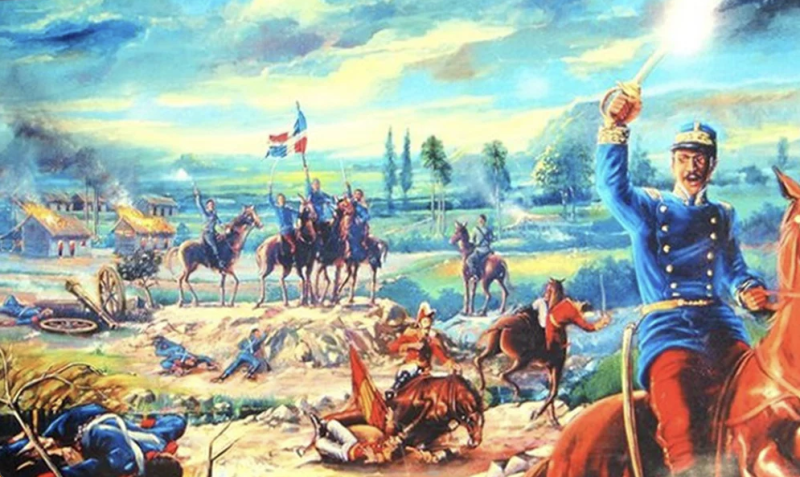
The Spanish army was ambushed in open country by the attack of the independence forces. Listín Diario
Santo Domingo, DR—On March 18, 1861, from the balcony of the presidential palace in Santo Domingo, a reading resounded with an echo of treason: the annexation of the Dominican Republic to Spain.
It was a unilateral decision by then-President Pedro Santana, an act that, for many historians, tore at the very essence of Juan Pablo Duarte‘s ideals: “Our homeland must be free and independent of all foreign powers or the island will sink.”
The Dominican Republic, just 17 years after having won freedom at the price of its Creoles’ blood, found itself once again under foreign rule. This was the beginning of one of the most enigmatic and bloody events in Dominican history: the Restoration. The big question: Why the annexation?
The annexation to Spain is an episode that still generates debate today. What real motivations drove Santana to surrender national sovereignty?
While some historians argue that unification with Spain promised economic development, others view the annexationist framework as influenced by the greed of elite figures.
In response to this question, Dominican historians such as Roberto Cassá, director of the National Archives (AGN), and Juan Daniel Balcácer, former president of the Dominican Academy of History, along with Rafael Jarvis Luis and Welnel Darío Féliz, members of the academy, presented their views on the annexation plot.
According to Jarvis Luis, Pedro Santana‘s “ambition” was the main driving force behind this decision, a desire also shared by the ruling elites of the time.
“Santana was going to benefit from a Spanish noble title as Marquis of Las Carreras,” an honorary distinction that included a lifetime pension of 12,000 pesos a year and great social prestige, reflections that Cassá and Balcácer support.
False hope
Initially, annexation was presented as a solution to the country’s precarious economic situation. Major infrastructure projects were promised, such as the construction of roads, bridges, and the development of ports, essential for connecting the various areas of the country that at the time lacked adequate roads.
“There were no roads, and there weren’t enough ports to allow deep-draft vessels to enter the country; so, if Spain offered to do that, economic groups expected to benefit from it,” said Jarvis Luis, noting that these promises were ultimately not kept. The population, although initially tolerating unification, did not identify with it. As Balcácer states: “The majority of the people tolerated unification, but did not identify with that action, because they believed they would have peace and hope.”
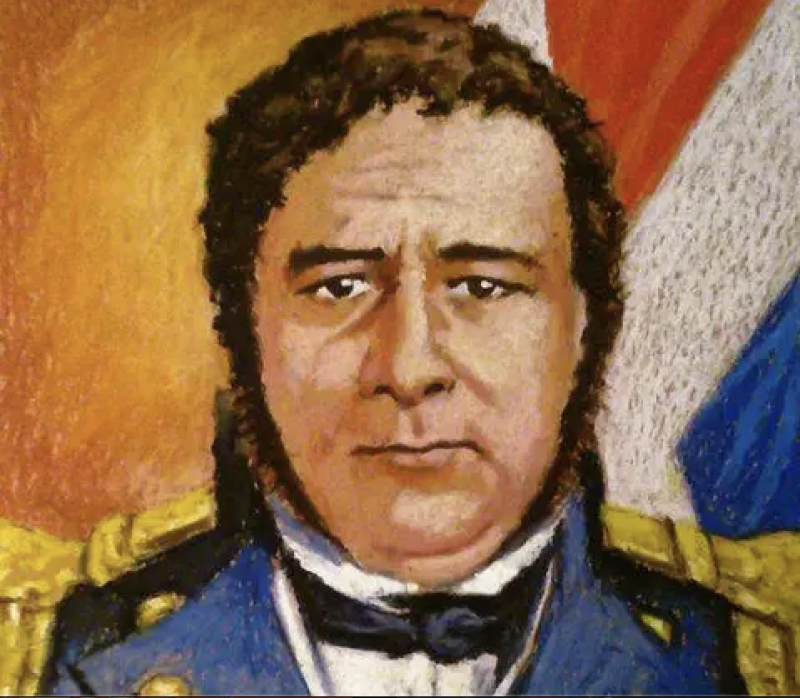
Pedro Santana’s “ambition” was the main driving force behind the country’s annexation to Spain. Listín Diario
However, since the proclamation of the annexation, Dominican patriots spontaneously attempted to overturn Santana’s actions with revolts in the Cibao.
By 1862, even before the “Grito de Capotillo,” the southern part of the country had already been the scene of clashes in Neiba, Azua, Barahona, and San Cristóbal, later spreading to the East.
Widespread outrage grew with the arrival of “rumors” about a possible return to slavery, fueled by the situation in Puerto Rico and Cuba, still under the Spanish yoke, as Welnel Féliz recounts.
After 24 months of annexation, the promises failed. What was presented as an economic rescue became, according to historians, a private benefit for a few.
Added to the impositions of the Catholic religion and, above all, the fear of slavery, this sparked discontent among the less privileged classes.
“The Spanish subjected the Dominicans to a precarious economic situation and severe taxes that ended up upsetting the peasantry,” said Jarvis Luis.
Uprisings
The unrest erupted on August 16, 1863, with the “Grito de Capotillo” (Cry of Capotillo) in the province of Dajabón. There, Santiago Rodríguez raised the National Flag for the first time in a long time, marking the formal beginning of the Restoration War.
The first stage of the patriotic milestone was based on the capture of Santiago, a province that became the “Cradle of the War .”
Thus, over days, the battle spread throughout the Cibao, under the tactic of “guerrilla warfare,” a technique that consisted of “ambushes, surprise and clandestine attacks” to attack the Spanish forces, says Roberto Cassá.
On August 18, the first battle took place in Guayubín, Monte Cristi province. “It was a decisive battle because the Dominicans defeated the troops stationed in Guayubín for an entire day, and this alarmed the Spanish superior forces,” notes Juan Daniel Balcácer.
The conflict then spread to Santo Domingo, the South, and the East, but with different strategies for appropriating territories.
The last battle before the Grito de Capotillo took place in the early morning of February 9, 1863, in Cambronal, Neiba.
In the southern region, however, the cry of “freedom” was proclaimed on September 17, 1863, in San Juan. From that moment on, it spread to Azua, Baní, and Ocoa, towns that had once been pro-Spanish.
Cinnamon Battle: The Final Blow
One hundred sixty years ago, the Battle of La Canela was fought in Barahona, classified by many historians as one of the “bloodiest” in the South during the Restoration War.
In this tragic event, the Dominican people confronted the Spanish with machetes, successfully weakening their forces and defending their homeland. The conflict was resolved through the union of guerrillas from the north and South, notes Welnel Féliz.
Some scholars point out that this battle is considered the decisive one in the patriotic milestone. There, the Spanish army was ambushed in open fields by the attack of the independence forces, a scenario that favored their victory.
After fighting for a day, the Spanish, already running out of ammunition, began their retreat in the afternoon, an action that proved their defeat.
As Féliz points out: “In the end, the South won the Restoration War and was the first to reach Santo Domingo and take possession of the city, proclaiming liberation.”
The role of Haiti
“The enemy of my enemy is my friend” is the proverb that often describes the complex relationship between the Dominican Republic and Haiti during the Restoration War as a key factor in expelling the Spanish crown.
At that time, the Haitian nation already enjoyed freedom and understood the danger posed by the presence of a European power in its vicinity, according to Dominican historians.
Despite having been forcibly expelled from Dominican territory after its defeat and proclamation of independence on February 27, 1844, the neighboring country contributed its cunning, says Rafael Jarvis Luis.
Corroborating this idea, Welnel Darío Féliz indicates that Haiti’s position was “decisive” in the development of the battle.
“From the very beginning, the Dominican people sought help from their neighboring country. This included obtaining weapons and ammunition that were later used in combat, as well as marketing products and supplying food,” he maintains.
However, the nation received this aid without compromising national sovereignty, Féliz points out.
The victory
This patriotic event, which lasted two and a half years, saw the Dominicans maintain a steadfast resistance that ultimately succeeded in disrupting and defeating the Spanish army, recounts Welnel Darío Féliz.
While revealing that the European militia also “could not resist viral diseases such as yellow fever.”
By July 11, 1865, the war was decided in favor of the Dominican Republic, culminating in the evacuation of the Spanish Empire. This act forged the Second Republic.
Those who have collected letters and fragments from the Restoration War today reveal that “the country was left in ruins, but it breathed freedom again.”
And although demographic records from the time are scarce, it is estimated that the Dominican population did not exceed 200,000 inhabitants.
Of these, between 10,000 and 15,000 Creoles lost their lives in the battle. The Spanish army, which numbered around 70,000 men, suffered approximately 35,000 casualties.
History
Insurrections in the South
War.
However, before declaring war, the insurrections in the South had already begun, turning the province of San Cristóbal into the “restoration bastion in the South.”
Professor and historian Welnel Darío Féliz, in his work “Annexation and Restoration in the Southwest,” winner of the 2022 Annual History Prize, recounts the experiences and development of the war in the lower part of the country through compilations of letters from the period.
The first significant insurrection occurred in June in San Juan de la Maguana, led by José María Cabral, Pedro Florentino, and other figures. The second movement against annexation occurred in Barahona on October 28.
By September 1862, a fourth confrontation took place in Barahona, where Haiti, a nation opposed to the Spanish Empire, played a crucial role.













And now everyone would love to live in Spain. Same as Haitians, they would love to have a life as France does, but they made their choice. Misery, corruption, poverty, caos. How sad.