
 Smaller
 Bigger
Dominican Republic doubles mango exports, promotes grapes
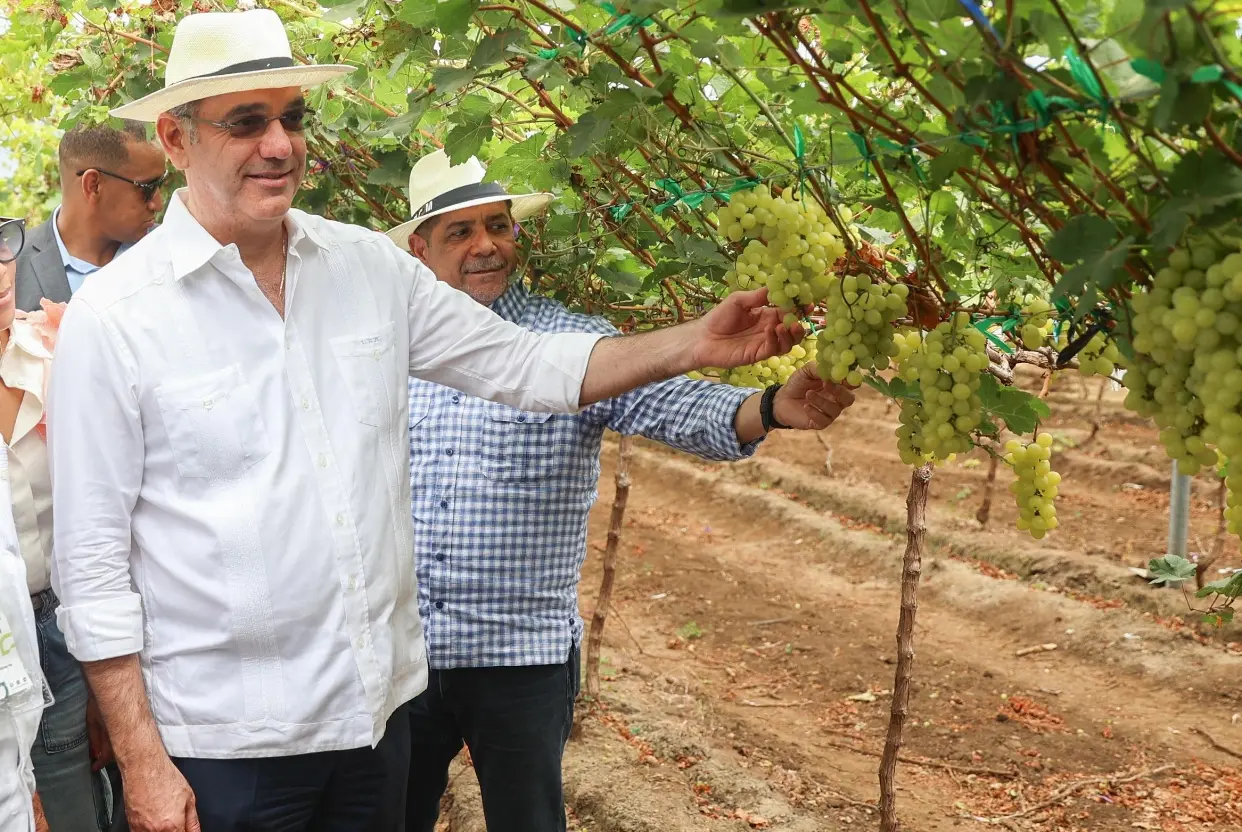
President Luis Abinader and Minister of Agriculture Limber Cruz at Arismendy Almonte's grape farm in Guayubín, Montecristi.
The Dominican Republic, which today celebrates Fruit Day, has doubled its mango exports and increased its avocado and other exports under the administration of President Luis Abinader, said Deputy Minister of Agricultural Production Eulalio Ramírez.
Limber Cruz, a banana and rice producer, has been with the Ministry of Agriculture for the five years of this government.
Ramírez said that in 2020, the country exported $20 million worth of mangoes and that this year, it has exported $50 million worth of different varieties, mainly to the United States and Europe.
He said that in 2020, $223.4 million worth of avocados were exported, and they exported $309.4 million.
He explained that other fruits have been added to exports, such as pitahaya and castaña de masa. There is a demand for this fruit in the international market that the country cannot yet supply. However, new plantations are being planted with the support of the Ministry of Agriculture and the Agricultural Bank, which offers financing to interested producers.
A lot of land is planted.
In the country, more than 150,000 acres are planted with mangoes of the Keit, Minolo, Banilejo, Crema de Oro, and Samaguí varieties, among others. There are 1,900 registered producers, according to Ramírez.
He noted that 850,000 acres are planted with different varieties of avocado, and citrus crops cover 716,760 acres, including 420,000 acres of two varieties of lemon and 860,000 acres of different varieties of coconut.
The Department of Fruit Trees (DEFRUT) is responsible for developing fruit growing, which contributes to food security. Fruit has become very important in the Dominican diet, with consumption increasing significantly. Fruit production in the five years of this government was 3,269,139 plants of different varieties.
Of this amount, 2,995,041 plants have been distributed to 25,173 producers, including 6,074 women, and 253,212 acres have been planted.
The Fruit Department’s technical team has provided 3,335 assistance to 2,489 producers of different types of fruit trees in different areas of the country.
According to the deputy minister of production, under Limber Cruz’s administration, the Ministry of Agriculture has been rescuing some fruits that were in danger of extinction, such as sapote, medlar, mandarin, and guava.
He indicated that Agriculture has also paid special attention to some new fruit crops, such as grapes, pitahaya, and masa chestnuts, which are in high demand in the international and local markets.
Until recently, the castaña de masa, also known as buen pan or mapen, was a wild fruit found in the yards of many homes, where it was sometimes consumed. Now, people know that this fruit contains minerals such as phosphorus, calcium, iron, and zinc. It is also made into gluten-free flour and can be used as a milk substitute.