
 Smaller
 Bigger
American newspapers discuss the challenges of artificial intelligence in the Dominican Republic
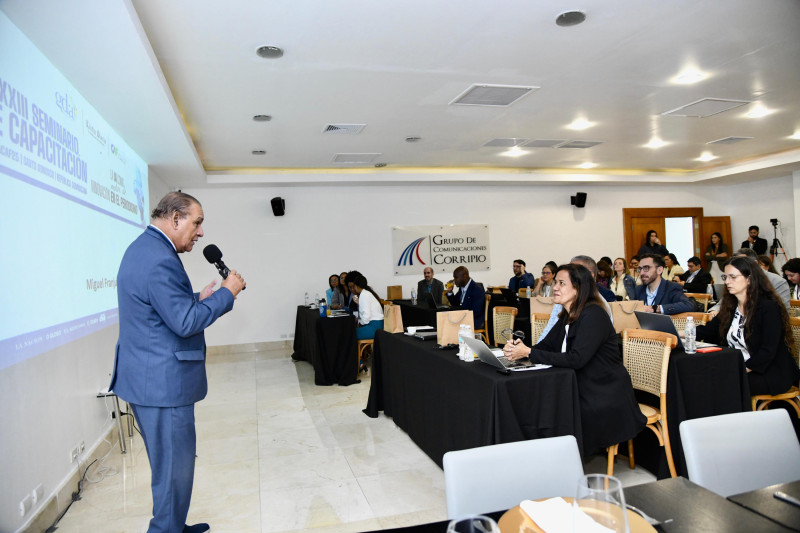
Miguel Franjul, director of Listín Diario, delivers the welcome speech at the Grupo de Diarios América seminar on Artificial Intelligence.
Santo Domingo, DR — The event, an initiative of Grupo de Diarios América, took place on Thursday and Friday at the headquarters of Grupo de Medios Corripio, on San Martín Avenue in the Dominican capital.
The seminar program featured a series of lectures and panels on the transformation in the field of communication brought about by the development of artificial intelligence. Activities included debates on the challenges of contemporary journalism and opportunities for direct interaction between participants and speakers, with a view to enhancing the impact and quality of journalistic work.
Miguel Franjul, director of Listín Diario, welcomed journalists and speakers from across the region, highlighting the importance of coming together to discuss a topic that is redefining the foundations of the journalistic profession.
“In a world where change is the only constant, coming together to analyze, learn, and debate this phenomenon is not an option, but a strategic necessity for the future of our newspapers and for the vitality of the independent journalism we represent,” Franjul told those present.
Franjul noted that the training sessions were led by 15 high-level speakers, whose credentials in academia and journalism gave them unquestionable authority.
“Their knowledge will be the compass that helps us adjust our vision of the future, guiding us toward a necessary, intelligent, and productive convergence with artificial intelligence,” he said.
GDA-CAF opened this edition with an introduction to advances in artificial intelligence worldwide, presented by Professor Renato González and Natalia Zuazo, a senior consultant at UNESCO.
Argentine consultant Álvaro Liuzzi and Karen La Hoz, from La Silla Vacía, addressed strategies for implementing artificial intelligence in the media.
Juan Carlos Simo, from La Nación in Argentina; Alicia Rojas and Ángel Pilares, from El Comercio in Peru; and Dimitrius Dantas, from O Globo in Brazil, spoke about the use of artificial intelligence in videos and other audiovisual projects.
Professor Renato González introduces the topic of artificial intelligence
Regional network of leading newspapers
This event is organized by the Grupo de Diarios América (GDA), an alliance of the 12 most important and influential newspapers in Latin America. Founded in 1991, the GDA seeks to promote independent journalism and strengthen democracy and innovation in the region through collaboration and the exchange of experiences among its members.
This regional network includes the leading newspapers in Argentina, Brazil, Chile, Peru, Colombia, Uruguay, Mexico, Venezuela, Costa Rica, El Salvador, Puerto Rico, and the Dominican Republic.
Listín Diario has been part of the Grupo de Diarios América since 2023. It is the oldest and most prestigious newspaper in the Dominican Republic, with an uninterrupted history since its founding in 1889.
The XXIII GDA CAF25 Seminar is intended to be an essential space for expanding knowledge and strengthening the capabilities of the journalistic community in a constantly changing environment, marked by economic, social, and technological challenges that demand innovation, accuracy, and social commitment in communication.
Practical workshops: AI does not work alone
On the second day, the media delved into testing artificial intelligence tools that journalists must use to avoid erroneous data in content creation or confirmation, as well as strategies to capture the audience’s attention.
They also discussed the latent reality represented by AI Overview and AI Mode for media content, as well as the digital well-being and mental health of journalists in the face of catastrophic coverage and the flow of information in a newsroom.
Ezra Eeman, from Wan-Ifra, was followed by David Sancha, from Hiberus Media, who spoke about how the concept of news is changing with the emergence of AI and about the strategies the media can apply to coexist in the new ecosystem.
On the same topic, Alicia Rojas and Ángel Pilares from the Peruvian newspaper El Comercio spoke about “Media Lab,” a department launched in February this year, through which, in addition to incorporating AI projects, they have trained more than 130 journalists in Peru.
The training also addressed how to boost digital subscriptions, a topic that drew on the experience of El País with Lucía González and The New York Times with Claudio Cabrera, vice president of the media outlet’s sports section, The Athletic.
Carlos Martínez, from El Nuevo Día in Puerto Rico, expanded on the applications used by that media outlet to streamline journalistic work.
Digital well-being and mental health
Martina Rua, an Argentine journalist and teacher, emphasized that “there is no quality journalism without healthy journalists,” highlighting the importance of mental health in newsrooms.
Rua emphasizes the importance of normalizing mental health and teaching reporters to disconnect when necessary, because “there is no quality journalism without healthy journalists.”
On the same topic, Mexican psychologist and therapist César Montesano Vásquez from Vita Activa provided tools for recognizing and managing stress.
He pointed out that stress is linked to the journalism profession, and the more committed one feels to the information, the greater the burden.
Among his recommendations for managing stress, the expert encouraged breathing, hydration, healthy eating, recognizing emotions and letting them out, exercise, and rest.
The training continued with practical workshops on tools, led by Mariana Alvarado, in which journalists learned how to create better prompts to avoid data errors in Google Gemini and how to use NotebookKLM and Pinpoint to organize and analyze data.
Finally, Álvaro Liuzzi, from IA First, created practical exercises for professionals to design solutions to problems they encounter in the newsroom and improve information flow.