

 Smaller
 Bigger
It affects days and nights: What changes in the Dominican Republic with the arrival of the winter solstice?
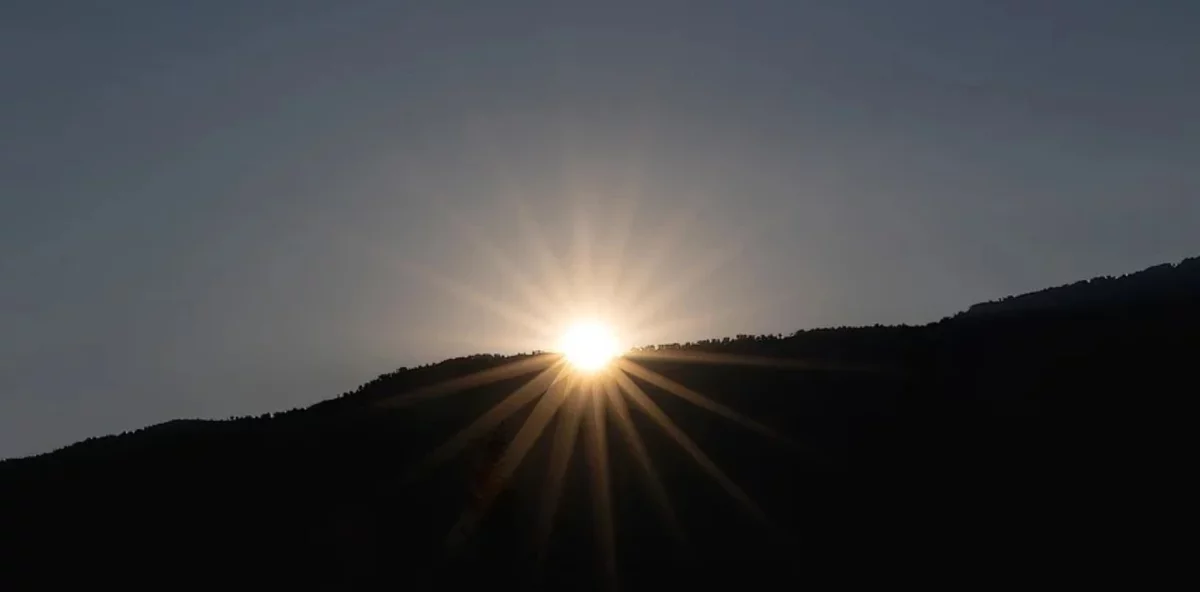
December has a particular air in the Dominican Republic: the days seem shorter, the nights longer, and the usual “friíto” or the Christmas breeze invites you to stay curled up at home. This sensation, far from being just perception, has an astronomical explanation that takes on special relevance every December 21, with the arrival of the winter solstice.
The winter solstice marks the shortest day and longest night of the year in the Northern Hemisphere. It occurs when the Sun is directly over the Tropic of Capricorn, 23.5 degrees south of the equator, which causes the Sun’s rays to fall more obliquely on our region.
What is the winter solstice, and how does it impact the country?
“On the winter solstice, the sun’s rays penetrate more inclined to the northern hemisphere, causing less sunshine (fewer hours of solar radiation), starting the winter season,” the meteorologist of the Dominican Institute of Meteorology, Cristopher Florian, explained to the newspaper HOY.

Meteorologist Cristopher Florian
In the Dominican Republic, this phenomenon translates to later sunrises and earlier sunsets, resulting in longer nights and shorter days. In addition, it favors a moderate drop in temperatures, especially during the night and early morning.
According to Florian, these conditions are felt more intensely in valley and mountain areas, mainly in provinces near the Central Cordillera, such as Santiago, Monseñor Nouel and La Vega, where episodes of fog or fog are also recorded at dawn.

Map of minimum temperatures on December 16
Will it still be hot?
Despite these changes, the specialist clarifies that, due to the country’s location in the Tropic of Cancer, high temperatures do not disappear completely.
“Temperature peaks above at°C will continue to be generated, even reaching ntiago Rod disappearríguez, Dajabón, Montecristi, among others,” he said.

Maximum temperatures corresponding to December 16
Less rain and more stability
Regarding rainfall, Florian indicated that during this period, rainfall tends to decrease, as a less humid environment predominates due to frequent anticyclonic systems, that is, areas of high pressure.
“These anticyclosystems fther conditions, observing a sunny sky, little cloudiness and little rainfall,” said the expert.
















It translates to “longer nights and shorter days” is wrong. The solstice begins the turn around of daylight hours to increase and night hours to decrease. It just seems to some people the nights are longer and daylight shorter during winter months.