
 Smaller
 Bigger
Concho motorcyclists Who are the motoconchistas: how they are organized and why they continue to be stigmatized in the Dominican Republic
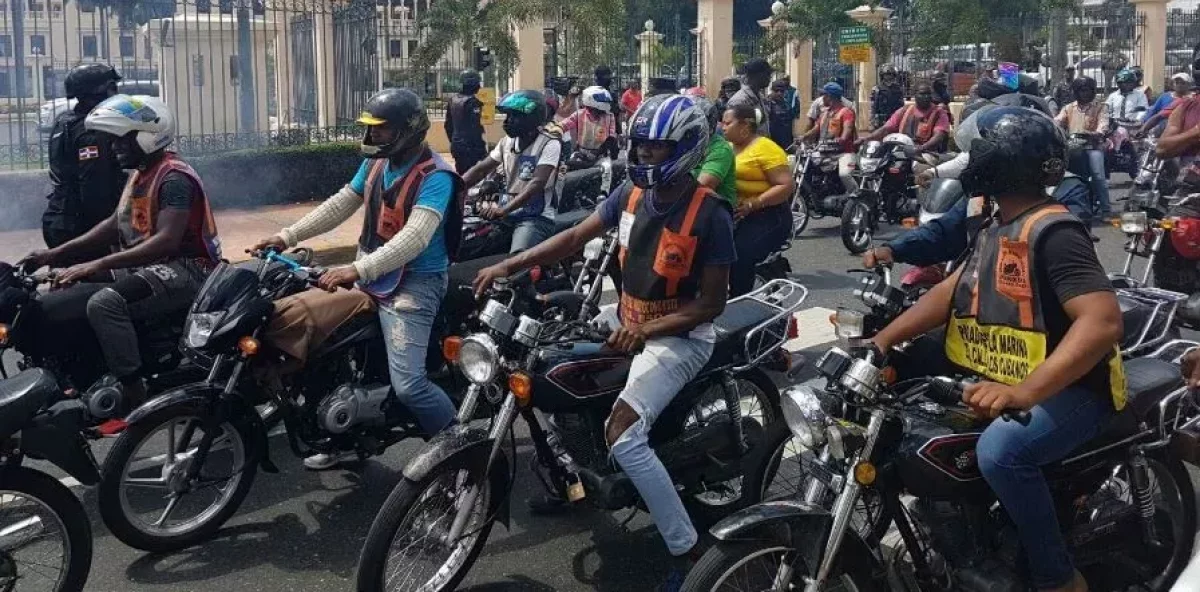
The newspaper Hoy spoke with several representatives from various associations representing motorcycle taxi drivers, as well as drivers of public and private cars, and citizens who use this mode of transportation daily as passengers, to learn their views on the behavior of motorcycle taxi drivers on Dominican streets and why they have historically been so vilified by the majority.
The death of Deivy Carlos Abreu Quezada, the driver of the garbage collection truck in Santiago on Sunday, April 19, revived one of the great debates that remains submerged in oblivion regarding traffic in the Dominican Republic and violence: the behavior of motorcyclists and motorcycle taxi drivers.

Motorcycle taxis have become a necessity for many citizens, who believe that this means of transport saves them time getting to their destinations.
The newspaper Hoy spoke with several representatives of different unions that group motorcyclists, drivers of public and private cars, and citizens who use this means of transport every day as passengers, to find out their opinions regarding the actions of the motoconchista on Dominican streets and why the majority have vilified him.
The president of the National Federation of Motorcycle Taxi Drivers (Fenamoto), Óscar Almánzar, told this newspaper that the entity organizes the stops with a list for each person, which includes the ID number, telephone number, and address, and then goes through a purification process.

Oscar Almánzar, president of Fenamoto.
“Then, they have to bring a certificate of good conduct, they have to have a license, they have to have insurance and all their papers up to date,” Almánzar said.
If any situation arises, whether with the motorcycle taxi driver or a passenger, the president of the entity said that they will communicate with the federation’s headquarters, where an investigation process is initiated to respond appropriately to the case, via the general secretary of the stop.
Regarding the criticism that has arisen from the incident that occurred in Santiago, the leader of Fenamoto told the newspaper Hoy that, after more than 25 years with the slogan “One blow to one, one blow to all,” the federation is evaluating modifying its motto, after the social outrage caused by the death of a garbage truck driver.
Almánzar explained that the organization is considering the decision and will submit it to a national assembly with its leaders. “It’s a motto we’ve had for 26 years, since we started, but we’re weighing it up. It’s not a matter of violence, but of solidarity among us,” he stated.
The new slogan under discussion is “One person’s cause is everyone’s cause,” intended to convey a message of unity and mutual support, far removed from violent interpretations.
For his part, Manuel García, a member of the Los Prados Motorcycle Taxi Drivers Union in the National District, explained that the organized motorcycle taxi driver “is not a violent person, as people believe,” but rather a worker who “goes out onto the streets every day, like any other job,” but not with the intention of attacking any citizen.

Manuel García, a member of the union in Los Prados.
“We’re not all the same,” García pointed out while waiting for passengers on Doctor Defilló Street near the corner of John F. Kennedy. “Now, because of what happened in Santiago, they want to blame all the motorcyclists in the entire country,” he complained.
This position coincides with that expressed by a member of the Núñez de Cáceres Avenue Motorcycle Taxi Drivers Association (Asomonuca), who preferred not to give his name.
The motorcycle taxi driver from Asomonuca pointed out that, because organized motorcycle taxi drivers have been on the streets for a long time, they have become “professionals” and make every effort to avoid any situation that endangers their lives or those of their passengers.
One of the attitudes in that association, the gentleman said, is respect for traffic laws, which include not exceeding speed limits and complying with traffic light signals.
What do public car drivers and taxi drivers think about motorcyclists?
However, some believe that Dominican streets are plagued by disorder, often attributed to motorcycle taxi drivers and motorcyclists. This is the opinion of some of the public and private car drivers interviewed by this newspaper.
“That’s a cancer. I don’t know what we’re going to do about them. Every time I see and hear them, I stay calm until they pass. If I hit them, I’m in trouble; if they hit me, I’m in trouble,” Venancio Urbino said of the motorcyclists and motorcycle taxi drivers.
For his part, Rey Esteban, a local thug, said that they have to make maneuvers “to protect them.”
Anthony Ariel, a public bus driver who operates on the route from the zoo to Duarte Avenue, also believes that motorcyclists “are reckless,” although he considered that “not all of them are the same.”
Meanwhile, Wellington Contreras, a motorcycle taxi passenger, believes that one reason for the behavior of these people, whether independent or not, is a lack of education.
“Although the government bears some of the blame, I believe it’s an issue of education. Unions also need to better regulate their members,” Contreras said.
While the newspaper Hoy was conducting a tour to gauge the public’s impressions of motorcyclists‘ behavior, several people were affected by a multiple-collision involving about four motorcyclists on Núñez de Cáceres Avenue, at the corner of Font Bernard, in the San Gerónimo sector, in the National District.

The average number of traffic accidents resulting in fatalities at the scene in the last five years (2019-2023) was 1,711, according to data from the National Statistics Office.
Accidents
The behavior of motorcycle taxi drivers and motorcyclists, added to how the public perceives them, is combined with another reality that is experienced in the Dominican Republic: the average number of traffic accidents that caused deaths at the scene in the last five years (2019-2023) was 1,711 fatal accidents, according to data from the National Statistics Office.
What does Intrant say?
In this regard, the National Institute of Transit and Land Transportation ( Intrant ) issued its position: “Given the concern about what immediate actions will be implemented in response to the disorder attributed to motorcyclists, it is important to clarify that the oversight and control of public roads corresponds to the General Directorate of Transit and Land Transportation Safety ( Digesett ), the entity responsible for enforcing the rules through operations, supervision and sanctions.”
“In this context, the Dominican Republic has a robust legal and regulatory framework. Law 63-17 (on Mobility, Land Transportation, and Transit) clearly establishes the mandatory use of helmets, driver’s licenses, insurance, and compliance with traffic laws. In addition, the National Institute of Transit and Land Transportation (INTRANT) has regulations regarding approved helmets and rules governing the operation of motorcycle taxi stands,” the entity added.
“Therefore, the main challenge is not the absence of rules, but their effective enforcement,” he said.
In that context, Intrant said that, “as the governing body and regulatory agency, we continue to promote actions of road safety education, regulation and organization of the system, including driver training, awareness campaigns and policies aimed at improving road safety.”
What is the solution?
According to Intrant, the solution requires coordinated action among institutions, in which regulation, education, and enforcement act in a complementary manner to generate sustainable changes in driver behavior.