
 Smaller
 Bigger
When Brussels Meets the Malecón: How European Capital is rewiring Dominican Innovation
By Jonathan Joel Mentor | @jonathanjmentor
The Dominican Republic is entering a moment it did not plan for, but for which it is uniquely positioned to capitalize: the point where European digital capital, Caribbean integration bodies, and Dominican regulatory capacity converge. Not in theory, but in execution.
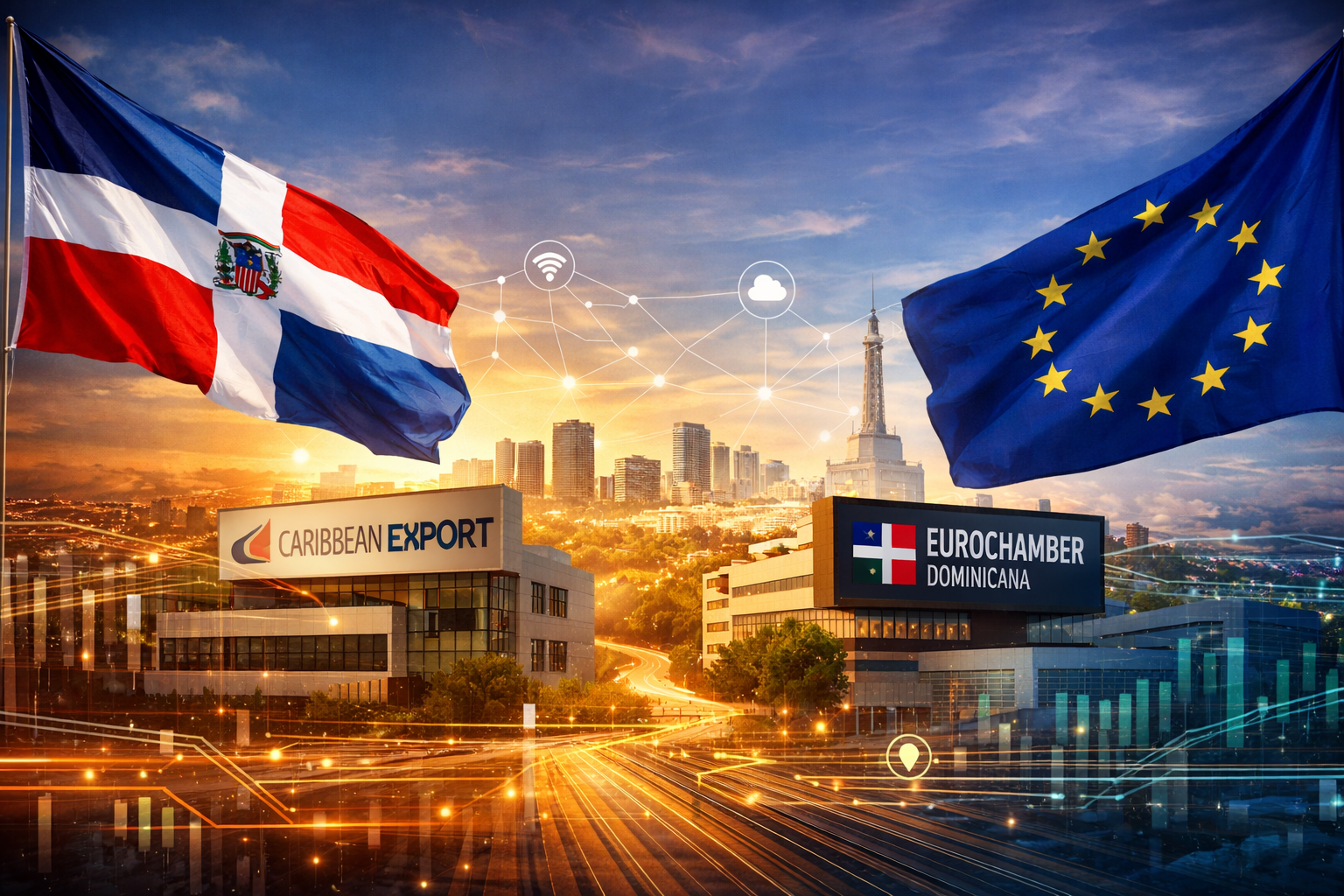
Two institutions sit at the center of this shift: Caribbean Export and the Eurochamber of the Dominican Republic, with programs such as the EU–LAC Digital Accelerator, the Digital Alliance, among others.
Together, they are creating the architecture that will determine how innovation, data, and investment flow through the Caribbean over the next decade. The Dominican Republic is no longer a passive beneficiary of these dynamics; it is becoming the testing ground where these ambitions take material form.
The Caribbean’s Quiet Turn Toward Digital Power
Caribbean Export has spent years building systems that others overlooked: frameworks for exporting intangible value, technology-enabled services, and growth driven by intellectual property (IP). Now that Europe is directing serious capital toward digital transformation, the organization has become the bridge that translates Brussels’ priorities into Caribbean opportunities.
Its growing alignment with the EU–LAC Digital Accelerator is not a symbolic partnership. It is the mechanism through which European digital policy begins to shape Caribbean competitiveness. The Dominican Republic, by virtue of its scale and momentum, is well positioned to benefit—but only if it leverages that alignment strategically.
This is an operational instrument through which the European Union’s standards, regulatory priorities, and digital policy approaches begin to directly influence the Caribbean’s competitive structure.
In this context, the Dominican Republic—given its economic scale, level of connectivity, and institutional dynamism—is ideally positioned to capitalize on this convergence, provided it proactively integrates itself into this strategy of digital transformation and regional positioning.
Why Europe Suddenly Sees the Dominican Republic
The EU–LAC Digital Accelerator is not treating the region as a periphery, but as a distributed innovation corridor. And within that corridor, the Dominican Republic offers something unique in the region:
- Macroeconomic stability with fast regulatory execution
- An ecosystem agile enough for real experimentation
- A technology sector ready to scale, not just run pilot projects
- Geographic neutrality in a polarized hemisphere
Brussels is not looking for a clone of its own innovation systems. It is seeking predictable, collaborative sandboxes where digital, regulatory, and capital experiments can move faster than continental bureaucracy allows. For the first time, the Dominican Republic fits that profile.
Where Europe’s Private Sector Meets Dominican Ambition
This is where Eurochamber RD becomes essential. As an institutional bridge between European private-sector clusters and the Dominican market, the Eurochamber brings something the region often lacks: industrial depth, investor alignment, and credibility with companies seeking serious landing zones.
Its initiatives in digitalization, competitiveness, and EU–DR business integration offer European firms a structured on-ramp into the local innovation landscape. More importantly, they create the connective tissue that links European digital capital with Dominican commercialization pathways.
In other words: Caribbean Export opens the regional door; the EU and its programs provide the acceleration engine; and the Eurochamber supplies the private-sector backbone that ensures projects do not die in “pilot purgatory.”
At this stage, Dominican leadership is defined less by the adoption of frameworks and more by its ability to demonstrate execution. As explained by Alan Fernández, an economist focused on entrepreneurship, innovation, and digitalization:
“More than exporting regulatory frameworks, that leadership must be built by showing how investment, technological knowledge, cooperation, and partnership translate into functional models of regulation, innovation, and public–private coordination, where the private sector participates from the design of solutions… This country has everything it needs to consolidate this convergence between institutional capacity, digital capital, and regional scalability.”
That distinction is critical. The Dominican Republic’s strategic advantage is not only its stability or connectivity, but its ability to become an environment where European frameworks are tested, refined, and then scaled regionally. That transforms the country from a mere program recipient into an institutional laboratory for bi-regional digitalization.
Pension Reform: The Capital Shock Europe Didn’t Expect
The recent reform of the Dominican pension system introduced something European partners rarely encounter in emerging markets: a domestic source of patient, long-term capital capable of sustaining innovation infrastructure, not just construction.
As SIPEN modernizes, AFPs diversify, and innovation agencies coordinate, the Dominican Republic becomes not only a recipient of European programs, but a market capable of co-financing them. This is why interest from the EU–LAC Digital Accelerator is accelerating—and why the Eurochamber is suddenly more important than most policymakers realize.
But attention alone is not a strategy. Someone must make sense of this convergence.
Why This Conversation Belongs in Santo Domingo
Across the region, the most significant shifts in digital policy and cross-border innovation are unfolding within working groups and technical committees—necessary, yes, but far removed from the public and private actors who will ultimately scale the results.
Santo Domingo offers something those closed rooms cannot: a neutral, high-visibility platform where European capital, Caribbean institutions, Dominican regulators, and regional innovators can engage openly and on equal footing.
That platform is the Digital Nomad Summit 2026 (DNS).
DNS is designed around the very themes Europe is now prioritizing—mobility, digital transformation, talent flows, and regulatory modernization—making it a natural stage for deeper coordination between EU and Caribbean stakeholders.
The Window Is Now
Europe wants stable, capable partners. The Caribbean wants scalable digital competitiveness. The Dominican Republic wants long-term capital and global positioning. This is the first moment in years when all three interests align with such clarity.
If the country moves intentionally, it will become the anchor market for EU–Caribbean digital collaboration. If it hesitates, someone else will claim that role. The convergence is already happening. The question is whether the Dominican Republic will use it to build durable power for Dominican founders and workers—or waste this window on ceremonial headlines.
What is at stake is institutional, economic, and geopolitical—and the clock is already running.
——————————————————————————————
Jonathan Joel Mentor is the CEO of Successment and architect of the Digital Nomad Summit™, scaling startups and challenging institutions to evolve. UN World Summit Award Nominee & ADOEXPO National Excellence in Exportation Award Winner www.jonathanjmentor.co | digitalnomadsummit.co